The movie “Kalki 2898 AD” has been creating waves in the film industry, and not just because of its star-studded cast. What really sets this movie apart is its groundbreaking use of visual effects (VFX). For anyone interested in VFX, “Kalki 2898 AD” is a masterclass in advanced techniques for VFX courses in India. Let’s take a look behind the scenes to understand the magic of VFX that brings this futuristic world to life.
The Visionary Team
The film is directed by Nag Ashwin, a visionary who has pushed the boundaries of Indian cinema. To realize his ambitious vision, Ashwin collaborated with some of the best VFX artists in the industry. The team’s goal was to create a world set in 2898 AD that feels both futuristic and believable.
Every great VFX journey starts with concept art. These are detailed drawings and paintings that visualize the world, characters, and scenes of the movie before they are brought to life. For “Kalki 2898 AD,” the concept artists spent months designing everything from towering skyscrapers and advanced technology to futuristic costumes and vehicles. This artwork serves as a blueprint for the VFX team.
Pre-Production of VFX
Once the concept art is approved, the next step is pre-visualization, or pre-vis. This involves creating rough 3D models and animations to plan out the scenes. Pre-vis helps the director and the B.sc in VFX filmmaking team see how the scenes will look and feel, and make any necessary adjustments before filming starts. It’s like creating a rough draft of the movie in digital form.
During filming, actors perform in front of green screens or in specially built sets. The green screen allows VFX artists to replace the background with digital environments later. To make the integration seamless, the team uses techniques like motion capture, where actors wear special suits that track their movements, and camera tracking, which captures the camera’s position and movement. This data is crucial for matching the live-action footage with the digital effects.
Creating Digital Environments
One of the most challenging aspects of VFX is creating realistic digital environments. For “Kalki 2898 AD,” the VFX team used advanced software to build entire cities and landscapes from scratch. They paid attention to every detail, from the texture of buildings to the way light reflects off surfaces. This level of detail makes the digital world feel as real as the physical one.
Character Animation: Bringing Creatures to Life
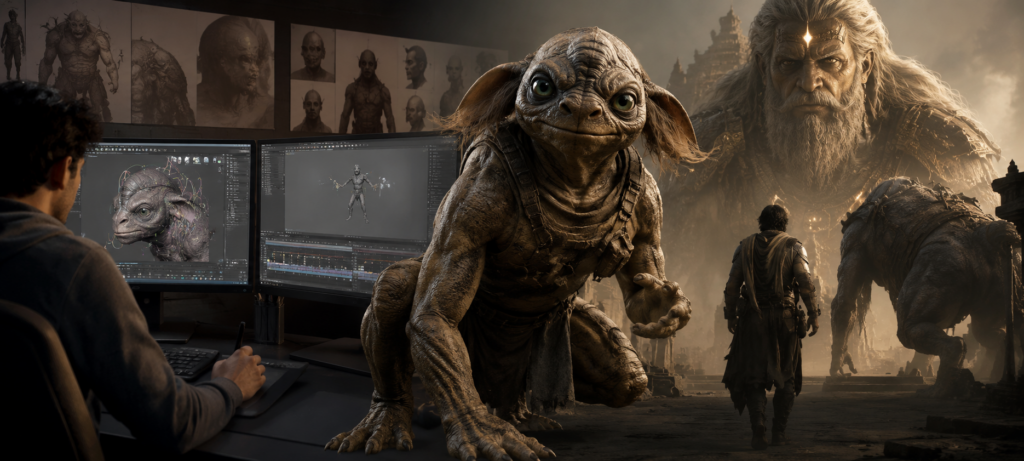
In a movie set in a futuristic world, you can expect to see some extraordinary creatures. The VFX team uses character animation to bring these beings to life. This involves creating a digital model of the creature, then animating it to move and react just like a real living thing. The process requires a deep understanding of anatomy, movement, and behavior.
Post-Production: The Final Touches
After filming, the real magic of VFX happens in post-production. This is when all the digital elements are combined with the live-action footage. The VFX team adds layers of effects, from explosions and laser beams to weather and lighting effects. They also use techniques like compositing to blend all the elements together seamlessly.
Learning Advanced VFX Techniques
For aspiring animation and VFX course artists, “Kalki 2898 AD” is a treasure trove of learning opportunities. Here are some key techniques to study:
- Concept Art and Pre-Vis: Start with strong concept art and pre-vis to plan your scenes.
- Motion Capture and Camera Tracking: Use motion capture for realistic character movements and camera tracking for seamless integration.
- Digital Environment Creation: Focus on details and realism when creating digital environments.
- Character Animation: Study anatomy and movement to create lifelike creatures.
- Compositing: Learn to blend digital and live-action elements seamlessly.
“Kalki 2898 AD” is not just a movie; it’s a showcase of what’s possible in the world of VFX. By exploring the advanced techniques used behind the scenes, aspiring VFX artists can learn how to push the boundaries of their own creativity. Whether you’re a fan of the film or an aspiring artist, the VFX of “Kalki 2898 AD” offers endless inspiration.
Conclusion
Kalki 2898 AD showcases how cutting-edge VFX can transform a bold creative vision into a believable cinematic experience. From concept art and pre-visualization to motion capture, CGI environment creation, compositing, and final rendering, every stage demonstrates the importance of technical expertise and creative collaboration. The film highlights how modern VFX pipelines combine artistic storytelling with advanced digital tools to build immersive worlds and realistic visual effects.
For aspiring VFX artists, studying the behind-the-scenes techniques used in Kalki 2898 AD offers valuable insights into industry-standard workflows and production practices. By mastering skills such as 3D modeling, tracking, lighting, compositing, and simulation, you can develop the expertise needed to work on films, OTT productions, gaming, and advertising projects. As the demand for high-quality visual effects continues to grow, learning advanced VFX techniques today can open the door to a rewarding and future-ready creative career.
FAQs
1. How was the VFX created in Kalki 2898 AD?
The VFX in Kalki 2898 AD was created using advanced CGI, 3D modeling, motion capture, digital environments, compositing, and visual simulations. Multiple VFX studios collaborated to produce the film’s futuristic cities, vehicles, creatures, and action sequences.
2. What VFX software was likely used in Kalki 2898 AD?
Although the complete production pipeline hasn’t been publicly disclosed, professional VFX studios commonly use software such as Autodesk Maya, Houdini, Blender, Unreal Engine, Nuke, Adobe After Effects, and ZBrush to create high-quality visual effects similar to those seen in Kalki 2898 AD
3. What can students learn from the VFX behind the scenes of Kalki 2898 AD?
Students can learn industry-standard techniques such as pre-visualization, 3D asset creation, environment design, motion tracking, lighting, compositing, FX simulations, and rendering. The film is an excellent example of how storytelling and technology work together in modern filmmaking.
4. Is learning VFX a good career choice after watching movies like Kalki 2898 AD?
Yes. The increasing demand for VFX artists in films, OTT platforms, gaming, advertising, and animation has made VFX one of the fastest-growing creative careers. Learning professional VFX tools and workflows can lead to opportunities in both Indian and international studios.
5. Which VFX skills are most important to create movie-quality visual effects?
The most in-demand VFX skills include 3D modeling, texturing, lighting, animation, particle and fluid simulations, motion tracking, compositing, green screen keying, digital matte painting, and rendering. Mastering these skills helps artists create cinematic visual effects for blockbuster films like Kalki 2898 AD.

Pooja Sharma is a creative education content writer who creates engaging articles on career guidance, skill development, and learning opportunities to help students make informed decisions.