
You’ve drawn a clean character, set your keyframes, and pressed play. The result moves like a paper cutout on a stick. Almost every beginner hits this wall, and it’s the most common reason people look for a structured 2D animation course after months of struggling alone.
The short answer: stiff animation comes from weak timing, missing overlap, poor arcs, and a lack of weight. All four can be learned and fixed with deliberate practice and good feedback.
Why Your Character Looks Stiff
Stiffness is rarely a drawing problem. It’s a motion problem. The usual causes:
- Straight-line movement. Real limbs and heads move in arcs. Straight in-betweens read as mechanical.
- Everything moves at once. The head, arm, and body start and stop together, so nothing feels connected.
- Even spacing. Without easing, motion looks like a slideshow instead of a living thing.
- No weight. A character who doesn’t compress when landing or lean into a push feels weightless.
- Too few poses. Going straight from first pose to last gives you sliding, not acting.
Fix 1: Build Motion on Arcs
Draw the path of a swinging arm or a turning head before you animate it. Lay a thin arc line on your canvas, then place each drawing on it. A simple test is to flip through your drawings and trace the wrist’s path. If it zigzags, redraw the in-betweens.
Fix 2: Use Slow In and Slow Out
Objects accelerate and decelerate. Place more drawings near the start and end of an action, and fewer in the middle. A character raising a hand should ease out of the rest pose and settle into the final one. This single change often removes 50% of the robotic feel (try it on one action and compare).
Fix 3: Add Overlap and Follow-Through
When a body stops, loose parts keep moving. Hair, sleeves, a ponytail, even fingers settle a few frames later. Offset them deliberately:
| Element | Movement | Offset |
| Torso | Leads | Starts first |
| Head | Follows | 1–2 frames later |
| Arms/hands | Drag behind | A few frames later |
| Hair/clothing | Settle last | Continues after the body stops |
These frame counts are starting points, not rules. Adjust them to the speed and mood of your shot.
Fix 4: Show Weight Through Squash, Stretch, and Anticipation
Before a jump, the character crouches (anticipation). On landing, the body compresses and rebounds. Even a subtle version on a walk cycle, such as a slight dip at the passing pose, gives the character mass. Keep volume consistent so the character doesn’t look like it’s inflating.
Fix 5: Push Your Poses, Then Refine
Make key poses exaggerated and clear. A good check is to view only your key poses as silhouettes. If you can’t read the action, the pose is weak. Animators commonly use straight-ahead and pose-to-pose methods together: pose-to-pose for structure, straight-ahead for loose elements like hair.
A Simple Practice Routine
- Animate a bouncing ball with a tail. Focus only on arcs, spacing, and follow-through.
- Move to a head turn with anticipation.
- Animate a basic walk cycle, then add personality (tired, confident, nervous).
- Finish with a short acting shot of 3–5 seconds.
Record yourself acting first. Reference footage is how professionals catch what imagination misses.
Should You Take a 2D Animation Course?
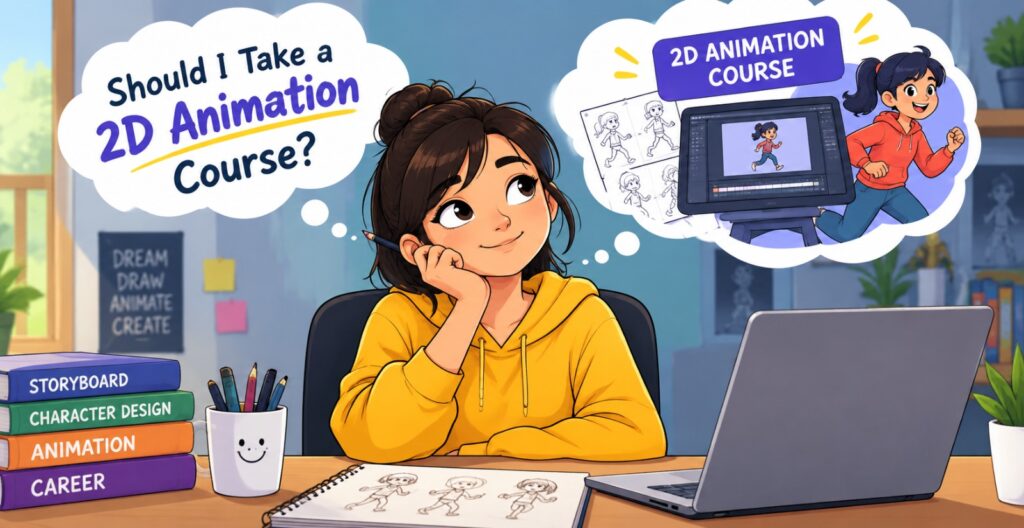
You can learn a lot from tutorials, but feedback is the missing piece. Nobody tells you your overlap is off when you watch a video alone. A good 2D animation course gives you:
- Frame-by-frame critique on your actual work
- A sequence that builds principles before complex shots
- Software training in tools used in the industry
- Portfolio pieces employers and clients can evaluate
When comparing 2D animation classes in Kolkata, check whether the syllabus covers the 12 principles of animation in depth, whether you’ll animate regularly (not just watch demos), and whether trainers review work individually. Ask to see student work, and judge it on motion quality, not just polish.
2D Animation Course Fees: What to Compare
2D animation course fees vary with duration, software covered, mentoring depth, and whether portfolio or placement support is included. Instead of comparing price alone, compare:
- Total course hours and batch size
- Software and hardware access
- Whether assignments are reviewed one-on-one
- Included portfolio or showreel guidance
- Payment flexibility
For current fee and batch details at Moople Institute, check the course page or contact the team directly, since fees and schedules can change.
Learning Across Kolkata
Whether you’re travelling from Baguiati, Barasat, Sonarpur, Serampore, or Chandannagar, or you’re closer in around Jodhpur Park, New Alipore, Chowringhee, or Sealdah, the commute matters for consistency. Animation improves through frequent practice, so pick a schedule you can actually keep. Students coming from Berhampore may want to ask about batch timings that suit longer travel.
FAQs
1. Why does my 2D animation look stiff even with good drawings?
Usually because of timing and spacing, not drawing skill. Add arcs, easing, and overlap first.
2. How long does it take to fix stiff animation?
Most learners see clear improvement within a few weeks of focused practice on arcs and spacing, though fluency takes longer.
3. Do I need to draw well to join a 2D animation course?
Basic drawing helps, but animation relies more on observation, timing, and acting. Many learners improve drawing alongside motion.
4. Which software is used in 2D animation classes?
It depends on the institute. Ask for the exact software list and whether training covers production workflows.
5. What is the difference between overlap and follow-through?
Follow-through is parts continuing after the body stops. Overlap is parts moving at different rates and starting at different times.
6. Are 2D animation course fees the same everywhere?
No. Fees reflect course length, mentoring quality, and facilities. Compare what’s included, not just the number.
7. Can I build a portfolio during the course?
A good course should help you produce short, polished shots such as a walk cycle, an acting clip, and a short sequence suited to a showreel.
Conclusion
Stiff animation isn’t a talent problem. It’s a skills gap you can close by working on arcs, easing, overlap, weight, and strong poses, ideally with someone reviewing your frames. If you’re ready to learn that way, explore Moople Institute’s 2D animation course to see the syllabus, batches, and fee details.

Farhat Jabeen is passionate about documenting the student enrollment journey in the fields of technology, design, and digital media. Through her writing, she shares practical guidance, industry insights, and real-world learning experiences that help aspiring students confidently navigate their path toward creative and technology-driven careers. Her goal is to empower learners with the knowledge they need to choose the right educational journey.