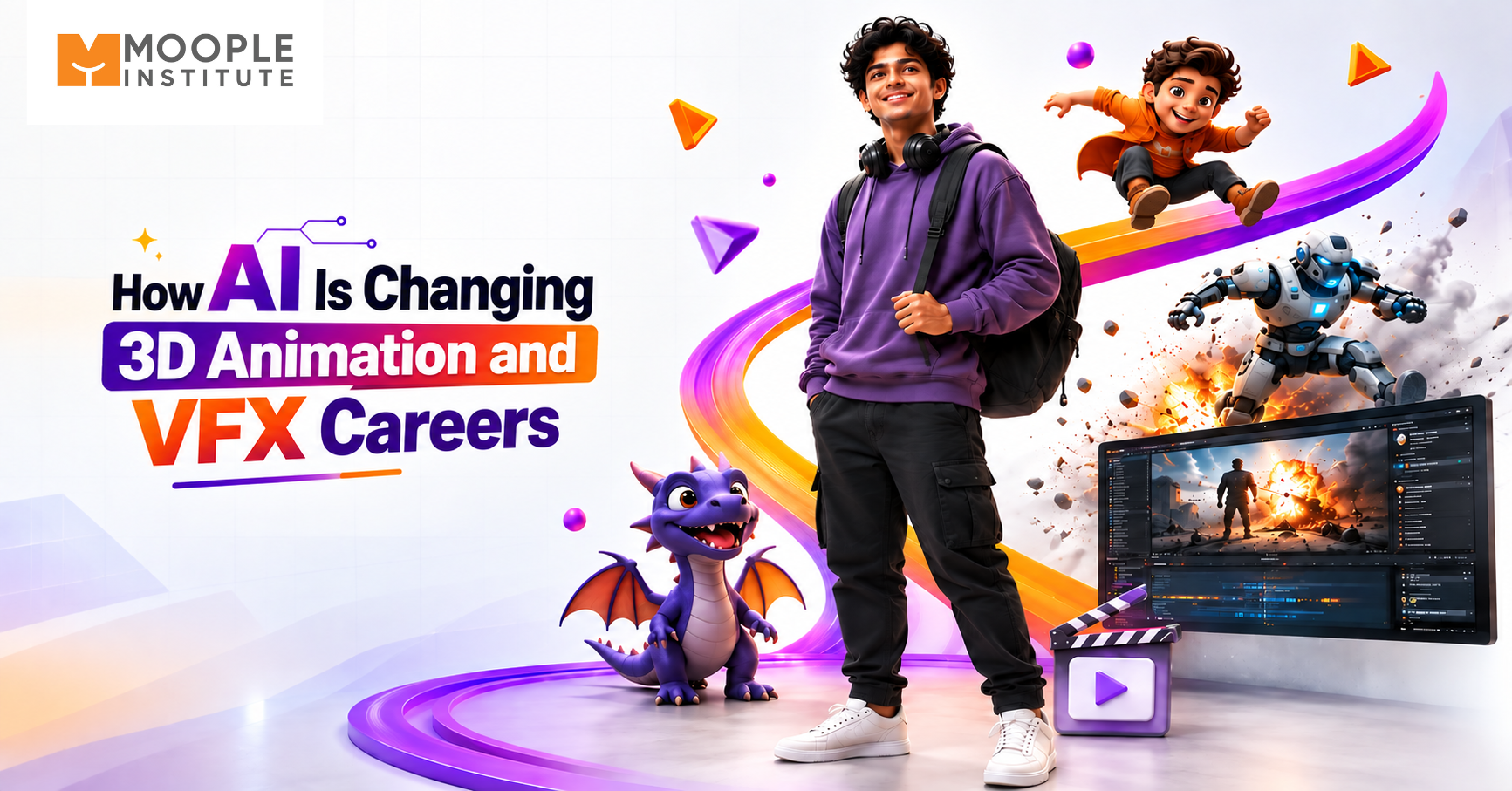
AI is not ending careers in 3D animation and VFX, but it is rewriting the entry-level job description. Repetitive work such as roto cleanup, denoising, previs mock-ups and texture variations is getting faster. Fundamentals, taste and pipeline knowledge are becoming the things that set you apart. If you are 18–30 and comparing 3d animation and visual effects courses in Kolkata, the useful question is not “AI or no AI?” but “which skills stay valuable while the tools keep changing?”
What AI Is Actually Changing in the Pipeline
AI shows up unevenly. Some stages have changed a lot; others barely at all.
| Pipeline stage | What AI now helps with | What the artist still owns |
| Rotoscoping and paint-outs | Faster first-pass mattes and cleanup | Edge quality, shot-specific fixes, approval |
| Rendering | AI denoising cuts waiting time | Lighting design, look-dev, render troubleshooting |
| Concept and previs | Quick visual options | Story logic, camera choices, final design |
| Modelling and texturing | Base meshes, texture variations | Topology, anatomy, consistency, production-ready assets |
| Animation | Motion cleanup and in-betweening help | Acting, timing, weight, emotion |
The pattern: AI speeds up the first draft. Someone still has to judge whether the draft is good enough for a film, ad or game, and that someone is a trained artist.
Is AI Taking 3D Animation and VFX Jobs?
Honestly, it is changing hiring, and anyone who says otherwise is selling something. A 2024 survey of 300 entertainment leaders in the US, commissioned by animation and concept-art guilds, found that three-quarters said AI had contributed to cutting, reducing or consolidating jobs in their divisions. That is a US-focused, executive-reported survey, not a forecast for India, but it shows the direction studios are exploring.
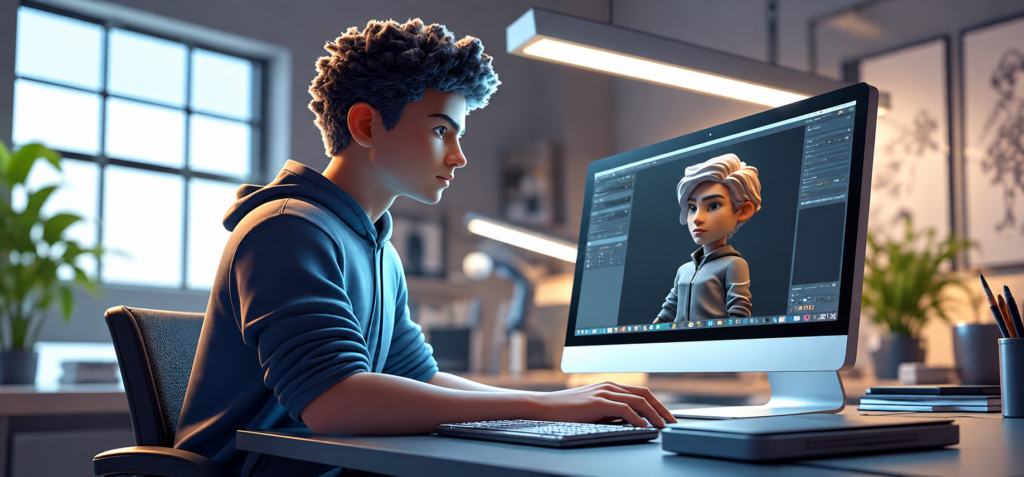
Artists on the other side report that many AI tools are not yet production-ready and are hard to fit into existing pipelines. Roles are shrinking in some places and shifting in others. The safest position is to be the person who can use AI and fix what it gets wrong.
Career Paths That Make Sense Now
- 3D generalist or modeller: strong fundamentals plus fast, AI-assisted iteration
- Compositor and roto/paint artist: judgment on final image quality matters more than manual speed
- FX and simulation artist: fire, smoke and destruction need technical understanding
- Lighting and look-dev artist: deciding how a shot feels is hard to automate
- Real-time artist (Unreal Engine): film, ads and games increasingly share tools
- Previs and motion graphics artist: speed and storytelling both count
What Good 3D Animation and Visual Effects Courses Should Teach
Industry guidance for 2026 keeps repeating one idea: strong fundamentals plus adaptability win. When you compare institutes, check for these:
- Core art skills: anatomy, timing, composition, colour and lighting, taught before shortcuts.
- Industry software: tools such as Maya, Blender, Houdini, Nuke and Unreal Engine are commonly used in studios. Ask which ones are actually taught, and for how many hours.
- AI inside the workflow: you should learn where AI helps and where it breaks, not just how to type prompts.
- Production exposure: working on real or studio-style projects teaches deadlines and feedback.
- A showreel, not just a certificate: employers look at work first.
At Moople, the certificate tracks are built with AI in the curriculum: Advanced 3D Animation & AI and Visual Effects & AI, which covers roto, paint, compositing and special effects. Moople also runs its own production studio, which matters for the exposure point above. Ask the counsellor for the current syllabus and software list.
Learning in Kolkata and Nearby
You do not need to relocate. Moople has centres across Kolkata (Chowringhee, Jodhpur Park, New Alipore, Sealdah, Baguiati) and nearby towns including Barasat, Sonarpur, Serampore, Chandannagar and Berhampore. Visit the centres page to find the closest one, and ask about a demo class.
Practical Tips for Students
- Build two or three polished shots rather than ten rough ones.
- Keep a before/after record that shows what you did versus what AI generated.
- Learn one tool deeply before collecting five.
- Follow studio breakdowns and artist communities to see how real pipelines use AI.
Frequently Asked Questions
1.Will AI replace 3D animators?
Not entirely. It automates parts of the job, especially repetitive tasks, but performance, timing and art direction still need people.
2. Is a 3D animation course still worth it in 2026?
Yes, if it teaches fundamentals, industry software and AI-assisted workflows, and you finish with a strong portfolio.
3. Which is better: a 3D animation course or a Visual Effect course?
Animation suits you if you love character performance and storytelling; VFX suits you if you enjoy compositing, simulations and problem-solving. Many studios value people who understand both.
4. Which software should I learn first?
Pick what your target job uses. Maya or Blender for 3D, Nuke or After Effects for compositing, Houdini for effects, Unreal for real-time.
5. Can I learn 3D animation after 12th or graduation?
Yes. Certificate and degree routes exist; see Moople’s BSc in Animation and BSc in VFX pages for eligibility.
6.What jobs can I apply for after training?
Modeller, texture artist, animator, roto/paint artist, compositor, FX artist, motion graphics artist or game artist, depending on your showreel.
Conclusion
AI is raising the bar for beginners while lowering the cost of experimenting. Students who combine solid fundamentals, studio-grade software skills and honest AI literacy will be better placed than those who bet on tools alone. If you are exploring 3d animation and visual effects courses in Kolkata, book a free counselling session at the nearest Moople centre, see the labs, and ask to review student showreels before you decide. Start from the Moople contact page.

Farhat Jabeen is passionate about documenting the student enrollment journey in the fields of technology, design, and digital media. Through her writing, she shares practical guidance, industry insights, and real-world learning experiences that help aspiring students confidently navigate their path toward creative and technology-driven careers. Her goal is to empower learners with the knowledge they need to choose the right educational journey.