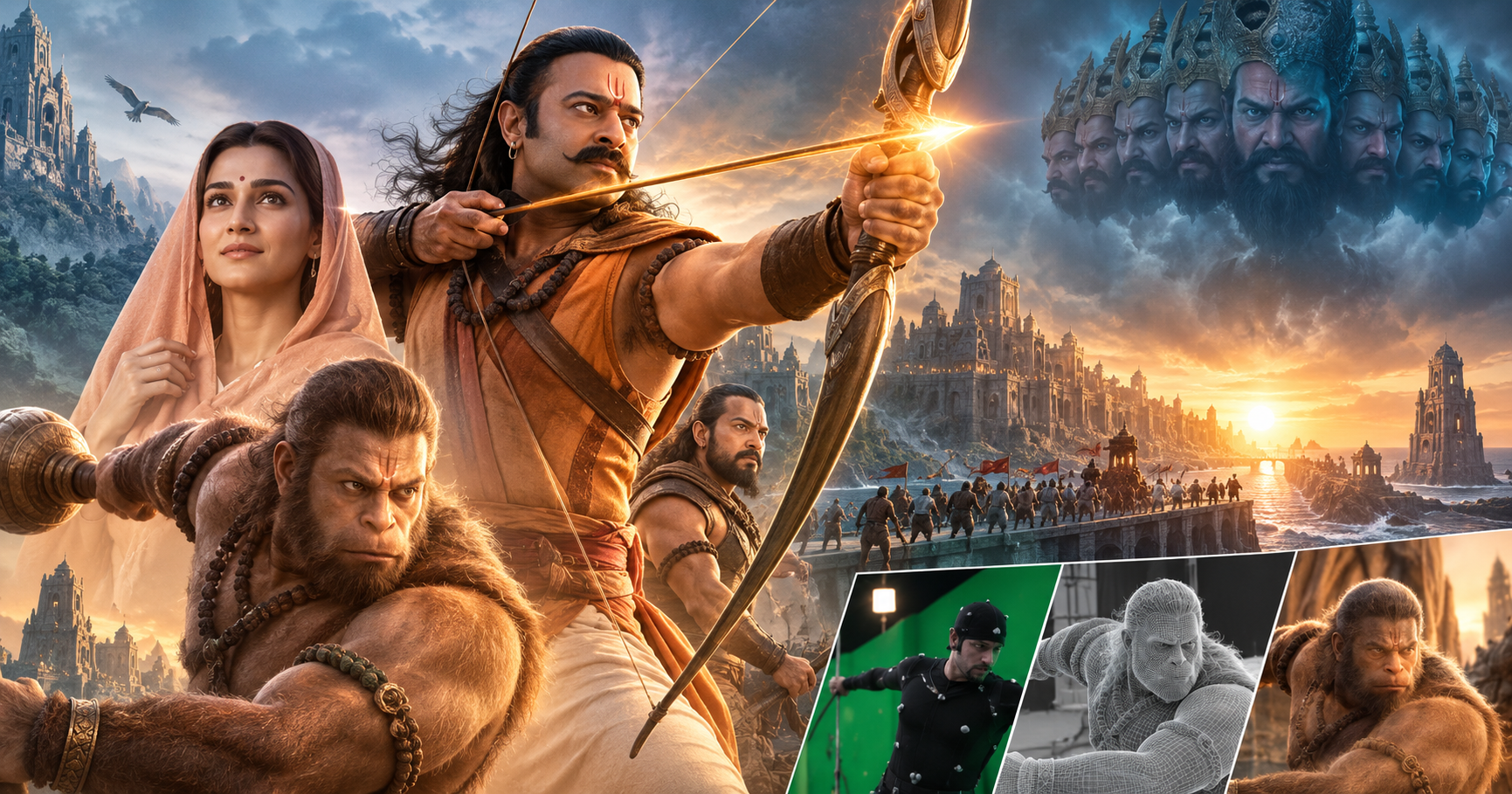
When Om Raut’s mythological epic Adipurush released its first teaser in October 2022, it didn’t just get reviews — it got roasted. Within hours, comparisons to Game of Thrones, Aquaman, and even King Kong started trending on social media. The backlash was so intense that the makers postponed the film, spent an additional ₹100 crore reworking the visual effects, and pushed the release from January to June 2023.
For most people, this was just another Bollywood controversy. But if you’re someone in Kolkata dreaming of a career in animation, VFX, or film production, the Adipurush VFX story is one of the best real-world case studies you’ll ever find. It shows, in the most public way possible, why VFX quality isn’t just about fancy software — it’s about training, pipeline discipline, and understanding audience expectations.
In this article, we’ll break down exactly what went wrong with Adipurush’s VFX, what changed in the rework, and — more importantly — what aspiring VFX artists in India can learn from it. We’ll also walk you through how a structured VFX course or animation course, including options like a BSc in VFX filmmaking or BSc in Animation filmmaking, prepares you to avoid these exact mistakes in your own career
What Happened With Adipurush’s VFX?
Adipurush is a 2023 Hindi mythological film, directed by Om Raut and produced by T-Series, that faced heavy public criticism for its visual effects when the first teaser was released in October 2022; the makers subsequently postponed the release by five months and spent additional resources reworking the CGI before its final theatrical release in June 2023.
Based on the Ramayana and starring Prabhas as Ram and Saif Ali Khan as Ravan, the film was pitched as one of India’s most ambitious VFX projects, reportedly built on a budget of around ₹500 crore. Expectations were sky-high, partly because the makers had claimed the film would feature nearly triple the VFX volume of the Baahubali franchise.
But when the teaser dropped, the reaction was almost instant disappointment. Viewers pointed out that:
- Ravan’s flying vehicle looked strikingly similar to a scene from Game of Thrones.
- Hanuman’s design reminded audiences of King Kong rather than traditional Indian iconography.
- Character skin textures and lighting looked unfinished, almost like an early animatic rather than a final shot.
The criticism was loud enough that the production team, led by VFX supervisor duo Vaibhav Studios along with international vendors, took the unusual step of publicly postponing the release to fix the effects — a rare move for a big-budget Indian film so close to launch.
Why Did the VFX Look Unfinished in the First Trailer?
This is the part most entertainment articles skip, but it’s exactly what matters if you’re studying VFX. A few technical and production factors likely contributed to the poor first impression:
Rendering was incomplete. Big VFX shots go through multiple passes — modeling, texturing, lighting, compositing, and color grading. If a teaser is cut together before the final render and compositing pass is done, it can look flat, plasticky, or “unfinished” even if the underlying work is solid. Many VFX professionals speculated this happened here.
Marketing timelines clashed with production timelines. Studios often lock a release date and build marketing around it before the VFX pipeline is actually complete. When the trailer deadline arrives before the compositing team has finished color-matching CG elements to live-action plates, the mismatch becomes visible immediately.
Reference and research gaps. Indian mythological VFX has a specific visual language — think of how Hanuman, Ravan, or celestial weapons are traditionally depicted in art, temple carvings, and earlier films. When VFX teams lean too heavily on Western fantasy references (dragons, armor styles, creature designs) without adapting them to Indian aesthetic expectations, the result can feel foreign to the audience it’s meant for.
Insufficient iteration time. Hollywood tentpole films typically spend 18–24 months purely on VFX post-production. Reports suggested Adipurush’s VFX timeline was compressed, leaving less room for the multiple rounds of client review and refinement that high-quality CGI usually needs.
What Changed in the Adipurush VFX Rework
After the backlash, the makers delayed the release from January 12, 2023, to June 16, 2023, giving the VFX teams roughly five extra months. Reports at the time indicated the rework focused on:
- Re-texturing and re-lighting key CG characters, including Hanuman and Ravan, to look less synthetic.
- Adjusting Ravan’s design and reducing elements that too closely resembled other franchises.
- Improving compositing so CG elements blended more naturally with live-action footage.
- Refining battle sequences and creature shots that had been singled out in early reactions.
Even after the rework, the film’s VFX received mixed reviews on release — some critics felt it had improved noticeably, while others still found certain sequences inconsistent. The film also faced separate criticism for its dialogue, which the makers revised after release. This is an important reality check: VFX fixes alone cannot always undo the reputational damage of a rushed first impression, which is precisely why getting the pipeline right the first time matters so much in this industry.
Adipurush vs. Other Indian VFX-Heavy Films: A Quick Comparison
| Film | Year | VFX Reception | Key Takeaway for Students |
|---|---|---|---|
| Baahubali 2 | 2017 | Widely praised, considered a benchmark for Indian VFX | Long pre-production and previs planning paid off |
| Brahmastra | 2022 | Generally appreciated, especially fire and energy effects | Strong reference boards and consistent art direction |
| Adipurush (Teaser) | 2022 | Heavily criticized, called unfinished and derivative | Rushed timelines and weak visual research hurt first impressions |
| Adipurush (Final Release) | 2023 | Mixed reception, improved but still debated | Reworking VFX late in the process is costly and doesn’t fully erase first-impression damage |
| RRR | 2022 | Praised globally, Oscar-winning VFX team | Iterative feedback loops and experienced supervisors matter |
This table makes one thing clear: the difference between a film that gets mocked and one that wins global awards usually isn’t the software being used — most major Indian studios use similar tools like Autodesk Maya, Houdini, Nuke, and Unreal Engine. The difference is process, planning, and trained talent.
5 Real Lessons for Anyone Learning VFX or Animation
If you’re considering a VFX course or animation course, the Adipurush case offers lessons that go far beyond gossip.
1. Software skills alone aren’t enough
Knowing how to use Maya, Blender, or Nuke is the starting point, not the destination. What separates a good VFX artist from a great one is understanding lighting theory, anatomy, physics, and storytelling — the things that make CG believable.
2. Reference research is non-negotiable
Before animating or modeling anything, professional VFX artists study real-world references extensively. For a mythological project, that means studying temple art, classical Indian sculpture, and cultural context — not just other films.
3. Compositing is where projects are won or lost
A perfectly modeled and animated character can still look fake if the compositing — the process of blending CG with live footage, matching color, grain, and light — isn’t done correctly. This is often the most underrated skill among self-taught beginners.
4. Timelines matter more than talent alone
Even skilled artists produce weak work under compressed deadlines. Understanding production pipelines and realistic scheduling is a professional skill taught in structured courses, rarely picked up from YouTube tutorials alone.
5. Audience and cultural context shape “good” VFX
What looks impressive in a Hollywood blockbuster may not land the same way in an Indian mythological film. Great VFX artists learn to adapt global techniques to local storytelling and audience expectations — a skill that comes from studying both craft and context.
Common Mistakes Beginner VFX Artists Make (And How Training Fixes Them)
Most students who try to learn VFX or animation purely through free online tutorials tend to repeat a familiar set of mistakes. Understanding them early can save you months of frustration.
A very common one is jumping straight into complex software without learning the fundamentals of art — perspective, color theory, and motion principles. Software is just a tool; without a foundation in visual storytelling, even advanced tools produce weak results, much like what critics initially flagged in Adipurush’s early shots.
Another frequent issue is skipping the planning stage. Beginners often want to start animating or compositing immediately, instead of building a proper previsualization, storyboard, or reference board first. Studios that skip this stage — as Adipurush’s rushed timeline suggests — often end up reworking expensive shots later, which is far costlier than planning properly upfront.
A third mistake is treating VFX as a solo skill rather than a team pipeline. In real productions, modelers, riggers, animators, lighting artists, and compositors all depend on each other’s work being consistent and on schedule. Structured courses simulate this pipeline through group projects, which is very different from working alone on personal experiments.
A well-designed VFX or animation course addresses these gaps directly through guided fundamentals, industry-style project pipelines, and mentor feedback—the exact ingredients that separate polished final work from a widely mocked teaser.
Skills You Actually Need to Work on Films Like Adipurush
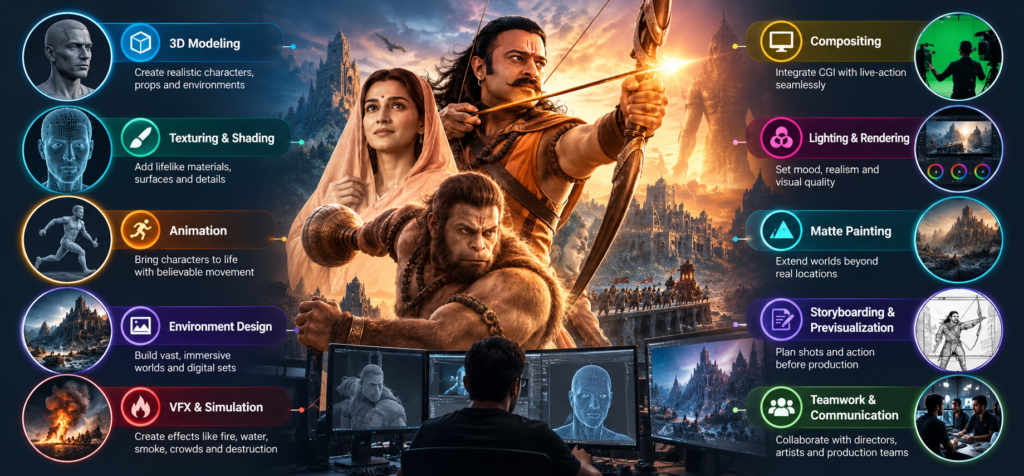
To work on VFX-heavy productions, whether in Bollywood, South Indian cinema, or international studios, you typically need a combination of the following:
- Foundational art skills — drawing, anatomy, perspective, and composition.
- 3D modeling and texturing — using tools like Autodesk Maya, Blender, or ZBrush.
- Rigging and animation — bringing characters and creatures to life believably.
- Lighting and rendering — using engines like Arnold, V-Ray, or Unreal Engine.
- Compositing — blending CG and live-action footage using Nuke or After Effects.
- Understanding of physics and simulation — for fire, water, cloth, and destruction effects using tools like Houdini.
- Storytelling and film language — knowing how a shot serves the narrative, not just how it looks technically.
Notice that only two or three of these are purely “software” skills. The rest are craft and judgment — the exact areas that structured, mentor-led training builds far more reliably than isolated tutorial-watching.
Why a BSc in VFX Filmmaking or Animation Filmmaking Makes a Difference
Many students in Kolkata and across India ask whether a formal degree like a BSc in VFX filmmaking or BSc in Animation filmmaking is really necessary when so many tutorials are free online. The honest answer: tutorials teach you buttons; a structured degree teaches you a craft.
A BSc-level VFX or animation program typically combines:
- Core theory — art history, film language, color theory, and design principles.
- Progressive technical training — starting from 2D fundamentals before moving into 3D modeling, animation, and compositing.
- Industry-standard software exposure — hands-on practice with the same tools used on real productions.
- Studio-style group projects — mimicking real production pipelines, deadlines, and client feedback rounds.
- Portfolio development — building a professional showreel that studios actually look for during hiring.
This structure matters because the VFX and animation industry rarely hires based on certificates alone — they hire based on demo reels and portfolios. A degree program that forces you to complete real, deadline-driven projects gives you exactly that portfolio, while also giving you the credential that many production houses and international studios still prefer for entry-level and visa-related hiring.
Career Paths After a VFX or Animation Course
Completing a structured VFX course or animation course opens doors across several career tracks, including:
- VFX Compositor — blending CG elements into live-action footage for films, ads, and OTT content.
- 3D Animator — animating characters for films, games, or web series.
- Rigging Artist — building the digital “skeletons” that let 3D characters move.
- Motion Graphics Designer — creating animated content for brands, YouTube channels, and digital marketing.
- Game Environment Artist — designing 3D worlds for the fast-growing Indian gaming industry.
- Freelance VFX Artist — taking on independent projects for regional films, ad agencies, and content creators.
India’s animation, VFX, gaming, and comics (AVGC) sector has been identified by the government as a priority growth area, with dedicated policy support aimed at building domestic talent and studio capacity — which means demand for well-trained artists is only expected to grow over the next decade.
How Moople Institute Trains You for the Real VFX Industry
At Moople Institute in Kolkata, our approach is built around the exact gaps this article has highlighted. We don’t just teach software; we teach the full pipeline — from fundamental art and storytelling to advanced 3D modeling, animation, lighting, and compositing.
Our VFX and animation courses, including pathways aligned with a BSc in VFX filmmaking and BSc in Animation filmmaking, are designed for 18–25-year-olds who are serious about building an industry-ready portfolio, not just collecting a certificate. Students work on structured, deadline-based projects that mirror real studio pipelines, guided by mentors with hands-on industry experience.
Whether your goal is to work on feature films, OTT content, advertising, or gaming, the foundation you build matters more than the software version you learn on. Cases like Adipurush are a reminder that the industry rewards artists who understand craft deeply — and that’s exactly what we focus on building at Moople.
Frequently Asked Questions
Why was Adipurush’s VFX so heavily criticized?
The initial teaser, released in October 2022, showed CG characters and creatures that many viewers felt looked unfinished and derivative of Hollywood films like Game of Thrones and King Kong. Factors like compressed production timelines and insufficient reference research likely contributed to this reaction.
Did the makers actually fix the VFX?
Yes, partially. The release was postponed from January to June 2023, and the makers reportedly invested significant additional resources into reworking character designs, lighting, and compositing. The final film received a more mixed — though still debated — response compared to the widely mocked initial teaser.
What software is used for VFX in films like Adipurush?
Big-budget Indian films typically use industry-standard tools such as Autodesk Maya for modeling and animation, Houdini for simulations, Nuke for compositing, and rendering engines like Arnold or V-Ray, often alongside real-time tools like Unreal Engine for previsualization.
Is a VFX course worth it if I can learn from YouTube for free?
Free tutorials are useful for learning specific software features, but they rarely teach production pipelines, deadline management, teamwork, or the art fundamentals that separate professional-quality work from amateur output. A structured course builds all of these systematically, alongside a portfolio that studios actually look for.
What is the difference between a VFX course and an animation course?
VFX typically focuses on blending computer-generated elements with live-action footage — think creatures, explosions, and digital environments in films. Animation focuses more on creating fully animated characters and worlds, often for films, series, or games. Many careers use skills from both, and several institutes, including Moople, offer combined foundational training before students specialize.

Pooja Sharma is a creative education content writer who creates engaging articles on career guidance, skill development, and learning opportunities to help students make informed decisions.