If you’re weighing whether a graphic design course in Kolkata is worth your time and money, you’re really asking a bigger question: will it actually lead to a job? It’s a fair question. Kolkata has always had a strong creative culture, from its advertising agencies on Park Street to a growing base of design studios and e-commerce brands that need visual content every single day. But a course only pays off if it’s built around what employers are hiring for right now, not what was true five years ago.
This guide walks through exactly what a graphic design course teaches, which careers it opens up, what salaries look like at each stage, and how to avoid the mistakes that leave many graduates with a certificate but no clear direction. Whether you’re finishing Class 12 or switching careers in your twenties, you’ll leave this article knowing precisely what to expect and how to choose well.
What Does a Graphic Design Course in Kolkata Actually Teach You?
A graphic design course is a highly viable career option with growing demand across advertising, IT, media, e-commerce, education, and startups. In simple terms, a graphic design course teaches you how to communicate ideas visually — using typography, colour, layout, and imagery — in a way that solves a real business problem, not just looks nice.
A well-structured graphic design course in Kolkata usually covers:
- Design fundamentals: composition, colour theory, typography, and visual hierarchy
- Industry software: Adobe Photoshop, Illustrator, InDesign, and increasingly Figma for UI work
- Branding and identity design: logos, brand guidelines, packaging
- Digital and print production: social media creatives, brochures, hoardings, packaging dielines
- Portfolio building and client communication
The gap between an average course and a genuinely useful one is how much of this is taught through live briefs — real or simulated client problems — rather than isolated software tutorials. A student who has only learned “how to use Photoshop” struggles in interviews. A student who has solved ten different design briefs, each with constraints and feedback rounds, walks in with answers ready.
Is Graphic Design a Good Career Choice Right Now?
Short answer: yes, and the numbers back it up. India’s creative economy is expanding quickly, and industry estimates suggest the country will need over 2 lakh graphic designers by 2027, with salaries rising 12 to 15% year-on-year as demand outpaces supply. Digital ad spend in India is projected to cross US$14.56 billion in 2026, and that spend translates directly into work for designers, since every campaign needs banners, creatives, and brand assets.
There’s a common misconception worth clearing up early: graphic design is not “just posters and logos” anymore. It has branched into several specialisations — UI/UX, motion graphics, packaging design, and brand strategy — each with its own demand curve. UI/UX roles alone have seen roughly 40% job growth between 2024 and 2026, driven by the explosion of apps, e-commerce platforms, and SaaS products.
That said, it’s honest to also mention the flip side: entry-level pay in graphic design is modest. According to Glassdoor data, average base pay for a fresher graphic designer in India sits around ₹25,000 per month. The real income growth comes after 2–3 years, once you specialise and build a portfolio that proves you can handle complex, branded work — not from the diploma alone.
Graphic Design Courses After 12th: Where Do You Start?
Most students researching graphic design courses after 12th get overwhelmed by options: certificate courses, diplomas, and full degrees all claim to teach “graphic design.” Here’s how they actually differ.
Diploma vs Degree vs Certificate Programs
| Program Type | Typical Duration | Best For | Depth of Training |
| Certificate Course | 3–6 months | Testing interest, upskilling in one software | Basic, tool-focused |
| Diploma Course | 6–12 months | Job-ready skills without a full degree commitment | Practical, industry-aligned |
| Advanced Diploma / PG Diploma | 12–18 months | Specialisation (branding, UI/UX, motion) plus placement support | Deep, portfolio-heavy |
| Full Degree (BA/BSc/BDes) | 3–4 years | Students wanting a formal degree plus design theory | Broad, academic + practical |
If you’re straight out of Class 12 and unsure whether design is a long-term career, a diploma is usually the smarter first step — it’s shorter, cheaper, and gives you real skills to test the waters before committing three or four years to a degree.
Graphic Design Course Duration: What to Expect
Graphic design course duration varies by program depth, but here’s a realistic breakdown most institutes in Kolkata follow:
- Foundation phase (4–8 weeks): design principles, colour theory, sketching, and software basics
- Core skill phase (2–4 months): typography, layout systems, branding projects, print and digital design
- Specialisation phase (1–3 months): choosing a focus such as UI/UX, packaging, or motion graphics
- Portfolio and placement phase (4–6 weeks): building a client-ready portfolio, mock interviews, and internship placement
A complete graphic design course should never end at “you now know the software.” It should end with a portfolio of 8–12 real projects and, ideally, an internship or live project under your belt — because that’s what recruiters actually screen for.
Top Career Paths After a Graphic Design Course
This is the part most course brochures gloss over, so let’s be specific.
In-House Design Roles
Companies across retail, media, and IT hire in-house designers to handle ongoing brand and marketing needs. Common entry titles include Junior Graphic Designer, Visual Designer, and Design Associate. These roles offer stability, mentorship from senior designers, and a steady stream of varied projects — a strong place to build your first two years of experience.
Agency and Freelance Careers
Design and advertising agencies hire designers to work across multiple client accounts, which builds versatility fast. Freelancing is also genuinely viable in this field — many new freelancers start earning within 3 to 6 months if they consistently build a portfolio, take on small projects, and use platforms like Behance, Upwork, or Fiverr to find clients. The trade-off is income stability: freelancing pays well once you have a reputation, but the first year is usually slower and requires discipline.
Emerging and Specialised Roles
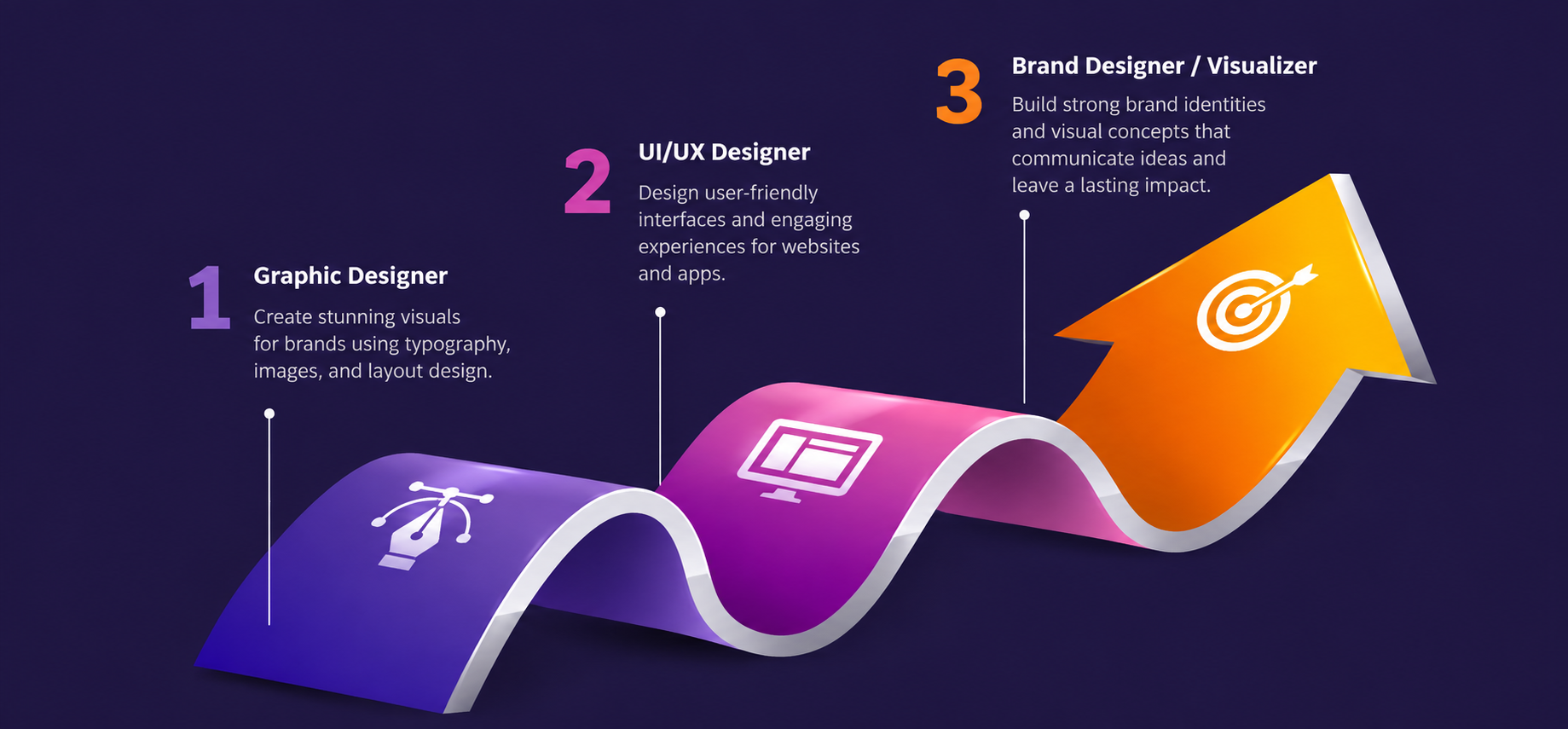
This is where the real income growth happens. As designers gain 2–4 years of experience, many move into:
- UI/UX Designer — designing app and website interfaces; one of the highest-paid entry specialisations right now
- Motion Graphic Designer — animated content for social media, ads, and explainer videos
- Packaging and Retail Designer — driven heavily by India’s booming e-commerce sector
- Brand Identity Designer — logos, brand systems, and guidelines for startups and established companies
- Creative Director (senior-level) — leading design strategy across teams and campaigns
| Role | Typical Experience Needed | Approx. Monthly Salary Range (India) | Core Skill Focus |
| Junior Graphic Designer | 0–1 year | ₹18,000 – ₹28,000 | Layout, branding basics, Adobe suite |
| Graphic Designer | 1–3 years | ₹28,000 – ₹45,000 | Branding, print + digital production |
| UI/UX Designer | 1–3 years | ₹40,000 – ₹90,000+ | Figma, wireframing, user research |
| Motion Graphic Designer | 1–3 years | ₹35,000 – ₹70,000 | After Effects, storytelling, animation |
| Senior Designer / Creative Lead | 4+ years | ₹60,000 – ₹1,20,000+ | Strategy, team leadership, client pitching |
Salary ranges are indicative estimates based on current industry reporting and will vary by city, company size, and portfolio strength.
Expert tip: Don’t chase the highest-paying specialisation immediately. Spend your first year mastering the fundamentals across formats — you’ll make a far more informed choice about which specialisation genuinely suits your strengths once you’ve tried a bit of everything.
What Makes an Advanced Graphic Design Course in Kolkata Worth It
Once you’ve completed a foundational course, many designers go back for an advanced graphic design course in Kolkata to specialise. The value of an advanced course isn’t more software training — it’s structured exposure to real client-style constraints: tight deadlines, brand guidelines you didn’t create, and feedback that isn’t always kind.
A genuinely advanced course should include:
- Live client briefs or agency-style project simulations
- Portfolio review sessions with working designers, not just instructors
- Exposure to at least one specialisation track (UI/UX, motion, or branding) in depth
- Placement support that includes interview preparation, not just a job listing forwarded by email
If a course marketed as “advanced” is just repeating software basics with a new name, that’s a red flag worth asking about directly before enrolling.
Skills Employers Actually Look For
Recruiters rarely say “we want someone who knows Photoshop.” What they actually screen for, based on common hiring patterns at agencies and design teams, includes:
- Problem-solving under constraints — can you design well when the client changes the brief halfway through?
- Typography sense — this is the single most underrated skill; weak typography is the fastest way to look like an amateur
- Consistency across a brand system — not just one nice poster, but a full brand kit that holds together
- Basic understanding of print production or web handoff — knowing file formats, resolutions, and how designs actually get built or printed
- Communication — explaining why a design choice works, not just presenting it
Software proficiency matters, but it’s the entry ticket, not the differentiator. The designers who get hired and promoted fastest are the ones who can defend their design decisions in a conversation, not just execute a brief silently.
How to Choose a Complete Graphic Design Course
A complete graphic design course should be judged on outcomes, not just curriculum length. Before enrolling anywhere, ask these questions directly.
Questions to Ask Before Enrolling
- What software and specialisations does the course actually cover, beyond the basics?
- How many live or simulated client projects will I complete?
- What does the placement support look like — is it a formal process or just informal contacts?
- Can I see portfolios or LinkedIn profiles of recent graduates?
- What is the batch size, and how much one-on-one feedback does that allow?
If an institute can’t clearly answer the placement and portfolio questions, treat that as useful information in itself.
Common Mistakes Students Make After Completing the Course
A few patterns show up again and again among graduates who struggle to land their first role:
- Treating the certificate as the finish line. Employers care about the portfolio, not the certificate. A certificate confirms attendance; a portfolio proves ability.
- Building a portfolio of practice exercises instead of real problems. Ten logo mockups for imaginary brands are far less convincing than three complete brand identity projects with reasoning behind each decision.
- Ignoring feedback culture. Design is iterative. Students who take critique personally instead of using it to improve tend to plateau quickly.
- Applying only for “Graphic Designer” job titles. Roles like Visual Designer, Junior Brand Designer, Content Designer, and Marketing Design Associate all use the same skill set — narrowing your search too early limits opportunities.
- Underpricing freelance work out of fear. New freelancers often charge too little, which attracts clients who don’t value design, creating a cycle that’s hard to break out of.
Expert Tips to Build a Strong Portfolio While Studying
Your portfolio matters more than your resume in this field, so start building it from week one, not after graduation.
- Pick 3–4 real or realistic case studies and go deep — show the problem, your process, and the outcome, not just a pretty final image.
- Get one real client project during your course, even if it’s unpaid or low-paid at first. A local shop’s rebrand or a friend’s startup logo is worth more in an interview than five polished practice pieces.
- Publish work on Behance early, even before it’s “perfect.” Consistency and visible growth over time are themselves signals to recruiters.
- Document your process, not just results. Employers want to see how you think — sketches, revisions, and reasoning behind colour and typography choices.
- Ask for critique from working designers, not just classmates. A slightly uncomfortable, honest review is worth more than ten polite ones.
The students who want to learn more can explore this blog: Why AI-Based Graphic Design Courses Are Trending in 2026
FAQs
Q1. Is a graphic design course in Kolkata enough to get a job, or do I need a degree?
A diploma or advanced diploma is enough for most entry-level roles, especially agency and in-house design positions. A degree helps for roles requiring formal design theory or for students wanting to eventually teach or work internationally, but it isn’t mandatory for most hiring managers, who prioritise portfolio quality.
Q2. What is the average graphic design course duration for a job-ready program?
Most job-ready diploma programs run between 6 and 12 months, including a portfolio and placement phase. Certificate courses run shorter (3–6 months) but usually need to be paired with self-directed practice before you’re truly job-ready
Q3. Can I pursue graphic design courses after 12th without a science or arts background?
Yes. Graphic design doesn’t require a specific stream in Class 12. What matters far more is visual sense, willingness to practise consistently, and comfort with design software, all of which are taught from scratch in most courses.
Q4. How much can a fresher earn after a graphic design course in Kolkata?
Entry-level salaries typically range from ₹18,000 to ₹28,000 per month, depending on the company, portfolio strength, and specialisation. This grows meaningfully — often 12–15% year-on-year — as you gain experience and move into specialisations like UI/UX or motion design.
Q5. Is freelancing a realistic option right after completing a graphic design course?
It’s possible but harder immediately after finishing a course, since freelancing requires client acquisition skills on top of design skills. Many designers freelance part-time while holding a junior in-house role for the first year, then transition fully once they have a client base.
Q6. What’s the difference between a graphic design course and a UI/UX course?
Graphic design focuses on visual communication broadly — branding, print, digital creatives. UI/UX design is a specialisation within the digital design field focused specifically on how users interact with apps and websites. Most designers learn graphic design fundamentals first, then specialise in UI/UX if that interests them.
Conclusion
A graphic design course in Kolkata can absolutely lead to a stable, well-paying career — but only if you choose a course that goes beyond software tutorials and actually builds a portfolio employers take seriously. The career paths are real and growing, from in-house design roles and agency work to specialisations like UI/UX and motion graphics that are seeing some of the fastest salary growth in the creative industry right now. What separates graduates who get hired quickly from those who struggle isn’t talent alone — it’s how deliberately they build real, defensible project work during the course itself, not after.

Farhat Jabeen is passionate about documenting the student enrollment journey in the fields of technology, design, and digital media. Through her writing, she shares practical guidance, industry insights, and real-world learning experiences that help aspiring students confidently navigate their path toward creative and technology-driven careers. Her goal is to empower learners with the knowledge they need to choose the right educational journey.