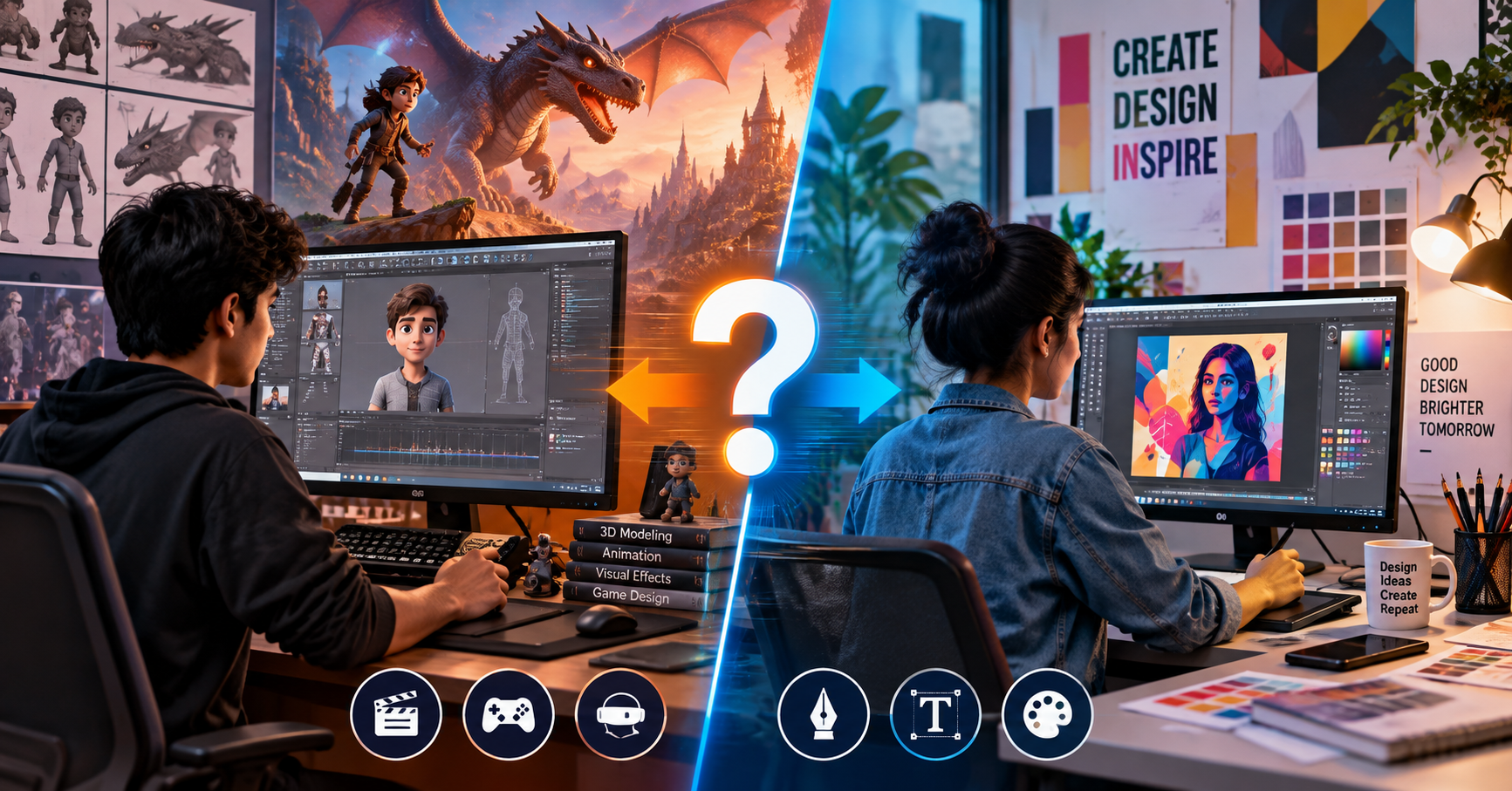
Choosing between an Animation Course and a Graphic Design Course is one of the most common dilemmas faced by students who want to build a career in the creative industry. Both fields are visually driven, both are in high demand, and both offer exciting career paths. Yet each has its own scope, skill requirements, and future growth trajectory. In this blog, we will break down both options in detail so you can make an informed decision about which path suits your interests, skills, and career goals better.
Understanding Animation as a Career Path
Animation is the art of bringing static images to life through movement. It powers everything from feature films and video games to advertisements, mobile apps, and social media content. An Animation Course typically teaches students the principles of motion, character design, 2D and 3D modeling, rigging, visual effects, and storytelling through moving images.
The animation industry has grown exponentially over the last decade, driven largely by the explosion of OTT platforms, gaming studios, and digital marketing agencies that need constant visual content. Studios producing animated films, web series, and short-form video content are hiring animators at a rapid pace. Additionally, industries like education (through animated explainer videos), healthcare (medical animation), and architecture (3D walkthroughs) have started relying heavily on animation professionals.
Career Opportunities After an Animation Course
Students who complete an Animation Course can explore roles such as:
- 2D/3D Animator
- Character Designer
- VFX Artist
- Storyboard Artist
- Motion Graphics Designer
- Game Animator
- Compositor
- Rigging Artist
The scope for animation is particularly strong in sectors like entertainment, gaming, advertising, and ed-tech. With the rise of AI-assisted animation tools, the workflow has become faster, but the demand for skilled human animators who understand storytelling and motion principles hasn’t reduced — if anything, it has increased because studios need people who can supervise, refine, and creatively direct these tools.
Understanding Graphic Design as a Career Path
Graphic design, on the other hand, is a broader and more foundational creative discipline. It involves the use of typography, color theory, layout, and visual hierarchy to communicate messages effectively. A Graphic Design Course trains students in branding, print and digital media design, packaging, UI/UX basics, typography, and software tools like Adobe Photoshop, Illustrator, and InDesign.
Graphic design touches almost every business function you can think of — marketing, branding, advertising, web design, packaging, and even product development. Every company, big or small, needs graphic designers to create logos, social media creatives, brochures, websites, and marketing collateral. This universal applicability is what gives graphic design such a wide and stable scope.
Career Opportunities After a Graphic Design Course
Graduates of a Graphic Design Course can pursue roles such as:
- Graphic Designer
- Brand Identity Designer
- UI/UX Designer
- Packaging Designer
- Art Director
- Visual Communication Designer
- Social Media Content Designer
- Print and Publication Designer
Unlike animation, which is often tied closely to entertainment and gaming industries, graphic design skills are required across nearly every sector — from fashion and food to tech startups and corporate enterprises. This makes the job market for graphic designers larger, though the average pay ceiling in some specialized animation roles (like VFX supervision or 3D character animation) can be higher.
Comparing Scope: Animation vs Graphic Design
To understand which course has more scope in the future, let’s compare both fields across several important parameters.
1. Industry Demand
The animation industry is booming, especially with international outsourcing projects coming to countries with skilled and cost-effective animation talent. Studios worldwide outsource animation and VFX work, creating strong job opportunities for those who complete a quality Animation Course. Similarly, graphic design demand remains consistently high because virtually every business, no matter how small, requires design support for branding and marketing.
2. Diversity of Roles
Graphic design offers a wider diversity of entry points because nearly every company needs design work done regularly. Animation, while growing, is more concentrated in specific industries like entertainment, gaming, ed-tech, and advertising. If you’re looking for broader employability across various sectors, a Graphic Design Course might open more doors initially.
3. Freelancing and Remote Work
Both fields offer excellent freelancing opportunities. Graphic designers often find quicker freelance gigs because businesses regularly need social media posts, logos, and marketing materials. Animators, especially those skilled in 3D or VFX, can also freelance on bigger projects, but these projects sometimes require more specialized software and higher-end systems.
4. Skill Complexity and Learning Curve
An Animation Course generally has a steeper learning curve because it requires understanding movement, timing, physics, and storytelling in addition to design fundamentals. Graphic design, while requiring strong aesthetic sense and software proficiency, tends to have a comparatively shorter learning curve for entry-level competency, though mastering branding strategy and advanced UI/UX design still takes years of practice.
5. Technology and AI Impact
Both fields are being reshaped by AI tools. AI-powered design tools can now generate logos, layouts, and even marketing copy suggestions, which means graphic designers need to continuously upskill in strategic thinking and brand storytelling to stay relevant. Similarly, AI is being used in animation for automating in-between frames, lip-syncing, and basic rigging, but creative direction, character performance, and storytelling remain uniquely human skills that keep animators in demand.
6. Long-Term Career Growth
In terms of long-term growth, animation professionals can move into direction, VFX supervision, or studio leadership roles, especially in gaming and film industries. Graphic designers can grow into creative directors, brand strategists, or UI/UX leads. Both paths offer strong senior-level opportunities, but the trajectory depends heavily on specialization and portfolio strength rather than the course title alone.
Which One Should You Choose?
The decision between an Animation Course and a Graphic Design Course ultimately depends on your personal interests and strengths.
Choose an Animation Course if:
- You enjoy storytelling through motion and character performance
- You are passionate about films, games, or visual effects
- You are comfortable with complex 3D software and technical workflows
- You want to work in entertainment, gaming, or VFX studios
Choose a Graphic Design Course if:
- You enjoy working with layouts, typography, and branding
- You want to work across diverse industries, not just entertainment
- You prefer faster project turnaround and varied client work
- You are interested in marketing, advertising, or UI/UX design
Combining Both Skills for Maximum Scope
Interestingly, many successful creative professionals don’t limit themselves to just one discipline. Motion graphics, for example, sits right at the intersection of animation and graphic design. Professionals who understand both animation principles and graphic design fundamentals often have a competitive edge, especially in digital marketing, where animated social media content and motion-based branding are increasingly popular.
If you’re unsure which path to commit to fully, consider starting with a Graphic Design Course to build a strong foundation in visual communication, and later specializing in animation or motion graphics as you discover your interests. Alternatively, if storytelling and movement excite you more than static visuals, diving directly into an Animation Course can help you build specialized skills early.
Future Outlook
Looking ahead, both fields are expected to grow steadily. The global demand for animated content across streaming platforms, mobile gaming, and educational technology suggests animation will continue to see strong hiring trends. At the same time, the ever-present need for branding, packaging, and digital marketing content ensures that graphic design will remain a stable and evergreen career choice.
Rather than viewing one course as definitively “better” than the other, it’s more productive to think of them as complementary paths within the broader creative industry. Your choice should be guided by where your creative strengths lie, what kind of work excites you daily, and what industry you envision yourself working in five or ten years from now.
Conclusion
Both an Animation Course and a Graphic Design Course offer promising career scope in the future, but they cater to different interests and industry needs. Animation offers deep specialization in entertainment, gaming, and visual storytelling, with strong growth in outsourced and freelance work. Graphic design offers broader applicability across virtually every industry, with steady demand for branding and marketing visuals.
Ultimately, the “better” choice depends on your personality, creative inclinations, and long-term career vision. Whichever path you choose, building a strong portfolio, staying updated with industry software, and continuously honing your craft will be the real determinants of your success in the creative field.

Pooja Sharma is a creative education content writer who creates engaging articles on career guidance, skill development, and learning opportunities to help students make informed decisions.