Every app you open without thinking about it was shaped by a designer. They decided where the button sits, how the form feels and why the checkout doesn’t make you want to quit. That quiet craft is UI/UX design, and it is now one of the more approachable creative careers for people in their late teens and twenties.
A Certificate in UI/UX Design with AI is a focused, skills-first program. It teaches you to design digital products people find easy and pleasant to use, and to work with AI tools as part of your normal workflow. You don’t need a degree in design to start. Below is what the certificate involves, what you’d learn, and how to judge a UI UX design course in Kolkata before you enrol.
What Does a Certificate in UI/UX Design with AI Mean?
The answer is in the three parts of the name:
- UI (User Interface): the visible layer, including layouts, typography, colour, icons and components.
- UX (User Experience): the thinking underneath, including research, user flows, wireframes and testing.
- With AI: using AI tools to speed up research, ideation and repetitive tasks, while you stay in charge of the design decisions.
A certificate suits you if you want practical, portfolio-ready skills without committing to a multi-year degree. Moople Institute lists UI/UX Design & AI among its web design courses, and you can see the programme page on the UI/UX design course page.
Why Learn UI/UX Design Now?
Nearly every business now needs a usable website or app, from food delivery startups to hospitals and banks. Those products need people who understand users, not just software. That is why a UI UX design course attracts students from very different backgrounds, including arts, commerce, science and engineering.
Here is where AI changes things. It can draft user personas, suggest layout variations and summarise research notes in minutes. It cannot understand your user’s frustration, judge whether a screen feels trustworthy, or decide what to leave out. Designers who combine good judgment with AI tools tend to work faster without losing quality. That is the practical idea behind the “with AI” in the title.
What You Can Expect to Learn
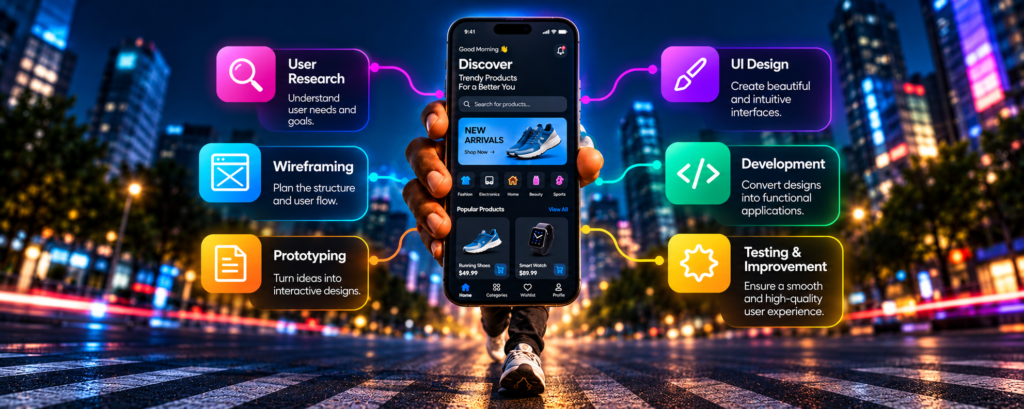
Syllabi differ between institutes, so always ask for the current module list. A solid UI/UX certificate usually builds skills in this order:
- Design fundamentals: colour, typography, spacing, grids and visual hierarchy.
- User research basics: interviews, surveys, personas and spotting real user problems.
- Information architecture and user flows: mapping how someone moves through an app or site.
- Wireframing and prototyping: turning rough ideas into clickable screens, typically in tools like Figma.
- UI design systems: buttons, cards and forms that stay consistent across screens.
- Usability testing: watching real people use your design and fixing what confuses them.
- AI-assisted workflows: using AI to brainstorm, generate content, speed up research and explore options.
- Portfolio building: packaging projects as case studies that explain your thinking.
The last point matters most. Recruiters in design rarely care about a certificate alone. They want to see how you solved a problem.
UI vs UX: A Quick Comparison
| UI Design | UX Design | |
| Focus | How it looks | How it works and feels |
| Key questions | Is it clear and visually consistent? | Is it easy and does it solve the user’s problem? |
| Typical outputs | Mockups, style guides, components | Research notes, flows, wireframes, test findings |
| Mindset | Visual craft | Problem solving and empathy |
Most beginners learn both. You can then lean towards whichever you enjoy more.
Who Is This Certificate For?
This program fits students and early-career learners aged roughly 18 to 30, including:
- Class 12 pass-outs who want a creative, tech-adjacent path
- College students who want a skill alongside their degree
- Graduates switching from non-design fields
- Graphic or web design learners who want to move into product design
You need curiosity about how people use things and a willingness to iterate. Strong drawing skills are not required.
Career Paths After Completing the Course
A certificate can open entry-level doors such as:
- UI Designer
- UX Designer or UX Research Assistant
- Product Designer (junior)
- Web or App Interface Designer
- Freelance Designer for small businesses and startups
Results depend on your portfolio, effort and the job market. No institute can promise a particular job, so be cautious of anyone who does. Moople does list placement guidance and a placement page where you can read what support is actually offered.
How to Choose a UI UX Design Course in Kolkata
Kolkata has many options, so compare them on substance rather than marketing. Ask these questions:
- Is the syllabus current? Does it include AI-assisted design and not just old Photoshop-era methods?
- Will you build real projects? Look for case studies, not just exercises.
- Who teaches? Industry experience matters more than a long title.
- Do you get a workstation and mentoring? Practice time is where skills form.
- Is there career support? Portfolio reviews and interview preparation make a real difference.
- Is it convenient to reach? A centre close to home or college makes it easier to stay consistent.
Moople Institute has centres across the city and nearby areas, including Baguiati, Barasat, Berhampore, Chandannagar, Chowringhee, Jodhpur Park, New Alipore, Sealdah, Serampore and Sonarpur. If you live near Sonarpur or Barasat, you don’t need to travel to central Kolkata. Check the centres page for current details, and visit a branch before deciding.
Practical Tips for Getting the Most from the Course
- Start a design habit early. Redesign one screen from an app you use every week.
- Document your thinking. A case study that explains why you made a choice beats a pretty mockup.
- Use AI as an assistant, not an author. Check every output against real user needs.
- Get feedback often. Show work to friends, classmates and mentors.
- Learn adjacent skills. Basic web design and graphic design knowledge strengthens your UI work.
FAQs
1. Do I need coding skills to join a UI/UX design course?
No. UI/UX design is about planning and designing interfaces, not building them. Basic awareness of how websites work helps, but coding isn’t required.
2. Can a beginner take a Certificate in UI/UX Design with AI?
Yes. Good programs start from fundamentals and build up. Beginners from non-design backgrounds do well when they practise regularly.
3. What is the difference between UI and UX design?
UI covers the visual look of a product. UX covers how easy and meaningful the experience is. Most courses teach both together.
4. What does “with AI” actually add to the course?
It means using AI tools for tasks like idea generation, research support and content drafts, so you can work more efficiently. The creative and strategic decisions stay with you.
5. Is a UI UX design course in Kolkata worth it?
It can be, if the course gives you hands-on projects, mentoring and a portfolio. The value comes from what you build, not just the certificate.
6. What can I do after completing the certificate?
You can apply for junior UI/UX or web design roles, take freelance projects, or continue into a related degree or specialisation.
7. Can I learn UI/UX while studying in college?
Yes. Many students pair it with their degree. Check batch timings and choose a centre that fits your schedule.
8. Which Moople centre is nearest to me?
Moople lists centres including Baguiati, Barasat, Berhampore, Chandannagar, Chowringhee, Jodhpur Park, New Alipore, Sealdah, Serampore and Sonarpur. The centres page or a counsellor can confirm which one suits you.
Conclusion
A Certificate in UI/UX Design with AI gives you a practical way into a field that rewards both creativity and clear thinking. Pick a course that emphasises real projects, current tools and honest career guidance, and build a portfolio that shows how you think.
If you’re exploring a UI UX design course in Kolkata, speak to the Moople team about the syllabus, fees, batch timings, and your nearest centre. You can book a free counselling session through the contact page and see the work students produce before you decide.

Farhat Jabeen is passionate about documenting the student enrollment journey in the fields of technology, design, and digital media. Through her writing, she shares practical guidance, industry insights, and real-world learning experiences that help aspiring students confidently navigate their path toward creative and technology-driven careers. Her goal is to empower learners with the knowledge they need to choose the right educational journey.