If you’re based in Guwahati and searching for a UI UX Design & AI Course, you’ve probably noticed two things. First, almost every job posting for a design role now asks for “AI-assisted workflow” experience. Second, most local course listings talk about software tools but say very little about what actually happens after you finish the course — how you build a portfolio, how you find your first client, or how much you can realistically expect to earn.
This article is written to fix that gap. Moople Institute has trained design and animation students from across India, including Northeast India, and this guide walks you through what a genuinely future-proof UI UX Design & AI course looks like — the curriculum, the fee range, the career outcomes, and the mistakes most beginners make before they even enroll.
By the end, you’ll know exactly what to check before choosing a UI UX Design & AI Course in Guwahati, whether it’s ours or anyone else’s.
Table of Contents
What Is a UI UX Design & AI Course?
A UI UX Design & AI Course is a structured training program that teaches you how to design digital products — apps, websites, dashboards — while also using AI tools to speed up research, wireframing, prototyping, and testing. It combines classic UI (User Interface) and UX (User Experience) design skills, like wireframing and usability testing, with modern AI-assisted tools such as Figma AI, Midjourney for concept art, and ChatGPT-based user research assistants.
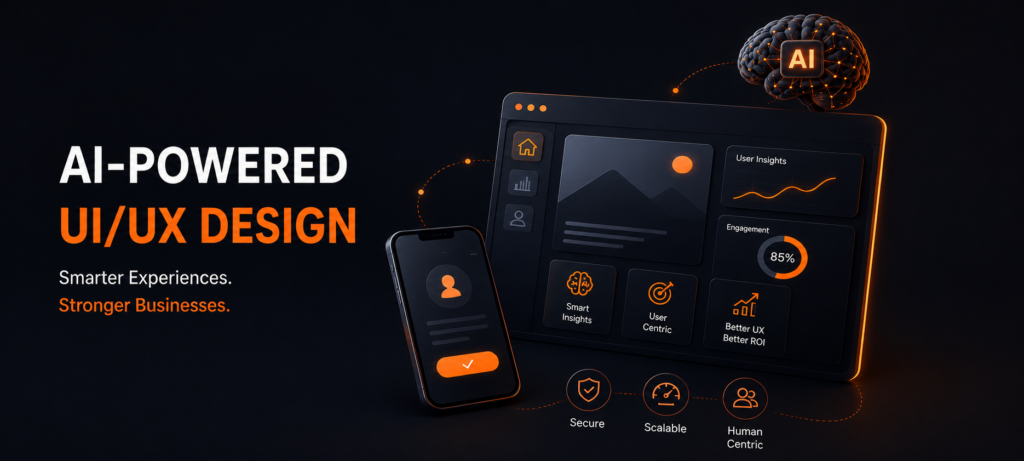
Unlike a pure graphic design course, this program focuses on how people use a product, not just how it looks. And unlike a plain coding bootcamp, it stays close to the visual and human side of technology.
Why Guwahati Students Are Choosing UI UX Design & AI Course Career Path
Guwahati has grown into a genuine tech and startup hub for Northeast India over the last few years, with co-working spaces, IT parks, and remote-first companies hiring locally. Design roles are one of the few tech careers that don’t require you to relocate to Bangalore or Delhi — a UI UX designer working for a Mumbai fintech startup or a US-based SaaS company can do the entire job from Guwahati.
This matters because design salaries have historically been higher in metro cities, but remote work has closed that gap significantly. A junior UI UX designer working remotely from Guwahati can now earn what used to be a Bangalore-only salary, provided their portfolio is strong enough to compete.
There’s also a simple demand-side reason: very few people in the region have combined UI UX training with practical AI tool fluency. That scarcity works in your favour if you learn it early.
What You’ll Actually Learn: Curriculum Breakdown
A well-structured UI UX Design & AI course should be built in layers, not as a random list of software tutorials. Here’s how the learning journey typically progresses:
Foundation Stage
- Design thinking and the double-diamond process
- User research methods: interviews, surveys, personas
- Information architecture and user flows
- Wireframing (low-fidelity to high-fidelity)
Core Design Stage
- Visual design principles: typography, color theory, grid systems
- Prototyping in Figma or Adobe XD
- Micro-interactions and motion design basics
- Accessibility (WCAG) fundamentals
AI Integration Stage
This is the part most courses in the region skip entirely, and it’s where the real differentiation happens.
AI for Research
Using AI tools to summarize user interview transcripts, cluster feedback themes, and generate quick user personas from survey data — cutting research synthesis time from days to hours.
AI for Design Generation
Generating mood boards, icon sets, and first-draft layouts using AI image and design tools, then refining them manually. The AI gives you a starting point; your design judgment does the rest.
AI for Prototyping and Testing
Using AI-assisted usability testing tools that can simulate user behavior or flag confusing UI patterns before you run a real test session.
Capstone and Portfolio Stage
- Building 3-4 real-world case studies (not fake “redesign this app” exercises)
- One-on-one portfolio reviews
- Mock interviews and freelancing/job-hunting guidance
Expert Tip: A portfolio with 3 deeply documented case studies (showing your research, iterations, and reasoning) will get you hired faster than 10 shallow “pretty screens” projects. Recruiters read the thinking, not just the visuals.
UI UX Design & AI Course Fees: What to Expect
Fee transparency is where a lot of institutes fall short, so let’s be direct about it. Course fees for a UI UX Design & AI Course typically depend on four factors: course duration, whether it includes live mentorship, whether AI tool training is genuinely included (not just mentioned), and whether placement or portfolio support is part of the package.
| Course Type | Typical Duration | Typical Fee Range (India) | What’s Usually Included |
| Short certificate course | 4-8 weeks | ₹8,000 – ₹20,000 | Basic software training only |
| Comprehensive diploma | 4-6 months | ₹25,000 – ₹60,000 | Design + AI tools + portfolio |
| Advanced program with placement support | 6-12 months | ₹50,000 – ₹1,20,000 | Full curriculum + mentorship + job assistance |
These figures are indicative industry ranges, not a quote for any specific institute. Always ask for the exact fee structure, installment options, and what happens if you need to pause the course midway.
Before enrolling anywhere, ask these three questions directly: What software licenses are included in the fee? Is there a separate charge for certification? What is the batch size for live sessions?
How AI Has Changed the UI UX Job Market
Design teams today expect faster turnaround because AI tools have compressed timelines that used to take weeks into days. According to a 2024 industry survey by the Nielsen Norman Group, a majority of UX practitioners reported already using generative AI tools in some part of their design process, most commonly for early ideation and content generation rather than final design decisions.
This has shifted what employers actually screen for. It’s no longer just “can you use Figma.” It’s “can you use AI to move faster without losing design quality.” Designers who can direct AI tools effectively — writing clear prompts, evaluating AI output critically, and combining it with solid UX fundamentals — are getting hired over designers who rely purely on manual work or purely on AI without design judgment.
That said, AI hasn’t replaced the core skill: understanding real human behavior. No AI tool can sit with your actual users and notice the confused pause before they click the wrong button. That observational skill is still entirely human, and it’s still the foundation every good UX designer needs.
Career Paths After the Course
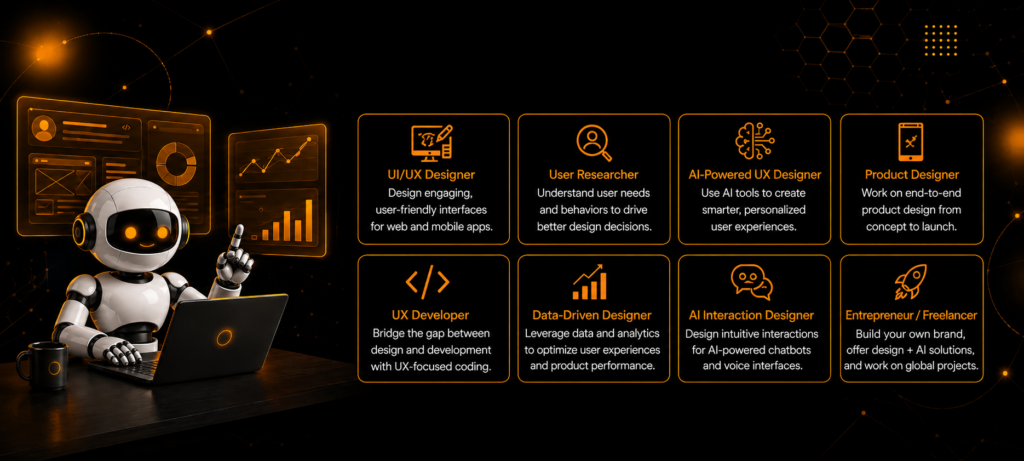
Graduates of a solid UI UX Design & AI program typically move into one of these roles:
- UI Designer — focused on visual interfaces, layouts, and design systems
- UX Designer / Researcher — focused on user research, flows, and usability testing
- Product Designer — a hybrid role covering both UI and UX plus some product strategy
- AI-Integrated Design Specialist — an emerging role focused specifically on building AI-assisted design workflows for teams
- Freelance Designer — working independently for multiple clients, often through platforms or direct referrals
Starting salaries vary widely by city and company size, but entry-level UI/UX designers in India with a strong portfolio typically start in the ₹3-6 LPA range, with product design and senior roles going significantly higher. Freelancers often earn per project, and a well-built AI-assisted workflow lets a freelancer take on more clients without burning out.
Explore More Blog: How to Choose the Right UI UX Design Classes for Your Career
How to Choose the Best UI UX Design & AI Course Institute
Use this checklist before signing up anywhere:
| What to Check | Why It Matters |
| Live projects, not just recorded videos | Design skill is built by doing, not watching |
| Portfolio-building support | Your portfolio is what actually gets you hired |
| Real AI tool training (not a single bonus lecture) | AI fluency is now a baseline expectation, not a bonus |
| Small batch sizes | Feedback quality drops sharply in large batches |
| Placement or freelancing guidance | Learning the skill is only half the outcome |
| Verifiable student outcomes | Ask to see actual past student portfolios, not just testimonials |
A genuinely good institute will happily show you real student work and connect you with alumni. If an institute is reluctant to do this, treat it as a warning sign.
Common Mistakes Beginners Make
Most students don’t fail because they lack talent — they fail because of avoidable planning mistakes.
Mistake 1: Choosing a course based only on price. The cheapest course often skips mentorship and portfolio review, which are the two things that actually get you hired.
Mistake 2: Learning tools instead of thinking. Knowing Figma’s every menu option means nothing if you can’t explain why you made a design decision. Interviewers test reasoning, not button-clicking speed.
Mistake 3: Treating AI as a shortcut instead of a tool. Students who let AI generate a full design and submit it as-is tend to produce generic, forgettable work. AI should speed up your process, not replace your judgment.
Mistake 4: Skipping user research practice. It’s tempting to jump straight into pretty screens. But recruiters specifically look for evidence that you understand real user problems, not just visual polish.
Online vs Offline vs Hybrid Learning in Guwahati
Since not every quality institute has a physical branch in every city, it’s worth understanding your options honestly.
Live online learning connects you directly with instructors in real time, with the same mentorship quality as an in-person class, minus the commute. This is currently the most practical option for students in Guwahati who want access to institutes with strong faculty and industry connections based in other cities.
Hybrid learning combines live online sessions with occasional in-person workshops or bootcamps, useful if you want some face-to-face networking without needing a full-time local campus.
Offline-only learning works well if a genuinely strong institute exists in your immediate city, but don’t choose “local” over “quality” — a mediocre nearby institute won’t out-teach a strong online-live program.
Moople Institute currently delivers its UI UX Design & AI Course through live, mentor-led online sessions, giving students in Guwahati direct access to the same curriculum, faculty, and portfolio-review process as students in Kolkata.
FAQs
1. What is a UI UX Design & AI Course?
It’s a training program that teaches user interface and user experience design skills alongside practical use of AI tools for research, prototyping, and design generation.
2. Do I need a design or coding background to join?
No. Most students join with zero design background. What matters more is visual curiosity and willingness to practice consistently.
3. How long does it take to become job-ready?
Most students reach a job-ready portfolio stage in 4-6 months with consistent practice, though this depends on how many hours per week you invest and how actively you seek feedback.
4. Can I do this course while studying or working full-time?
Yes, most live online programs offer evening or weekend batches specifically for this reason.
5. Is AI going to replace UI UX designers?
Unlikely in the near term. AI is replacing repetitive, low-judgment tasks, but it still can’t replace human empathy, contextual judgment, and real user observation — all central to good UX design.
Conclusion
A future-proof design career isn’t built by learning software shortcuts — it’s built by combining solid UX thinking with genuine AI fluency, then proving both through a strong portfolio. For students in Guwahati, the opportunity right now is real: the demand for design talent is growing, remote work has removed the location disadvantage, and very few local candidates have combined UI UX skills with practical AI tool experience.
Choose a course that treats AI as a tool for better thinking, not a replacement for it, and prioritize mentorship and portfolio support over flashy marketing claims.

Swarnali Chatterjee is an SEO content writer specializing in education blogs for colleges and universities. She creates well-researched, search-optimized content that simplifies academic programs, admissions, and career opportunities for students and parents. With a strong grasp of higher education trends and SEO best practices, she helps institutions boost online visibility and credibility through clear, student-focused writing.