

A good website development course in Kolkata should teach you more than HTML, CSS and JavaScript. It should teach you to build sites that load fast, respond instantly and stay stable while people use them. Google measures exactly that with Core Web Vitals, and usability testing is how you find out whether real people experience your site that way.
If you’re a student between 18 and 30 comparing options, this guide explains the three metrics in plain language, shows how to test them, and lists what to check before you enrol.
What Are Core Web Vitals?
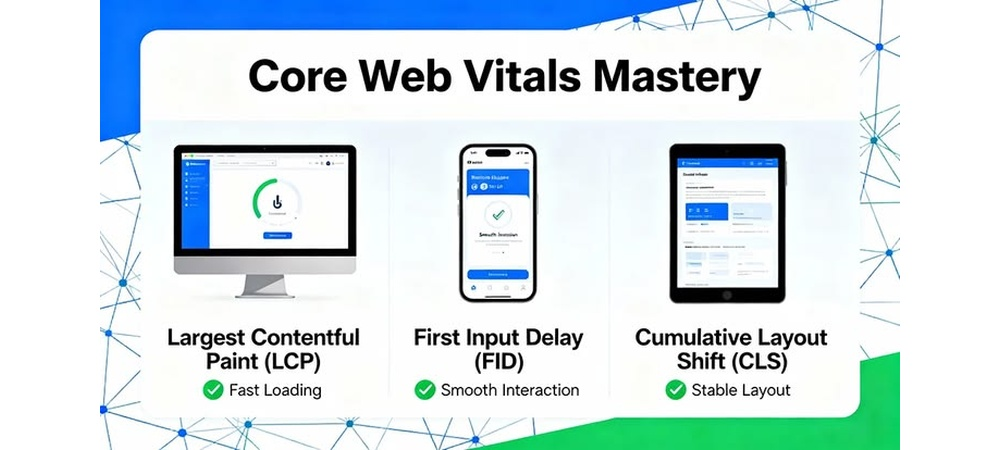
Core Web Vitals are three metrics Google uses to describe real-world page experience: loading, interactivity and visual stability. They are part of Google’s page experience signals, but they are one factor among many. Relevant, helpful content still matters most. Fast pages simply don’t get in the way of it.
| Metric | Measures | “Good” threshold |
| LCP (Largest Contentful Paint) | How quickly the main content appears | 2.5 seconds or less |
| INP (Interaction to Next Paint) | How quickly the page responds to taps and clicks | 200 milliseconds or less |
| CLS (Cumulative Layout Shift) | How much the layout jumps around | 0.1 or less |
These thresholds are assessed at the 75th percentile of real visits, so most of your visitors need a good experience, not just you on office Wi-Fi.
LCP: Does the Page Feel Loaded?
LCP times how long the biggest visible element takes to render. It is usually a hero image, a banner or a large heading.
Common causes of a slow LCP:
- Uncompressed hero images, such as a 3 MB photo straight from a phone
- Slow server response
- Render-blocking CSS or JavaScript
- Web fonts that delay text
Practical fixes: serve modern formats like WebP or AVIF, size images to their display dimensions, don’t lazy-load the hero image, and preload the key resource.
INP: Does the Page React When You Tap?
INP replaced First Input Delay as a Core Web Vital in March 2024. It looks at how long the page takes to visually respond across a visit, not just on the first click. A menu that opens late or a button that seems dead usually points to heavy JavaScript blocking the main thread.
To improve it, break long tasks into smaller ones, remove unused scripts, and be careful with third-party widgets such as chat plugins and trackers.
CLS: Does Anything Jump?
Picture reading an article on your phone and going to tap a link, only for a late-loading banner to shove the text down so you hit the wrong thing. That jolt is layout shift. It mostly comes from images with no set dimensions, banners that appear after the page has rendered, and fonts that swap in late. Give every image, ad slot and embed a fixed space up front, and the page stops jumping. . Reserve space for every element before it loads and most CLS problems disappear.
Where Usability Testing Fits In
Core Web Vitals give you numbers. Usability testing tells you why those numbers matter to a person. A page can score well and still confuse visitors, and a lovely design can feel painful on a mid-range phone with patchy mobile data.
A simple testing routine you can learn in a website development course:
- Measure first. Run PageSpeed Insights and Lighthouse, then check the Core Web Vitals report in Google Search Console once the site has real traffic.
- Throttle your connection. In Chrome DevTools, simulate slow 4G and a mid-range phone.
- Watch real people. Give 3–5 friends a task such as “find the course fee” and watch silently. Note where they hesitate.
- Fix one thing at a time.Change one thing, then run the test again. That way you know which tweak actually moved the score.
- Record before and after. A portfolio case study with measured improvements impresses interviewers far more than a pretty screenshot.
Lab tools (Lighthouse) and field data (Search Console, the Chrome UX Report) can disagree. Lab results are a controlled test, while field data reflects actual visitors. Good developers know which one to trust for which decision.
What to Look for in a Website Development Course in Kolkata
Course names sound alike, so compare the content. A strong programme should cover:
- Fundamentals: semantic HTML, modern CSS (Flexbox, Grid), responsive design and JavaScript basics
- A framework or CMS: such as React or WordPress, depending on your career goal
- Performance basics: image optimisation, caching, and a working understanding of LCP, INP and CLS
- Usability and accessibility: testing with real users, readable contrast, keyboard navigation
- Version control: Git and GitHub from the first month
- Live projects: at least two or three sites you can show publicly
- Mentor feedback: code reviews, not just recorded lectures
Ask to see the syllabus and sample student work before paying. Be wary of any institute that guarantees jobs. Outcomes depend on your effort and portfolio, and nobody can promise them honestly.
Learning Close to Home
Kolkata’s learners are spread across the metro area, and commute time is a real factor. Students from Baguiati, Barasat, Sonarpur and Serampore often travel via Sealdah or the suburban lines, while those in Jodhpur Park, New Alipore and Chowringhee are closer to the city’s centre. Berhampore and Chandannagar students may prefer hybrid options. Ask any institute, Moople Institute included, about batch timings, weekend slots and online access so the schedule fits your life.
Frequently Asked Questions
How long does a website development course in Kolkata usually take?
The length depends on the institute and how far the syllabus goes. A front-end-only track is typically shorter, while a full-stack track with frameworks and projects runs longer. Ask the institute for its current batch length before you enrol.
2. Do I need coding experience to start?
No. Most beginner batches start from HTML and CSS. Curiosity and regular practice matter more than prior knowledge.
3. Are Core Web Vitals a Google ranking factor?
They are part of Google’s page experience signals, but they work alongside hundreds of other signals. Relevance and content quality usually matter more.
4. What replaced First Input Delay?
Interaction to Next Paint (INP) replaced FID in March 2024 and measures responsiveness across the whole visit.
5. Which free tools can I use to test Core Web Vitals?
PageSpeed Insights, Lighthouse in Chrome DevTools, and Google Search Console are free and enough for beginners.
Conclusion
Choosing a website development course in Kolkata is easier once you know what separates a good one: fundamentals, real projects, and a habit of testing what you build. LCP, INP and CLS give you a clear language for speed and stability, and usability testing keeps you honest about how people actually use your work.
If you’re exploring options, visit Moople Institute at moople.in, review the syllabus, and ask about a demo class so you can judge the teaching before you commit.

Farhat Jabeen is passionate about documenting the student enrollment journey in the fields of technology, design, and digital media. Through her writing, she shares practical guidance, industry insights, and real-world learning experiences that help aspiring students confidently navigate their path toward creative and technology-driven careers. Her goal is to empower learners with the knowledge they need to choose the right educational journey.