
If you’ve just finished Class 12 and you’re weighing your options, chances are the BCA course in Kolkata has already come up in a few conversations — with parents, teachers, or seniors who took the same route. It’s one of the most searched-for degree programs among Kolkata students who like computers but aren’t sure they want a full four-year engineering degree.
This guide is written for exactly that stage of confusion. We’ll walk through what a BCA degree course actually involves, what it costs in Kolkata specifically, which colleges are worth shortlisting, what the job market looks like after graduation, and — because we work closely with young people choosing between technical and creative careers — where BCA fits next to specialized paths like animation, UI/UX, and VFX. No fluff, no generic “BCA is a great course” filler. Just what you need to make a decision you won’t regret in three years.
Table of Contents
What Is a BCA Course?
A BCA degree course, or Bachelor of Computer Applications, is a four-year undergraduate program that teaches programming, databases, networking, and application development. Think of it as the practical, industry-facing cousin of a Computer Science degree — less heavy on pure mathematics and theoretical algorithms, more focused on building software you can actually use.

In Kolkata, BCA has grown popular over the last decade because it opens two doors at once: you can walk straight into an IT job after graduation, or use it as a stepping stone to an MCA (Master of Computer Applications) if you want to go deeper into software engineering or systems design.
BCA Course Eligibility After 12th
Most Kolkata colleges follow a similar eligibility pattern for BCA course after 12th admissions:
- You must have passed Class 12 from a recognized board (WBCHSE, CBSE, ICSE, or equivalent).
- Mathematics is compulsory in Class 12 at most institutions, though a handful of private colleges accept Computer Science or Commerce students without Mathematics—always confirm with the specific college, since requirements vary more than students expect.
- A minimum aggregate of 45-50% is typical, with government-aided colleges sometimes setting the bar higher due to demand.
- Some colleges under Calcutta University or affiliated with the state’s Common Admission process conduct a short aptitude or logical reasoning test before final admission.
An expert tip worth remembering here: don’t assume Mathematics is compulsory everywhere. We’ve seen Commerce-background students in Kolkata get rejected from one college and accepted into another for the same course, purely because eligibility criteria weren’t standardized. Always check the specific college’s prospectus before ruling yourself out.
BCA Course Duration and Structure
The BCA program in Kolkata, like everywhere else in India, runs for four years, split into six semesters. Each semester typically combines theory papers with lab-based practical sessions, since the entire point of the degree is to make you employable with working code, not just exam answers.
A few colleges have also started offering a four-year BCA under the National Education Policy (NEP) framework, with the fourth year allowing an Honours specialization or research project. If you’re comparing colleges, ask specifically whether they follow the four-year or four-year NEP-aligned structure, because the credit transfer and higher-study pathways differ.
BCA Course Fees in Kolkata
BCA course fees in Kolkata vary widely depending on whether you choose a government-aided college, a state university department, or a private institution.
| College Type | Approximate Annual Fees | What You’re Paying For |
| Government-aided colleges | ₹15,000 – ₹35,000 | Lower cost, larger batch sizes, established affiliation |
| State university departments | ₹25,000 – ₹50,000 | Recognized degree, moderate infrastructure |
| Private colleges/universities | ₹60,000 – ₹1,80,000 | Better labs, placement cells, smaller batches |
These figures are indicative and change year to year, so always verify current fee structures directly on the college website or admission office before applying. On top of tuition, budget separately for lab fees, a laptop (most colleges expect students to bring their own by second year), and study material — this often adds ₹20,000-₹40,000 across the full course, an expense many students forget to plan for.
Top BCA Colleges in Kolkata
Here are well-established options students commonly shortlist for BCA colleges in Kolkata. This isn’t a ranking — it’s a starting list to research further based on your budget, location, and specialization interest:
- Moople Institute – ( BCA Programme in Academic Partnership with Behala College )
- Institute of Engineering and Management (IEM)
- Techno India University
- Techno Main Salt Lake (TMSL)
- University of Engineering & Management (UEM)
- The Heritage Academy
- Brainware University
- NSHM Knowledge Campus
- Techno International New Town (TINT)
- Narula Institute of Technology (NIT)
Before shortlisting any college, check four things beyond the brochure: the actual placement record for the last two years (not just the highest package advertised), whether faculty includes working industry professionals or only full-time academics, and whether the lab infrastructure is genuinely updated or aging. Visiting during an open day, if possible, tells you more than any website.
BCA Syllabus: Subjects Semester-Wise
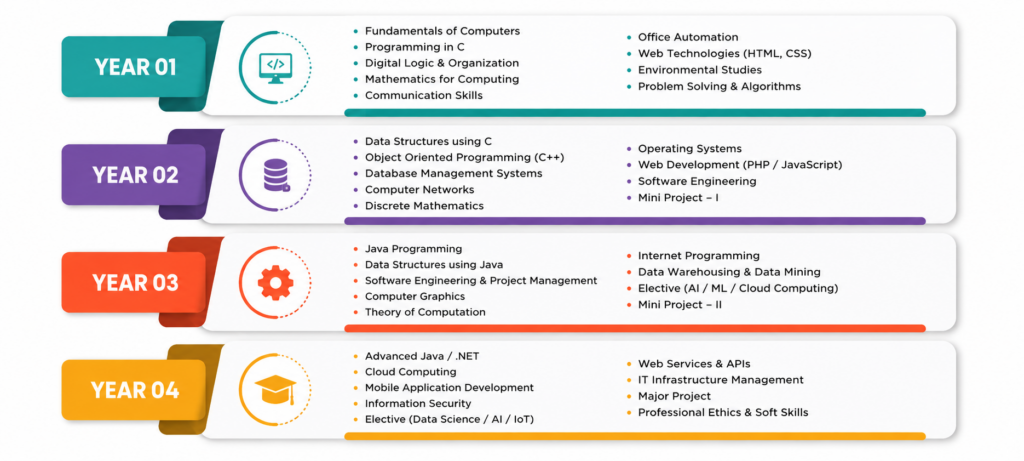
While the exact syllabus differs slightly by university, most BCA programs in Kolkata cover a broadly similar core:
1st Year – Foundation
The first year focuses on computer fundamentals, programming, mathematics, data structures, database management, web basics, and communication skills. Students build a strong foundation in computer applications and logical problem-solving.
2nd Year – Programming & Development
The second year covers Java, Python, operating systems, computer networks, software engineering, web development, computer graphics, UI/UX, and advanced databases, with practical application-based learning.
3rd Year – Advanced Technologies
The third year introduces students to AI, machine learning, cloud computing, cybersecurity, mobile applications, full-stack development, data analytics, IoT, DevOps, and software testing.
4th Year – Projects & Industry Readiness
The fourth year focuses on advanced application development, generative AI, big data, cloud deployment, project management, internships, live projects, and a major final-year project to prepare students for professional careers.
BCA vs B.Tech vs B.Sc Computer Science
A question we hear constantly from Kolkata students and parents is how BCA actually compares to the alternatives. Here’s an honest side-by-side:
| Factor | BCA | B.Tech (CSE) | B.Sc Computer Science |
| Duration | 3 years (4 in NEP model) | 4 years | 3 years |
| Focus | Applied programming, software development | Engineering principles, deep math/algorithms | Theoretical computer science |
| Entrance Exam | Usually none or a college-level test | JEE Mains or state engineering entrance | Usually none or college-level test |
| Typical Fee Range (Kolkata) | ₹15,000 – ₹1,80,000/year | ₹80,000 – ₹3,00,000/year | ₹15,000 – ₹1,00,000/year |
| Best Suited For | Students who want to code and build apps quickly | Students strong in Maths/Physics wanting an engineering title | Students leaning toward research or further M.Sc. study |
| Higher Study Path | MCA, MBA | M.Tech, MS abroad | M.Sc, MCA |
If your goal is to start working in software development as soon as possible without committing to four years of engineering mathematics, BCA is usually the more efficient route. If you enjoy Physics and Maths and want the engineering tag on your resume, B.Tech makes more sense despite the higher cost and longer duration.
Career Scope After BCA
Once you graduate, a BCA degree typically opens roles such as:
- Software Developer or Junior Programmer
- Web Developer (front-end, back-end, or full-stack)
- Database Administrator
- System Analyst
- IT Support and Network Administrator
- QA/Software Tester
Many Kolkata-based BCA graduates also pursue an MCA immediately after, which significantly improves eligibility for mid-level software roles and government IT recruitment exams. According to the National Association of Software and Service Companies (NASSCOM), India’s IT and business services sector continues to be one of the largest formal employers of computing graduates nationally, which is part of why BCA has held steady demand despite newer competing degrees.
BCA Salary in Kolkata: What to Realistically Expect
Fresher salaries after BCA in Kolkata typically range from ₹1.8 lakh to ₹4 lakh per annum, depending on the company size, your project portfolio, and whether you’ve picked up in-demand skills like React, Python, or cloud platforms during college. Salaries in Kolkata tend to run somewhat lower than Bengaluru or Hyderabad for identical roles, largely due to the concentration of larger tech employers in those cities — something worth factoring in if relocation is on the table for your first job.
An important honest point competitors rarely mention: your BCA degree alone rarely determines your starting salary. Two students from the same college, same batch, often land in very different salary brackets purely based on the projects, internships, and certifications (AWS, Google, or coding platform credentials) they added on their own during the four years.
Where BCA Fits Next to Creative-Tech Careers
Here’s something most BCA guides skip entirely: not every student researching “BCA course in Kolkata” actually wants to be a backend developer. A meaningful number of students land on BCA simply because it’s the most well-known “computer course,” without realizing there are equally serious, degree-adjacent career paths in animation, graphic design, UI/UX, and VFX — fields that also use logic and software skills, just applied toward visual and creative problem-solving instead of pure backend systems.
If you enjoy the software side of BCA — the logic, the structured thinking — but you’re also drawn to visual storytelling, design, or motion, it’s worth researching specialized creative-tech training before committing four years to a generalist coding degree you may not end up using. At Moople Institute in Kolkata, we train students specifically in animation, VFX, graphic design, and web design — disciplines where India’s creative and gaming industry has been expanding rapidly, driven partly by growing OTT and gaming content demand. These aren’t “BCA alternatives” in a competitive sense; they’re a different specialization entirely, and for the right student, a more direct and faster route into a creative-technical career than a general computer applications degree.
The honest advice here: if you’re unsure which path fits you, spend a week trying basic coding tutorials and a week trying basic design or animation tutorials before you commit to either a BCA seat or a creative training program. Your genuine engagement level in that one week tells you more than any career counselor’s opinion.
Expert Tips Before You Apply
Apply to at least three to four colleges across government-aided and private categories rather than betting everything on one option, since admission cutoffs shift unpredictably year to year in Kolkata. Talk to at least one current second- or third-year student at any college you’re seriously considering — they’ll tell you things the admission brochure never will, particularly about faculty quality and actual placement support. And finally, start building a small coding portfolio (even two or three basic projects on GitHub) before your first semester even begins; it puts you meaningfully ahead of classmates who wait until placement season to start.
Frequently Asked Questions
Is BCA a good course in Kolkata?
Yes, for students who want a practical, software-focused degree without the four-year commitment of engineering. Its value depends heavily on the specific college’s placement support and the student’s own project work.
What is the fee for BCA in Kolkata?
BCA course fees in Kolkata typically range from around ₹15,000 per year at government-aided colleges to ₹1,80,000 per year at premium private universities, excluding lab and material costs.
Can a Commerce student do BCA after 12th?
Many Kolkata colleges allow Commerce-background students to apply for BCA, though a few require Mathematics as a compulsory Class 12 subject. Always check individual college eligibility before applying.
Is Mathematics compulsory for BCA?
It depends on the college. Several BCA colleges in Kolkata require Mathematics in Class 12, while some private institutions accept students without it. Confirm this directly with your shortlisted colleges.
What is the difference between BCA and B.Tech CSE?
BCA is a three-year, application-focused degree with lighter mathematics requirements, while B. Tech CSE is a four-year engineering degree with deeper algorithmic and mathematical grounding, usually requiring an entrance exam like JEE.
What jobs can I get after BCA?
Common roles include software developer, web developer, database administrator, QA tester, and system analyst. Many graduates also pursue an MCA to access higher-level software roles.
Is BCA better than a diploma in animation or design?
Neither is “better” universally — they lead to different careers. BCA suits students who want to build software and applications, while animation, VFX, or design training suits students drawn to visual and creative-technical work. The right choice depends on your genuine interest and where the industry demand fits your skillset.
Conclusion
A BCA course in Kolkata can be a genuinely strong launchpad if you enjoy structured, logical work and want to enter the software industry without a four-year engineering commitment. But the degree itself is only half the equation — the college you pick, the projects you build, and the skills you add independently will matter just as much as the certificate on your wall. Before you finalize your decision, take an honest look at whether general software development is really where your interest lies, or whether a specialized creative-tech path might suit you better.
Explore More Blog: Bachelor of Computer Application: Is It Worth in 2026

Farhat Jabeen is passionate about documenting the student enrollment journey in the fields of technology, design, and digital media. Through her writing, she shares practical guidance, industry insights, and real-world learning experiences that help aspiring students confidently navigate their path toward creative and technology-driven careers. Her goal is to empower learners with the knowledge they need to choose the right educational journey.