
If you’ve been researching a career in cyber security, you’ve probably noticed that two degrees keep showing up: BSc in Cyber Security and BTech in Cyber Security. They sound similar, they both lead to jobs in the same industry, and yet they are structured very differently — and picking the wrong one for your goals can cost you a year of catch-up later.
This guide breaks down both degrees in plain language: what you’ll actually study, how long each one takes, what they cost, what kind of job you can expect afterward, and — importantly — which one makes more sense depending on whether you’re a “build things” person or a “solve problems fast” person. We’ll also look at what most comparison articles skip: how private BSc cyber security colleges structure their labs, what recruiters actually check on a resume, and the mistakes students commonly make when choosing between the two.
By the end, you should be able to answer the question for yourself, without needing to Google it again.
Table of Contents- What Is a BSc in Cyber Security?
- What Is a BTech in Cyber Security?
- BSc vs BTech Cyber Security: Key Differences at a Glance
- Eligibility Criteria Compared
- Curriculum and Subjects: What You’ll Actually Study
- Duration and Course Structure
- Fees: What to Realistically Budget
- Career Scope and Job Roles After Each Degree
- Salary Expectations in India
- Which One Should You Choose? A Decision Framework
- Choosing a BSc in Cyber Security College in Kolkata
- Common Mistakes Students Make
- Expert Tips Before You Enrol
- Frequently Asked Questions
- Conclusion
What Is a B.Sc in Cyber Security?
A B.Sc in Cyber Security is a four -year undergraduate degree that trains students in protecting computer systems, networks, and data from digital threats, combining core computer science fundamentals with applied cyber security training such as ethical hacking, network defence, and digital forensics.
Unlike an engineering degree, a B.Sc programme leans more toward application. You still learn programming, networking, and operating systems, but the syllabus is built around using that knowledge to secure systems rather than designing new hardware or writing large-scale software architecture. Most BSc in Cyber Security colleges structure the course as a mix of classroom theory, lab-based practicals, and at least one industry certification track (such as CompTIA Security+ or Certified Ethical Hacker prep) built into the final year.

Think of it this way: if BTech is about understanding why a system works the way it does at an engineering level, BSc cyber security is about understanding how someone could break it and how to stop them — with just enough underlying theory to make that possible.
What Is a B.Tech in Cyber Security?
A B.Tech in Cyber Security is a four-year engineering degree, usually offered as a specialization under Computer Science Engineering (B.Tech CSE with Cyber Security specialization) or as a standalone BTech programme by technical universities. It follows the same structural DNA as any other engineering degree: a strong first two years of mathematics, physics, electronics, and core computer science, followed by two years of specialized cyber security coursework — cryptography, secure software development, network security architecture, and often a mandatory research or engineering capstone project.
Because it’s an engineering degree, a B.Tech carries more weight in roles that require deep systems-level understanding — for example, designing secure infrastructure from scratch, working in embedded security, or moving into R&D-heavy cyber security roles later in your career.
B.Sc vs B.Tech Cyber Security: Key Differences at a Glance
Here’s the side-by-side comparison most students are actually looking for:
| Parameter | B.Sc in Cyber Security | B.Tech in Cyber Security |
| Duration | 4 years | 4 years |
| Degree Type | Science (application-focused) | Engineering (theory + design-focused) |
| Eligibility | 10+2 (any stream, Maths preferred) | 10+2 with Physics, Chemistry, Maths (PCM) |
| Entrance Exam | Usually not required (some private colleges have their own test) | Often requires JEE Main, state CET, or a university entrance test |
| Core Focus | Applied security skills, hands-on labs | Engineering fundamentals + security specialization |
| Math Intensity | Moderate | High (calculus, discrete math, linear algebra) |
| Typical Fees (India, private) | ₹1.5 – 4 lakh total | ₹4 – 10 lakh total |
| Best Suited For | Students who want to enter the job market faster with practical skills | Students aiming for engineering-heavy, R&D, or infrastructure design roles |
| Higher Studies Path | MSc Cyber Security, MBA, industry certifications | MTech, MS abroad, specialised engineering roles |
This table alone answers about 70% of the “which one is better” question — the rest depends on your personal goals, which we’ll unpack below.
Eligibility Criteria Compared
For a BSc in Cyber Security, most colleges ask for a 10+2 pass from any stream (Science, Commerce, or even Arts in some cases), though Mathematics or Computer Science at the +2 level is preferred and sometimes mandatory. Admission is typically merit-based, using your 12th-grade marks, and many private institutes skip entrance exams entirely, relying instead on a short aptitude interview.
A BTech in Cyber Security, on the other hand, almost always requires 10+2 with Physics, Chemistry, and Mathematics (PCM) as compulsory subjects. Most government and top private engineering colleges require a valid score in JEE Main or a state-level engineering entrance exam (like WBJEE in West Bengal). This is a critical filter: if you didn’t take PCM in your 12th grade, a BTech route is off the table without a bridge course, whereas a BSc in Cyber Security remains open to you.
Curriculum and Subjects: What You’ll Actually Study
In a BSc Cyber Security programme, expect subjects like:
- Fundamentals of Programming (Python, C, Java)
- Operating Systems and Networking
- Ethical Hacking and Penetration Testing
- Cryptography Basics
- Digital Forensics
- Cyber Laws and Compliance (including India’s IT Act, 2000)
- Cloud Security Fundamentals
- A final-year capstone project or internship
In a B.Tech Cyber Security programme,
The first two years look almost identical to any core engineering degree — Engineering Mathematics, Physics, Electronics, Data Structures, Discrete Mathematics — before specialization subjects kick in during years three and four:
- Cryptography and Network Security (in depth)
- Secure Software Development Lifecycle
- Malware Analysis and Reverse Engineering
- Blockchain and Security Applications
- IoT and Embedded Systems Security
- A mandatory engineering thesis or major project
The practical difference: BSc programmes weight labs and applied tools heavily from year one, while BTech programmes front-load theory and only get deeply specialized in the final two years. If you’re the type of learner who wants to be running Wireshark and setting up a firewall lab in your first semester, a BSc structure will feel more rewarding early on.
Duration and Course Structure
A B.Sc in Cyber Security is a 4-year, 8-semester programme, occasionally offered in a 3+1 format that includes an optional post-graduate diploma year for deeper specialization. A B.Tech is a 4-year, 8-semester programme, following the standard AICTE-approved engineering structure, including mandatory semester-end projects and, in many colleges, a 6-month final-year industry internship.
The one-year difference matters more than it seems. It’s not just about time — it’s about opportunity cost. A BSc graduate can be earning and gaining work experience a full year before a B.Tech graduate from the same batch enters the job market, which is a common reason cyber security aspirants who want to start working quickly lean toward the B.Sc path.
Fees: What to Realistically Budget
Fees vary widely depending on whether you choose a government university, a private university, or a specialized institute. As a rough national benchmark for India:
- BSc in Cyber Security (private colleges): ₹50,000 – ₹1,50,000 per year, totaling roughly ₹1.5 – 4 lakh for the full course.
- BTech in Cyber Security (private engineering colleges): ₹1 – 2.5 lakh per year, totaling roughly ₹4 – 10 lakh for the full course, before hostel and other charges.
- Government/state universities for either degree are typically 40–60% cheaper than private institutions, but seats are limited and competitive.
Beyond tuition, factor in the cost of industry certifications (CEH, CompTIA Security+, or CISSP later in your career), which most serious cyber security professionals pursue regardless of which degree they hold. Budgeting an extra ₹15,000–₹40,000 for at least one certification during or right after your degree is a realistic expectation, not an optional extra.
Career Scope and Job Roles After Each Degree
Both degrees open the door to similar entry-level roles, but the speed and type of entry differ.
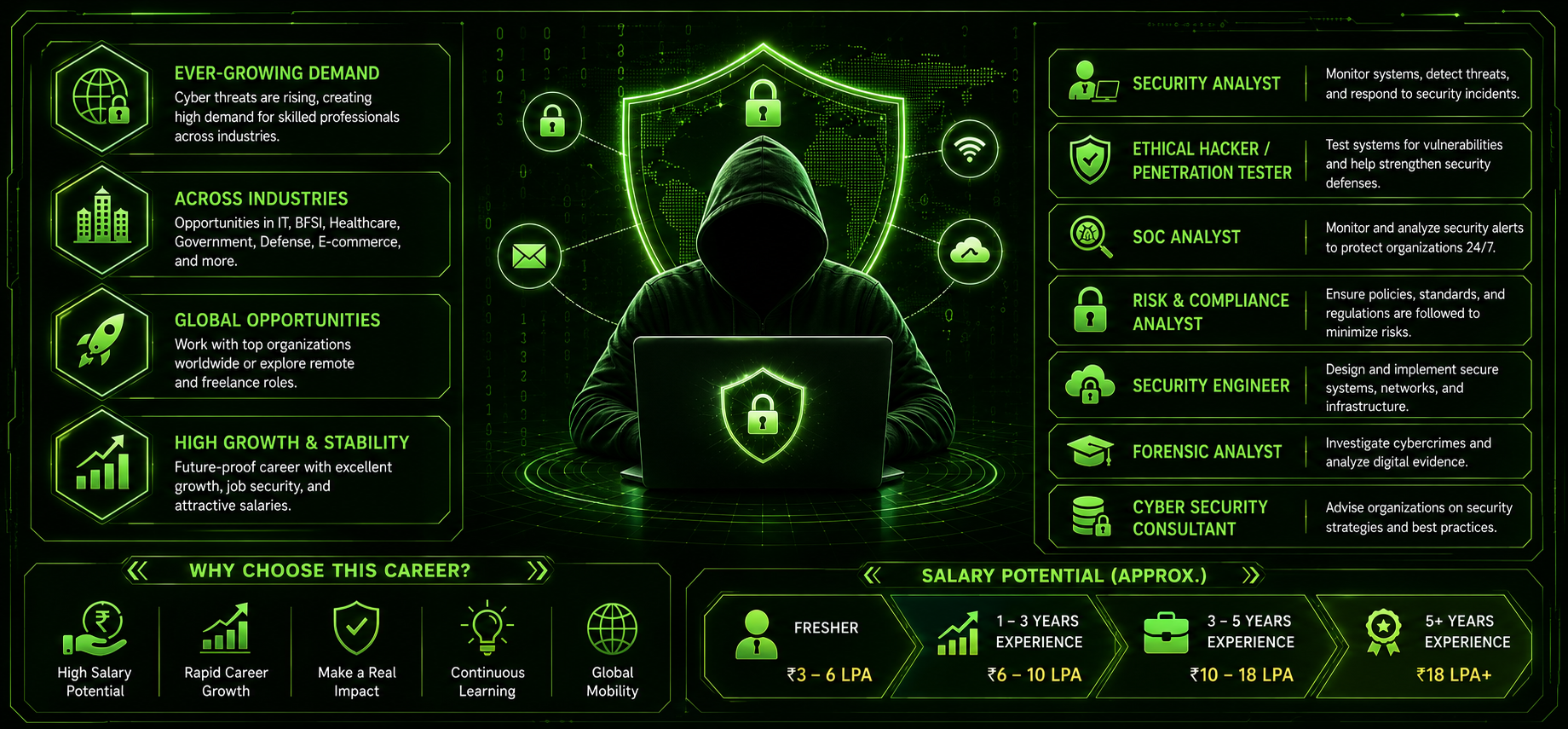
Common roles after a BSc in Cyber Security:
- Security Analyst (SOC – Security Operations Center)
- Junior Penetration Tester
- IT Auditor / Compliance Analyst
- Network Security Administrator
- Cyber Forensics Assistant
Common roles after a BTech in Cyber Security:
- Security Engineer (infrastructure/design-focused)
- Cryptography Engineer
- Application Security Engineer
- Security Software Developer
- Cyber Security Researcher (often a stepping stone to R&D or MTech)
In practice, Indian recruiters — particularly in IT services companies and SOC teams — care less about “BSc vs BTech” on paper and more about demonstrated skills: certifications, capture-the-flag (CTF) competition experience, and a portfolio of documented projects (a home lab, a bug bounty write-up, or a GitHub with security scripts). This is the part most comparison articles leave out: your degree gets you an interview; your lab work and certifications get you the offer.
Explore More Blog: Everything You Need to Know About Cyber Security Courses After 12th
Salary Expectations in India
Entry-level salaries for both degrees typically start in a similar range, since most companies pay based on role and skill, not degree type. As a general guide for the Indian job market:
- Fresher Security Analyst / SOC Analyst: ₹3 – 6 LPA
- Junior Penetration Tester: ₹4 – 7 LPA
- Security Engineer (BTech background, product companies): ₹5 – 9 LPA
- Cyber Forensics / Compliance roles: ₹3.5 – 6 LPA
With 3–5 years of experience and at least one advanced certification (CISSP, OSCP, or CISM), professionals from either educational background commonly cross ₹10–15 LPA in mid-sized cities, and considerably more in metro-based product companies or MNCs. The degree opens the first door; certifications and hands-on experience determine how fast the salary climbs afterward.
Which One Should You Choose? A Decision Framework
Rather than telling you “it depends,” here’s a practical way to decide:
Choose a BSc in Cyber Security if:
- You didn’t take Physics, Chemistry, and Maths in 12th grade, or your PCM scores aren’t competitive for entrance exams.
- You want to start working sooner and value hands-on, tool-based learning over heavy theory.
- Your career goal is analyst, auditor, penetration testing, or SOC-based roles rather than building security systems from the ground up.
- You’re comfortable pairing your degree with industry certifications to strengthen your resume.
Choose a B.Tech in Cyber Security if:
- You have a strong PCM background and enjoy mathematics-heavy problem-solving.
- You’re aiming for roles in secure software engineering, embedded security, or cryptography research.
- You want the option to pursue an MTech or MS abroad later, where an engineering base is often preferred.
- You don’t mind the extra year and higher fee in exchange for a deeper engineering foundation.
Neither path is objectively “better” — they’re built for different starting points and different end goals. The mistake is picking one because it sounds more prestigious rather than because it fits how you learn and where you want to end up.
Choosing a B.Sc in Cyber Security College in Kolkata
If you’re evaluating a B.Sc cyber security college in Kolkata specifically, a few local factors matter beyond the general checklist:
- Lab infrastructure: Kolkata has a growing number of institutes offering cyber security tracks, but not all of them have dedicated penetration-testing labs or licensed tools (like Kali Linux environments, network simulators, or forensic software). Ask to see the lab before enrolling, not just the prospectus.
- Industry connect: Kolkata’s IT and BPO sector, along with a growing number of fintech and SaaS companies in Salt Lake and New Town, actively hires SOC analysts and junior security staff. A college with placement tie-ins to these clusters gives you a real local advantage over a generic national curriculum.
- Faculty with practitioner experience: Look for instructors who have worked in security roles, not only academic backgrounds. A practitioner-led classroom typically covers real incident scenarios that textbooks don’t.
- Certification alignment: Strong Kolkata-based programmes will map their syllabus toward at least one recognised certification (Security+, CEH, or equivalent) so you graduate with more than just a degree certificate.
If you’re comparing institutes in the city, ask direct questions during your campus visit: how many hours per week are lab-based versus lecture-based, which companies visited for placements in the last two years, and whether current final-year students are willing to talk about their experience.
Common Mistakes Students Make
A few patterns show up again and again among students choosing between these two degrees:
Choosing B.Tech purely for the “engineering” label without checking whether they actually enjoy mathematics-heavy coursework is one of the most frequent regrets — students end up struggling through two years of core engineering subjects before reaching the cyber security content they actually wanted to study. On the flip side, some students pick a BSc assuming it’s an “easier” option, then find themselves unprepared for how technical and lab-intensive a genuinely good BSc cyber security programme actually is; the workload is different, not lighter. Another common misstep is ignoring lab quality entirely and choosing a college based on brand name or fee discount alone — a cyber security degree without hands-on lab time produces graduates who can define terms but can’t demonstrate skills in an interview.
Expert Tips Before You Enroll
Before signing up for either programme, request a detailed semester-wise syllabus in writing, not just a marketing brochure — this tells you exactly when practical, tool-based learning starts. Ask current students or alumni about the real placement percentage and average starting salary from the last two batches, rather than relying on advertised “up to” figures. And if possible, sit in on a live lab session before enrolling; a working demonstration reveals more about teaching quality than any prospectus.
Frequently Asked Questions
Is BSc in Cyber Security a good career option in India?
Yes. India’s cyber security workforce demand continues to outpace supply, and a BSc in Cyber Security gives you a faster, more affordable route into entry-level analyst, auditor, and penetration testing roles compared to a four-year engineering path.
Can I do B. Tech Cyber Security without Maths in Class 12?
No, in almost all cases. B.Tech programmes require Physics, Chemistry, and Mathematics (PCM) at the 10+2 level, and most also require a valid entrance exam score such as JEE Main or a state CET.
Which pays more, BSc or BTech in Cyber Security?
Starting salaries are broadly similar for equivalent entry-level roles, since Indian employers pay largely based on skills, certifications, and role rather than degree type alone. Over time, BTech graduates in engineering-heavy roles sometimes see a higher ceiling, but BSc graduates who pair their degree with strong certifications close that gap quickly.
Is a B.Sc in Cyber Security equivalent to a B.Tech for higher studies like MTech?
Not automatically. Most MTech programmes prefer or require a BTech/BE background. BSc graduates wanting to go deeper academically usually pursue an MSc in Cyber Security or Information Security instead, which is a more natural progression.
Do I need to know coding before starting a B.Sc in Cyber Security?
No prior coding experience is required. Most BSc cyber security programmes start with programming fundamentals in the first semester, assuming no prior background, though basic computer literacy helps you keep pace.
How is cyber security training different from a formal degree?
Cyber security training (short courses, bootcamps, or certifications) focuses narrowly on specific tools or skills over weeks or months, while a full BSc or BTech degree builds broader theoretical foundations alongside practical training over three to four years. Most serious professionals eventually combine both — a degree for foundation, targeted training for specialization.
Conclusion
Choosing between a B.Sc in Cyber Security and a B.Tech in Cyber Security really comes down to two honest questions: what does your academic background allow, and what kind of work do you actually want to do five years from now? If you want to move fast, work hands-on, and step into analyst or testing roles without a heavy engineering detour, the BSc route is built for exactly that. If you’re mathematically inclined and want to eventually design secure systems or move into research, the BTech path gives you that deeper foundation, at the cost of an extra year and higher fees.

Farhat Jabeen is passionate about documenting the student enrollment journey in the fields of technology, design, and digital media. Through her writing, she shares practical guidance, industry insights, and real-world learning experiences that help aspiring students confidently navigate their path toward creative and technology-driven careers. Her goal is to empower learners with the knowledge they need to choose the right educational journey.