Every time you watch a superhero fly across a burning city, a dragon soar over a medieval castle, or a historical epic recreate an ancient empire, you are watching the work of visual effects artists. Visual effects (VFX) have become the backbone of modern entertainment, powering films, web series, advertisements, video games, and even virtual reality experiences.
If you have just completed your 12th and love art, technology, or storytelling, VFX could be a rewarding career path. It rewards creativity, technical skill, and patience, and it does not require a traditional engineering or medical background. This guide walks you through the best VFX courses after 12th, what each involves, the skills you will build, and how to choose the right program for your future.
Why Choose a Career in VFX?
India’s media and entertainment industry has grown rapidly, and VFX is one of its fastest-growing segments. Bollywood, regional cinema, OTT platforms, and international studios outsourcing work to India have created steady demand for trained artists. Here is why students are increasingly drawn to this field:
- Growing demand: Streaming platforms produce more content than ever, and almost all of it involves some level of visual effects.
- Diverse career options: You can work in films, television, gaming, advertising, architecture visualization, and augmented and virtual reality.
- Creative satisfaction: Your work becomes part of stories seen by millions.
- Global opportunities: VFX is a global industry, and skilled artists can work with studios abroad or freelance for international clients.
- Attractive earning potential: With experience and a strong portfolio, VFX professionals can earn competitive salaries.
Who Should Consider a VFX Course?
You do not need to be a professional artist before you begin. However, you will do well if you have:
- A love for movies, animation, and storytelling
- Basic drawing or design sense (helpful, not mandatory)
- Comfort with computers and software
- Patience for detailed, time-consuming work
- Curiosity about how visual magic is created
Students from any stream, whether science, commerce, or arts, can generally enter the VFX field after 12th, though eligibility varies by institution.
Types of VFX Courses After 12th
Before choosing, it helps to understand the levels of training available. Broadly, options fall into four categories.
1. Certificate Courses (3 to 6 Months)
These short programs introduce beginners to the basics of software and concepts such as compositing, editing, and simple animation. They suit students who want to test their interest before committing to a longer program, or who want to build a base alongside other studies.
Best for: Beginners exploring the field.
2. Diploma Courses (1 Year)
Diploma programs go deeper than certificates. They typically cover the core VFX pipeline, including modeling, texturing, lighting, rotoscopy, matchmoving, and compositing, and teach industry-standard software.
Best for: Students who want faster entry into the industry with practical, software-focused training.
3. Advanced Diploma or PG-Level Programs (1.5 to 2 Years)
These offer specialization in areas such as 3D animation, compositing, or FX simulation, and often include portfolio building and studio-style projects.
Best for: Students who want detailed technical training without a full degree.
4. Bachelor’s Degree Programs (3 Years)
Degree programs combine technical training with academic learning in cinema, design, and media. They are ideal if you want a recognized qualification along with practical skills.
Best for: Students seeking a well-rounded education and broader career flexibility, including higher studies.
Best VFX Courses to Pursue After 12th
Let’s look at the top options in detail.
1. BSc VFX in Filmmaking
Among degree options, BSc VFX in filmmaking stands out for students who want to combine visual effects with the larger art of cinema. This three-year undergraduate program typically blends technical VFX training with filmmaking fundamentals such as screenwriting, cinematography, editing, sound, and direction.
What you will learn:
- Fundamentals of filmmaking and visual storytelling
- 2D and 3D animation basics
- Digital compositing and green screen techniques
- Rotoscopy, matchmoving, and camera tracking
- Modeling, texturing, lighting, and rendering
- Editing and post-production workflows
- Portfolio and showreel development
Why it is valuable: Understanding how a film is made from concept to screen makes you a better VFX artist. A BSc VFX in filmmaking helps you think like a filmmaker, not just a software operator. You learn how a shot is planned on set, which makes it easier to plan and execute effects during post-production. The degree also keeps doors open for postgraduate study.
Career options after this degree: VFX artist, compositor, rotoscopy artist, matchmove artist, FX artist, video editor, assistant director, or filmmaker.
2. Diploma in VFX and Compositing
This focused program is ideal if you want to become a compositor, the artist who combines live-action footage, CGI, and other elements into one seamless shot. You will work heavily with node-based and layer-based compositing tools and learn color matching, keying, and cleanup.
Best for: Students who love the finishing touch, attention to detail, and problem-solving.
3. Diploma or Degree in 3D Animation and VFX
This route emphasizes modeling, rigging, animation, and simulation. It is perfect for students who want to create characters, creatures, environments, and dynamic effects like fire, smoke, water, and destruction.
Best for: Students drawn to gaming, animated films, and high-end visual effects.
4. Certificate Course in Rotoscopy and Paint
Rotoscopy and paint are among the most common entry-level roles in VFX studios. A short specialized certificate can help you land a first job and grow into higher roles over time.
Best for: Students who want quick, practical entry into a studio environment.
5. Bachelor’s in Multimedia, Animation, or Design with VFX Specialization
Some universities offer broader multimedia or animation degrees with VFX as a specialization. These are useful if you want flexibility across animation, graphic design, and media production.
Best for: Students who haven’t decided on a single specialization yet.
Choosing the Right VFX Course in Kolkata
Kolkata has a rich cultural and cinematic heritage. From Satyajit Ray’s legendary films to today’s thriving Bengali cinema and Tollywood productions, the city has always valued storytelling. It is also becoming a growing hub for animation and creative education, making it a good place to learn.
If you are searching for a VFX Course in Kolkata, here are the advantages of studying in the city:
- Cinematic environment: Proximity to film studios, production houses, and a strong film culture gives you exposure and networking opportunities.
- Affordable living: Compared to metros like Mumbai or Bangalore, Kolkata often offers a lower cost of living for students.
- Growing creative ecosystem: Advertising agencies, digital media companies, and production units continue to expand in the region.
- Access to festivals and events: Film festivals, exhibitions, and workshops help you learn and connect with industry professionals.
A good VFX Course in Kolkata should offer hands-on training on real projects, not only theory. Whether you choose a degree, diploma, or certificate program, look for practical, studio-style learning that prepares you for real production work.
Key Factors to Consider Before Enrolling
Not all programs are equal, so evaluate them carefully. Ask these questions:
1. Is the curriculum industry-relevant?
The syllabus should cover the entire VFX pipeline and include current software and techniques. Outdated content will leave you behind.
2. Who are the faculty?
Instructors with real industry experience bring practical insight that textbooks cannot offer.
3. What infrastructure is available?
Modern computer labs, high-performance systems, green screen studios, and licensed software make a big difference.
4. Are there project and portfolio opportunities?
In VFX, your showreel matters more than your certificate. Choose a program that helps you create a strong portfolio.
5. What about placement and internship support?
Look at the institute’s connections with studios and its track record in helping students find internships and jobs. Be wary of guaranteed-placement promises, and ask for verifiable details.
6. Is the degree or certificate recognized?
Skills You Need to Succeed in VFX
Technical training is only part of the story. To build an outstanding career, develop these skills alongside your course:
- Visual sense: Study composition, color, lighting, and movement.
- Software proficiency: Learn industry-standard tools thoroughly rather than superficially.
- Problem-solving: Every shot presents new challenges, and solutions come from experimenting.
- Teamwork: VFX is a collaborative pipeline, and clear communication is essential.
- Time management: Studios work to tight deadlines.
- Continuous learning: Technology evolves quickly, from real-time engines to AI-assisted tools, so staying updated is vital.
Career Opportunities After a VFX Course
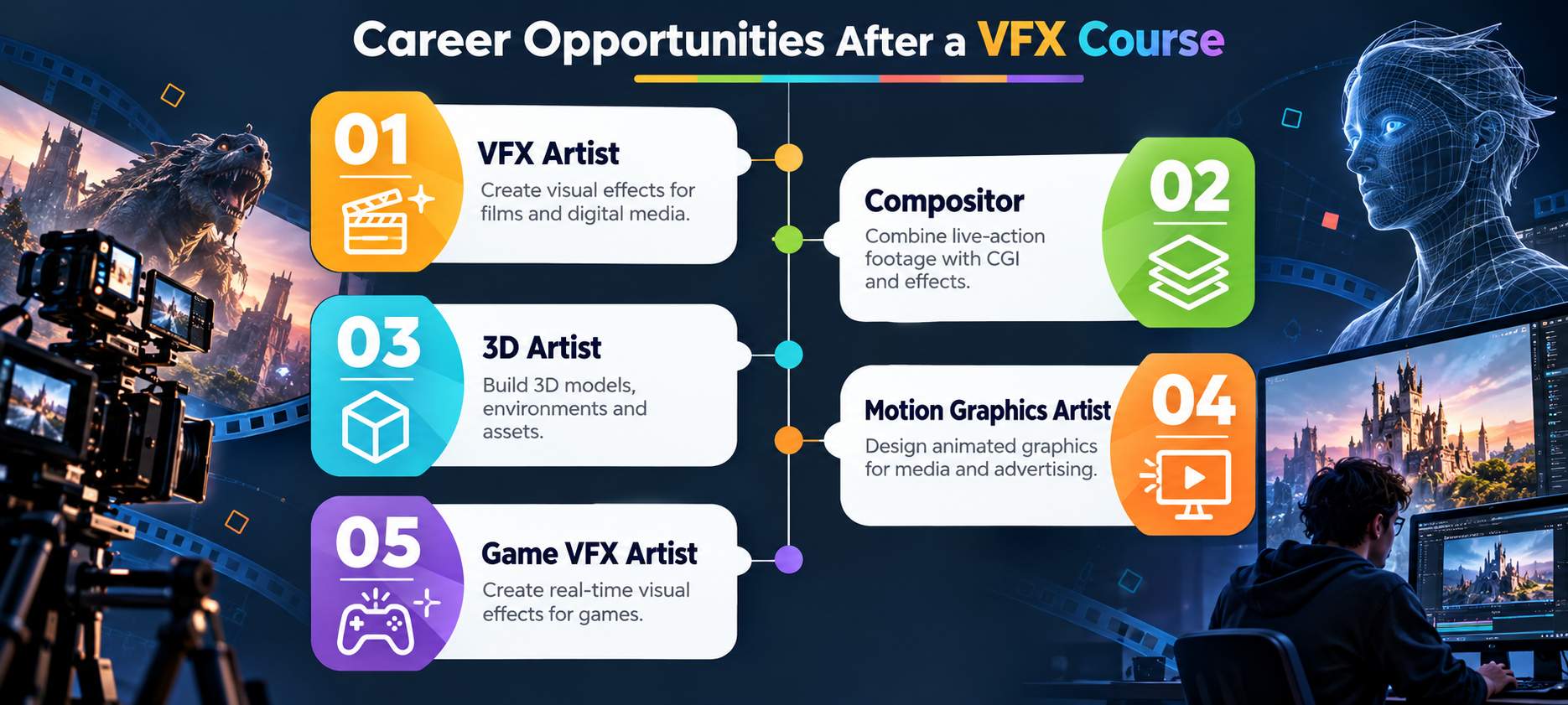
Once you complete your training, a wide range of roles opens up:
- Rotoscopy Artist
- Paint and Cleanup Artist
- Matchmove Artist
- Compositor
- 3D Modeler
- Texture Artist
- Lighting and Rendering Artist
- FX (Effects) Artist
- Animator
- Concept Artist
- Video Editor
- VFX Supervisor (with experience)
Most artists start in entry-level roles such as rotoscopy or paint, then move into specialized positions like compositing or FX as they gain experience. With time, you can grow into lead, supervisor, or even director roles. Many artists also choose freelancing or start their own studios.
Industries That Hire VFX Professionals
- Film and television production
- OTT and web series
- Advertising and marketing agencies
- Game development companies
- Animation studios
- Architecture and real estate visualization
- Virtual reality and augmented reality companies
- Educational and corporate media houses
Tips to Build an Outstanding VFX Career
Start building your showreel early. Even small practice projects show your growth. A polished showreel is your most powerful tool when applying for jobs.
Practice every day. Consistency matters more than occasional marathon sessions.
Learn from breakdowns. Study VFX breakdown videos of films you love to understand how shots are built layer by layer.
Seek internships. Real studio exposure teaches you workflows, deadlines, and professional etiquette.
Network actively. Join online communities, attend workshops and film events, and connect with working professionals.
Stay adaptable. Emerging technologies like virtual production, real-time rendering, and AI tools are reshaping the industry. Artists who adapt will stay ahead.
Final Thoughts
Choosing the right VFX Course after 12th is one of the most important decisions in shaping your creative career. If you want a well-rounded education that combines technical mastery with cinematic understanding, a BSc VFX in filmmaking is an excellent choice. If you prefer faster, skill-focused training, diploma and certificate programs offer a practical entry into the industry. And if you want to study in a city with a deep artistic legacy and growing opportunities, exploring a VFX Course in Kolkata can give you the right mix of culture, affordability, and quality training.
Whichever path you choose, remember that success in VFX depends on passion, practice, and persistence. Research your options carefully, visit campuses if possible, talk to current students, and pick a program that matches your goals. With the right training and dedication, you can turn your love for movies and creativity into a career that brings imagination to life on the big screen.

Pooja Sharma is a creative education content writer who creates engaging articles on career guidance, skill development, and learning opportunities to help students make informed decisions.