If you’ve started researching VFX course fees in Kolkata, you’ve probably noticed something frustrating: every institute quotes a different number, and none of them explain what that number actually includes. One brochure says ₹90,000. Another says ₹3.5 lakh. A university degree page says ₹6 lakh over three years. Are these even the same thing?
They’re not. And that’s exactly why so many students end up either overpaying for a program that doesn’t match their goals, or underpaying for one that leaves them undertrained when they walk into a studio interview.
This guide breaks down what a VFX course in Kolkata really costs diploma and degree what’s included in that fee, what usually gets left out of the brochure, and how to decide which path fits your budget, timeline, and career goals. It’s written for students aged 18 to 25 in Kolkata who are serious about a career in visual effects, not just casually curious.
What Determines VFX Course Fees in Kolkata
VFX course fees in Kolkata typically range from ₹60,000 for a short-term diploma to ₹4–6 lakh for a full-time degree, depending on course duration, software training depth, faculty experience, and whether the institute offers industry-standard labs and placement support. The exact fee depends less on the city and more on how deep the curriculum goes.
Four factors drive the price difference between institutes more than anything else:
- Course depth — a 6-month compositing crash course will always cost less than a 2-3 year program covering modeling, rigging, simulation, and compositing.
- Software access — licensed tools like Autodesk Maya, Nuke, Houdini, and SideFX require lab investment that gets passed on in fees.
- Faculty and mentorship — institutes staffed by working VFX artists (not just trainers reading slides) usually charge more, and it’s often worth it.
- Placement infrastructure — career support, showreel reviews, and studio tie-ups add cost but also add real value if you’re looking for a job after the course.
Kolkata sits in a middle band nationally. It’s more affordable than Mumbai or Bangalore, where studio-adjacent institutes charge a premium, but the quality gap between the cheapest and most rigorous programs in the city is still wide. That gap is exactly what this guide helps you navigate.
Diploma vs Degree in VFX: The Real Difference
Before comparing fees, it helps to know what you’re actually paying for.
A VFX diploma is a focused, skill-based program, usually 6 months to 2 years long, built to get you job-ready in specific tools and roles — compositing, rotoscoping, matte painting, or VFX for film and OTT. A VFX degree (such as a B.Sc. in Animation & VFX) is a 3-year academic program that combines VFX training with general education requirements, theory courses, and a broader curriculum.
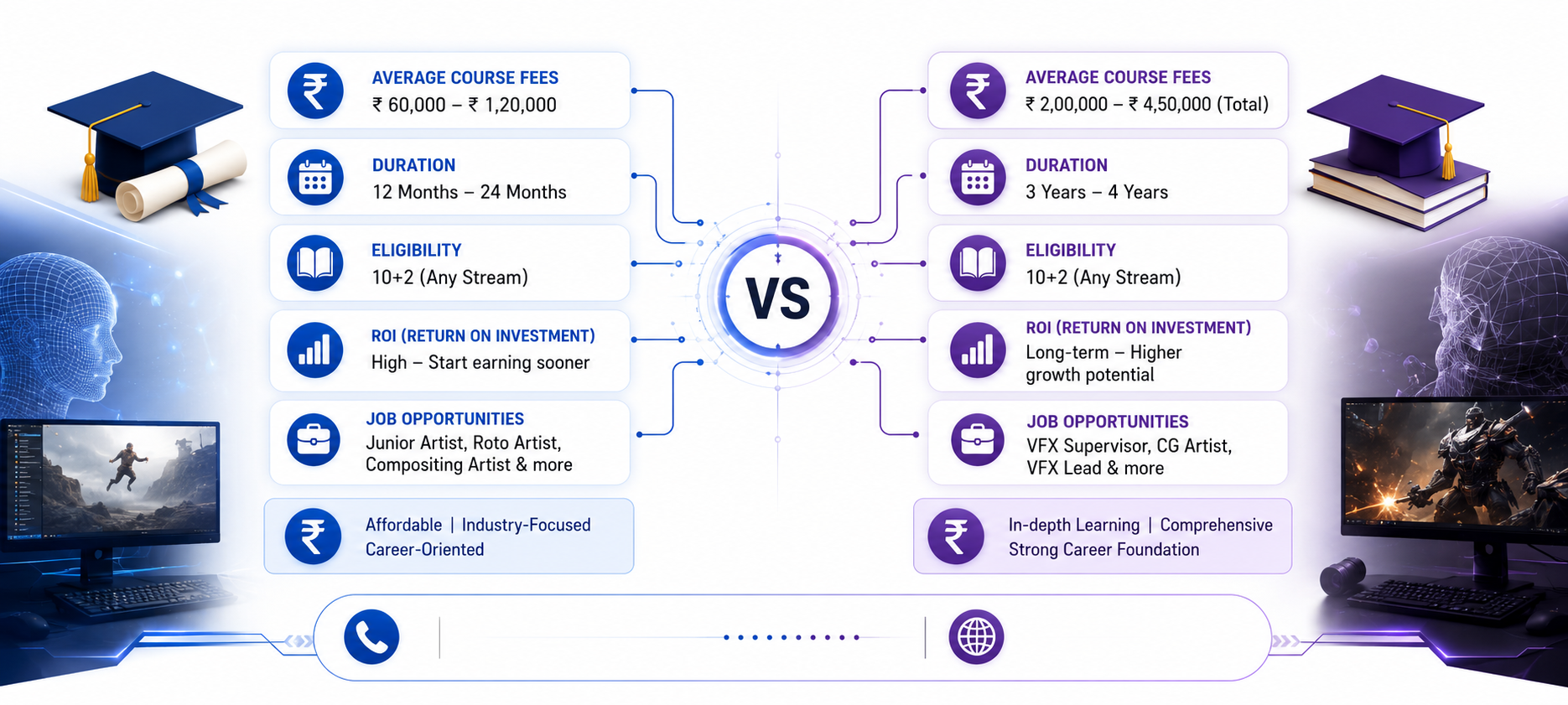
Here’s the difference in plain terms:
- Diploma: Faster, more affordable, narrowly focused on production skills, ideal if you already know VFX is your career.
- Degree: Longer, costlier, includes general academic subjects, useful if you want a formal degree certificate for eligibility in government jobs, higher studies abroad, or corporate HR filters that ask for a bachelor’s degree.
Neither is objectively “better.” A senior compositor at a Mumbai studio told one of our mentors that showreels get you hired — degrees get you shortlisted. Both matter, but for different reasons.
VFX Diploma Course Fees in Kolkata
Diploma programs in Kolkata generally fall into three tiers:
- Short certificate courses (3-6 months): ₹15,000 to ₹60,000. These cover a single tool or skill, like basic compositing in Nuke or rotoscoping. Good as a starting point, but not sufficient on their own for a full-time VFX career.
- Standard diploma (6-12 months): ₹55,000 to ₹2,00,000. Covers multiple VFX disciplines — 3D modeling, texturing, lighting, compositing, with a portfolio-building component.
- Advanced diploma (12-24 months): ₹1,50,000 to ₹4,00,000. Goes deeper into simulation, dynamics, and full production pipelines, often including a mentored final project meant to become your showreel.
Most students aiming for an actual VFX job, not just a hobby skill, should budget for the standard-to-advanced diploma tier. The 3-6 month certificate route is useful only if you’re testing interest before committing further, or if you’re adding a specific skill to an existing portfolio.
VFX Degree Course Fees in Kolkata
A full-time B.Sc. in Animation & VFX or equivalent degree in Kolkata generally costs between ₹2 lakh and ₹6 lakh for the complete 3-year program, paid annually or semester-wise. Postgraduate diplomas and M.Sc. programs in VFX or Game Design typically run ₹2 lakh to ₹4 lakh for two years.
Degree fees are usually structured as:
- An admission/registration deposit (₹15,000-₹30,000)
- Annual or semester tuition installments
- Separate charges for convocation, library, and university affiliation, if the degree is awarded through a partner university
One thing worth knowing before you commit: degree programs spend a meaningful chunk of their timetable on general education subjects unrelated to VFX production. That’s not a flaw — it’s the nature of a degree — but it does mean the “VFX-specific training hours per rupee spent” is usually lower than a well-designed diploma.
Diploma vs Degree Fee Comparison Table
| Factor | VFX Diploma | VFX Degree |
| Typical fee range | ₹55,000 – ₹4,00,000 | ₹2,00,000 – ₹6,00,000 |
| Duration | 6 months – 2 years | 3 years |
| Focus | Production skills, tool mastery | Academic + production skills |
| Best for | Fast entry into studio jobs | Formal qualification, further studies |
| Placement readiness | High, if portfolio-focused | Moderate, varies by university |
| Flexibility to switch specialization | High | Lower once enrolled |
| Recognized for govt/PSU eligibility | Rarely | Usually yes |
| Cost per month of VFX-specific training | Generally lower | Generally higher |
Use this table as a starting filter, not a final answer — the right choice still depends on your career goal, which we cover next.
What’s Actually Included in VFX Course Fees
A fee quote is only useful if you know what it buys. Ask every institute you shortlist to break down whether the quoted fee includes:
- Software licenses (many institutes use lab-installed licenses; some expect you to buy your own)
- Lab and hardware access hours outside class time
- Study material, project briefs, and reference assets
- Portfolio or showreel mentorship
- Placement assistance and interview preparation
- Certification and exam fees
Two institutes quoting similar headline fees can offer very different value once you check this list. A ₹1.5 lakh diploma with unlimited lab access and dedicated portfolio mentorship is often better value than a ₹1.2 lakh diploma that only includes classroom hours.
Diploma or Degree: Which Should You Choose?
If your goal is to start working as soon as possible
A diploma is usually the faster, more cost-efficient route. Studios hiring junior compositors, roto/paint artists, or 3D generalists care primarily about your showreel and tool proficiency. A focused 12-18 month diploma with a strong final project can get you interview-ready faster than a 3-year degree, at a fraction of the cost.
If you want a formal degree for broader eligibility
If you’re weighing options such as government exams, further studies abroad, or corporate roles where HR software filters resumes by “Bachelor’s degree required,” a degree has value beyond VFX skills alone. In that case, the extra cost is buying you a credential, not just training.
If you’re unsure which path fits
Start with a shorter, focused course to confirm VFX is genuinely the right fit before committing three years and several lakh rupees. Many students discover halfway through a general degree that they wish they’d started production work sooner — and many diploma-only students later realize they need a degree for a specific opportunity. Talking to a career counsellor at a training institute before enrolling can save you both money and time.
How to Judge Whether a VFX Institute in Kolkata Is Worth the Fee
Faculty background
Ask directly: have the instructors worked on real productions, or have they only taught? Both can be good teachers, but working artists bring pipeline knowledge of how studios actually operate that textbook-only trainers can’t.
Software and lab access
VFX training without hands-on time on industry-standard software (Maya, Nuke, Houdini, Blender, After Effects) is largely theoretical. Ask how many lab hours you get per week and whether access extends beyond scheduled class time.
Portfolio and showreel support
In VFX hiring, your showreel matters more than your certificate. A good institute treats showreel-building as a core part of the course, not an afterthought in the last two weeks.
Placement track record
Ask for actual placement data — not just “we help with placements,” but which studios, how many students, and what roles. A vague answer is a warning sign.
Batch size
Smaller batches generally mean more individual feedback on your work, which matters enormously in a skill-based field like VFX where technique improves through correction, not just instruction.
Common Mistakes When Comparing VFX Course Fees
The biggest mistake students make is comparing headline fees without comparing hours of hands-on training, software depth, or placement support behind those numbers. A cheaper course that teaches less isn’t actually cheaper — it just shifts the cost forward to a longer, harder job search.
Other frequent mistakes:
- Choosing a course purely because a friend joined it, without checking if it matches your specific interest (VFX has distinct paths — compositing, 3D, simulation — and not every course covers all of them equally well)
- Ignoring the total cost of ownership (software, hardware, commute) and budgeting only for tuition
- Assuming a degree is automatically “safer” than a diploma, without checking actual industry hiring patterns for entry-level VFX roles
- Not asking about installment flexibility, which matters if your family is funding the course in stages
Expert Tips to Get the Best Value for Your Money
Sit in on a trial class or lab session before paying the full fee. If the institute allows it, this tells you more about teaching quality than any brochure. Ask to see recent student showreels, not just the institute’s own promotional reel; a genuine student portfolio shows you what someone at your starting point can realistically achieve. And where possible, negotiate a fee structure with milestone-based installments rather than paying everything upfront, so your payment is tied to your continued satisfaction with the training.
Explore More Blog: Best VFX Institute in Kolkata
FAQs
1. What is the average VFX course fee in Kolkata?
Most VFX diploma courses in Kolkata range from ₹55,000 to ₹4,00,000 depending on duration and depth, while full degree programs typically cost ₹2,00,000 to ₹6,00,000 over three years.
2. Is a VFX diploma enough to get a job in a studio?
Yes, for many entry-level roles like junior compositor, roto/paint artist, or 3D generalist, studios prioritize showreel quality and tool proficiency over the type of certificate you hold. A well-structured diploma with strong portfolio mentorship is often sufficient.
3. Which is more affordable — a VFX diploma or a VFX degree?
A diploma is almost always more affordable in total cost and faster to complete, since it skips general academic subjects and focuses entirely on production skills.
4. Do VFX institutes in Kolkata offer installment payment options?
Most reputable institutes do offer semester-wise or milestone-based installment plans. Always confirm this in writing before enrolling, since policies vary by institute.
5. What additional costs should I budget for besides the course fee?
Budget an extra ₹10,000 to ₹50,000 for registration, software access beyond the lab, study material, exam fees, and possibly a capable personal laptop if you plan to practice outside class hours.
6. Can I switch from a diploma to a degree program later?
Some institutes allow credit transfer or lateral entry into degree programs after completing a related diploma, but this depends on the specific university affiliation. Confirm this option before enrolling if it matters to your long-term plan.
Conclusion
The real question behind VFX course fees in Kolkata isn’t which number is lowest — it’s which program actually prepares you for the career you want, at a cost your family can sustain without financial strain. A diploma gets you into the industry faster and cheaper if you’re focused on production skills. A degree costs more and takes longer, but adds a formal credential that opens certain doors a diploma can’t.
Whichever path you’re leaning toward, insist on a full fee breakdown in writing, ask hard questions about faculty and placement track record, and judge the course by the hours of real, hands-on training it gives you — not just the headline price.
Ready to Compare VFX Course Options in Kolkata?
At Moople Institute, we train students in industry-standard VFX, animation, and design tools with mentorship from experienced professionals, dedicated lab access, and portfolio-focused project work built for the way studios actually hire. If you’re weighing a diploma against a degree, our counsellors can walk you through a fee breakdown built around your specific goals — no vague brochures, no hidden charges.
We’ve helped Kolkata students build showreels that got them noticed by studios, not just certificates that sat in a drawer. Book a free counselling session and see exactly what your VFX training path could look like.

Farhat Jabeen is passionate about documenting the student enrollment journey in the fields of technology, design, and digital media. Through her writing, she shares practical guidance, industry insights, and real-world learning experiences that help aspiring students confidently navigate their path toward creative and technology-driven careers. Her goal is to empower learners with the knowledge they need to choose the right educational journey.