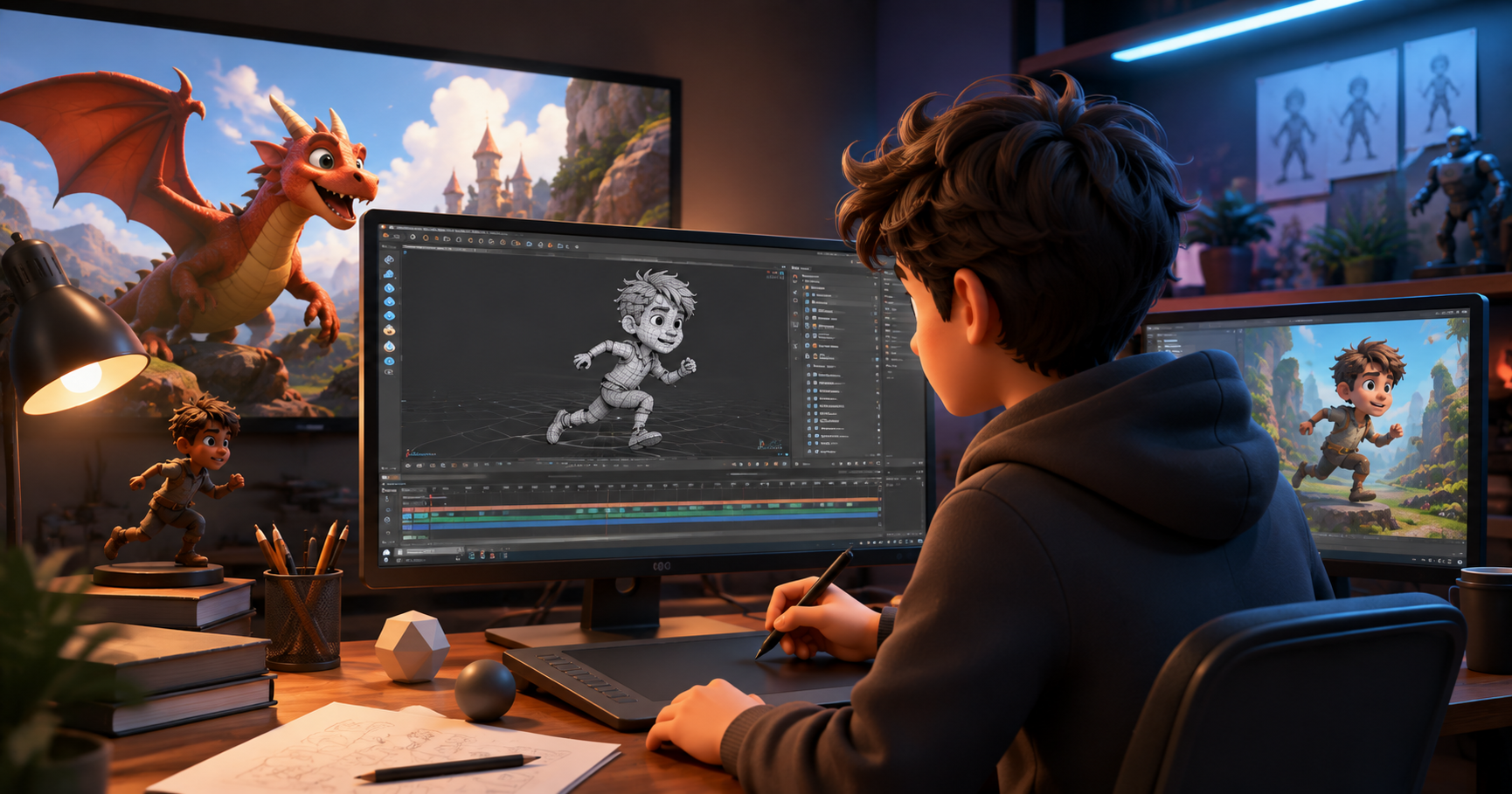
We’ve heard of animation. But do you know what 3D animation is? It is the art of moving images in a virtual environment. If you like animation, you can take anything to the virtual environment. You can turn anything, from easy drawings to challenging animations, into a 3D model. With the help of 3D animation, you can bring any idea, story, or character to life. Though the basics of 3D animation are simple, the skills required to make it happen can be complex.
In this blog, you will get to learn about the core 3D animation features that will take you from an amateur to a professional. Plus, this discipline uses different software and tools to transform ideas seamlessly into life.
What is 3D Animation?
You may know what animation is. But what about 3D animation? It’s the process of making pictures move in a digital space. It lets you bring ideas, stories, and characters to life.
With 3D animation course, you can turn simple sketches or complex designs into models that move and feel real. It’s fun, creative, and full of possibilities.
Main Features of 3D Animation
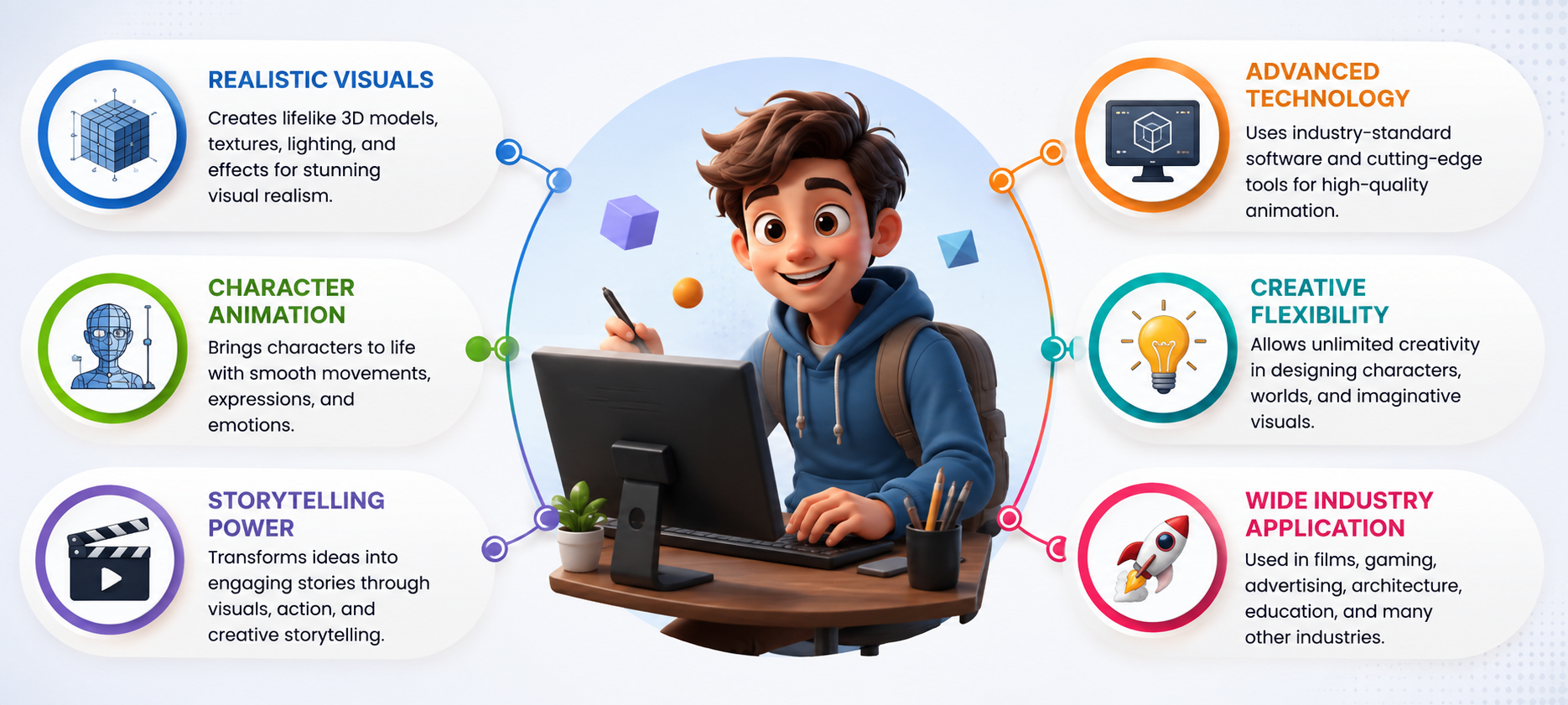
3D animation is a powerful digital technique used to create realistic characters, objects, environments, and visual effects in a three-dimensional space. It is widely used in films, advertising, gaming, television, architecture, and digital media. Some of the main features of 3D animation include:
- Realistic Visuals – 3D animation can create detailed characters, objects, lighting, textures, and environments that look highly realistic.
- Character Animation – Animators can create expressive characters and bring them to life through movement, facial expressions, gestures, and body language.
- 3D Modelling – It allows artists to design and develop three-dimensional objects, characters, buildings, and complete environments.
- Lighting and Rendering – Advanced lighting and rendering techniques add depth, shadows, reflections, and realistic visual quality to animated scenes.
- Visual Effects – 3D animation can be combined with VFX to create complex effects such as explosions, fire, water, smoke, fantasy environments, and other cinematic elements.
- Motion and Simulation – Animators can simulate realistic movements, physics, cloth, hair, particles, and other natural effects.
- Creative Flexibility – 3D animation gives artists the freedom to create imaginary worlds, creatures, products, and scenes that may be difficult or impossible to capture in real life.
Learn 3D Animation Through a Professional Course
Students interested in building a career in animation can consider a 3D Animation Course to develop practical skills in modelling, texturing, lighting, rigging, character animation, rendering, and visual effects. A well-structured course provides hands-on training with industry-relevant software and helps students develop a professional portfolio.
For students looking to enter the animation and VFX industry, choosing a 3D Animation Course can be a strong step toward careers such as 3D Animator, 3D Modeller, Character Animator, Lighting Artist, VFX Artist, and 3D Generalist.
Top Tools for 3D Animation
To make amazing 3D animations, you’ll need to use some key tools. These help bring your ideas to life:
- Photoshop
- After Effects
- Autodesk Maya
- Unreal Engine
- Substance
- ZBrush
Applications of 3D Animation
3D animation is used across many industries. Some popular applications include:
- Movie production
- Video games
- Business presentations
- Architectural visualizations
- Commercials
- Prototypes
- Government training
- Scientific research
- Live shows
Why Learn at Moople Institute
Choosing the right institute can make a major difference when building a career in 3D animation. Moople Institute focuses on practical, industry-oriented learning that combines creative concepts with professional tools and technologies.
- Industry-seasoned faculty: Learn from experienced professionals with animation-industry expertise.
- AI-integrated curriculum: Gain exposure to AI-powered tools alongside traditional 3D animation workflows.
- Industry-standard software: Develop practical skills using tools such as Maya, Photoshop, Arnold, After Effects and Unreal Engine.
- Practical learning approach: Work through different stages of the animation pipeline, from modelling and texturing to rigging, animation, lighting and rendering.
- Portfolio & showreel support: Build professional work that can help showcase your skills to potential employers or clients.
- Career and placement guidance: Moople highlights dedicated placement guidance and employability-focused training as part of its approach.
Explore More Blog: Top Career Opportunities After Learning Advanced 3D Animation
Conclusion
A 3D Animation – 0 to Pro Course can be a strong starting point for students and creative professionals who want to turn their interest in animation into practical career skills. From modelling and texturing to character animation, lighting, rendering, and showreel creation, a structured learning path helps you develop both technical knowledge and creative confidence.
With its industry-oriented curriculum, experienced faculty, AI-integrated learning, and focus on practical projects, Moople Institute provides a career-focused environment for aspiring 3D artists and animators.
If your goal is to build professional 3D animation skills and create a portfolio that represents your abilities, starting with the right training can be an important step toward your creative career.
FAQs
1. What is a 3D Animation – 0 to Pro Course?
A 3D Animation – 0 to Pro Course is designed to take learners from the fundamentals of 3D design to professional-level animation skills. Students can learn areas such as 3D modelling, texturing, rigging, lighting, rendering, character animation, body mechanics, and visual storytelling. Moople’s Advanced 3D Animation & AI curriculum covers the workflow from 3D pipeline and modelling to animation, lighting, rendering, Unreal Engine assets, and showreel development.
2. Is a 3D Animation course suitable for beginners?
Yes. A well-structured 3D Animation course can start with fundamental concepts and gradually progress toward advanced techniques. Prior professional animation experience is not essential when the course provides practical, step-by-step training. Moople’s animation programs are designed for learners at different skill levels.
3. What software is taught in a 3D Animation course?
Depending on the curriculum, students may work with professional tools such as Autodesk Maya, Photoshop, Arnold, After Effects, Unreal Engine, and AI-powered creative tools. Moople’s current Advanced 3D Animation & AI curriculum incorporates several of these industry-oriented tools and technologies.
4. What career opportunities are available after a 3D Animation course?
After developing strong technical and creative skills, learners can explore roles such as 3D Animator, Character Animator, 3D Modeler, Lighting Artist, Rigging Artist, Texturing Artist, Game Animator, and Environment Artist. 3D animation skills can be applied across film and television, gaming, advertising, architecture, AR/VR, and other digital-content industries.
5. Does a 3D Animation course include portfolio and career preparation?
A career-focused course should help students turn their skills into demonstrable work. Moople’s Advanced 3D Animation & AI curriculum includes resume and interview preparation as well as showreel development, helping students present their abilities professionally.

Pooja Sharma is a creative education content writer who creates engaging articles on career guidance, skill development, and learning opportunities to help students make informed decisions.