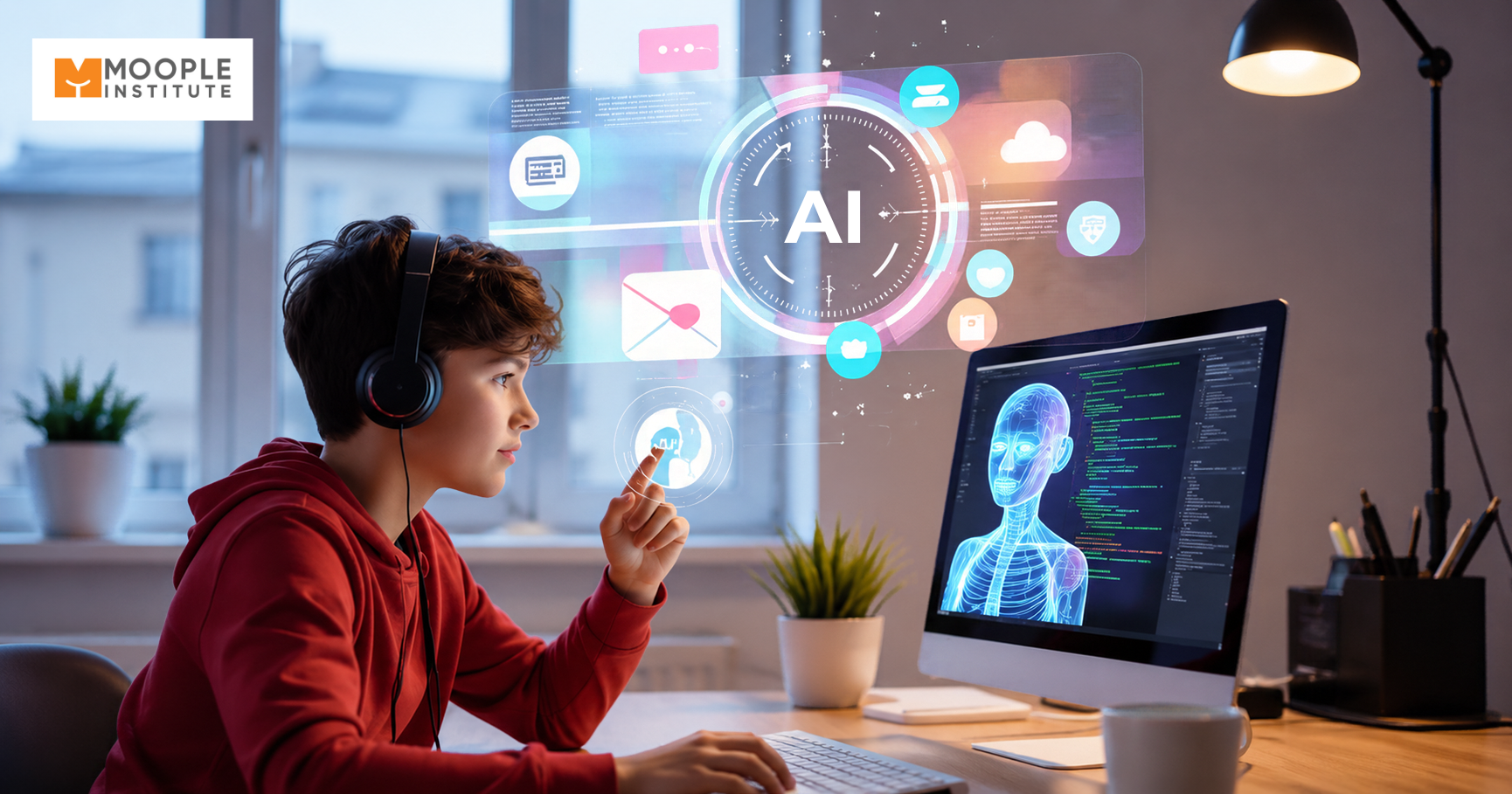
If you have spent any time on animation forums or YouTube tutorials in the last two years, you have probably seen the same debate repeating itself: is AI going to replace animators? The honest answer, based on how studios and freelancers are actually using these tools today, is no — but it is changing what a well-trained animator’s day looks like. AI is quietly taking over the repetitive, time-consuming parts of animation work, and that is freeing up artists to focus on the parts that actually need a human eye: timing, emotion, storytelling, and style.
This shift matters just as much for someone learning animation for the first time as it does for a working professional. If you are researching an animation course in Kolkata or anywhere else, understanding how AI fits into a modern animator’s toolkit will help you pick a program that actually prepares you for the industry, not just the software of five years ago.
In this article, we will walk through exactly where AI is being used in animation pipelines today, what it can and cannot do, what mistakes beginners make when relying on it too early, and how a structured animation diploma course in Kolkata — like the one at Moople Institute — teaches you to use these tools as an advantage rather than a crutch.
Table of Contents
- What “AI in Animation” Actually Means
- Where AI Tools Are Genuinely Speeding Up Animation Work
- Where AI Still Falls Short
- AI Tools vs Traditional Animation Skills: A Quick Comparison
- Common Mistakes Beginners Make With AI in Animation
- Why Formal Animation Training Matters More, Not Less
- What a Modern Animation Course Should Teach You
- Animation Course After 12th: Is It the Right Path?
- Animation Training Course Fees: What Affects the Cost
- Why Choose Moople Institute in Kolkata
- FAQs
- Conclusion
What “AI in Animation” Actually Means
AI in animation refers to software tools that use machine learning to automate specific, repetitive production tasks — such as in-betweening, rigging, lip-sync, rotoscoping, and upscaling — while the creative decisions of storytelling, timing, and character performance remain with the human animator.
It is easy to picture “AI animation” as a single button that turns a script into a finished cartoon. In practice, that is not how it works inside real production pipelines. Studios and freelance animators use a collection of separate AI-powered features, each solving one narrow problem. Adobe has built AI-assisted rotoscoping and motion tools directly into After Effects. Toon Boom and other 2D animation software have introduced smarter in-betweening assistance. Motion capture cleanup, which used to take hours of manual keyframe correction, now gets a significant head start from machine learning models trained to smooth out noisy mocap data.
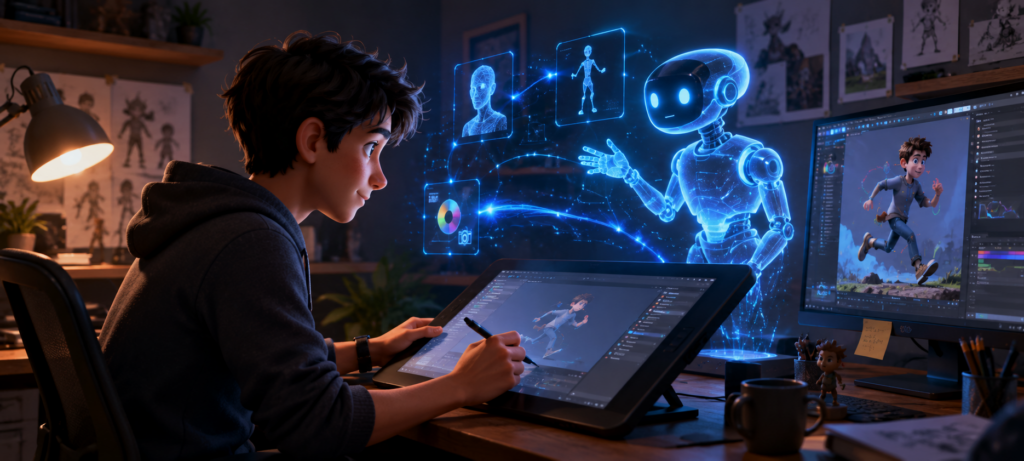
The important distinction is this: these tools speed up execution, not imagination. A machine learning model can generate plausible in-between frames, but it does not know why a character should hesitate before throwing a punch, or how a sad walk cycle should differ from a tired one. That judgment still comes from training, observation, and practice, the exact things an animation training institute is meant to teach.
Where AI Tools Are Genuinely Speeding Up Animation Work
Let’s get specific, because vague claims about “AI changing everything” are not very useful to someone actually trying to learn the craft.
In-Betweening and Tweening Assistance
Traditional 2D animation requires drawing key poses and then filling in the frames between them. AI-assisted tweening tools can now generate a rough first pass of those in-between frames based on the key drawings, which the animator then refines. This does not eliminate the need to understand spacing and timing — it just removes some of the mechanical drawing labor.
Rotoscoping and Background Removal
Rotoscoping — tracing over live footage frame by frame — used to be one of the most tedious jobs in a VFX or animation pipeline. AI-powered masking tools can now isolate a subject from the background in seconds, a task that previously took a trained rotoscope artist hours per shot.
Motion Capture Cleanup
When actors perform in mocap suits, the raw data is often jittery or has tracking errors. Machine learning models trained on large motion datasets can now predict and smooth out these errors far faster than manual keyframe-by-keyframe correction.
Lip-Sync Automation
Matching mouth shapes to dialogue audio is repetitive, technical work. AI lip-sync tools analyze audio waveforms and automatically generate a first pass of mouth shapes, which animators then polish for personality and exaggeration.
Upscaling and Frame Interpolation
For older footage or lower frame-rate animation, AI upscaling tools can increase resolution and generate smoother motion by interpolating additional frames — useful in restoration work and in stretching limited animation budgets.
Style Transfer and Concept Exploration
During pre-production, artists use AI image tools to quickly explore different visual styles or color moods for a project before committing to a final art direction. This is exploratory, not final-output work in most professional pipelines, since AI-generated frames still need heavy manual correction for consistency.
Expert tip: If you are learning animation today, treat every AI tool as a “first draft generator,” not a finisher. The moment you rely on AI output without understanding the underlying principle — like the 12 principles of animation — your work will look technically fast but creatively hollow. Recruiters and studio leads notice this immediately in a portfolio.
Explore More Blog : How AI and Animation Are Creating New Career Opportunities
Where AI Still Falls Short
It is just as important to be honest about the limits, because a lot of the online conversation around AI and animation is either hype or fear, with very little practical nuance.
AI models struggle badly with consistency across frames — a character’s face, proportions, or costume can subtly shift from one AI-generated frame to the next, which is why fully AI-generated animation sequences still look unstable compared to hand-animated or traditionally rigged work. AI also has no real understanding of narrative intent. It cannot decide that a character should pause for two extra frames before a reaction to build comedic timing, because timing decisions come from directorial judgment, not pattern prediction.
There is also a practical production issue: most professional pipelines — including those used by Indian animation and VFX studios working on international projects — still require software fluency in tools like Autodesk Maya, Toon Boom Harmony, Adobe Animate, Blender, and industry-standard compositing software. AI features exist as plugins or add-ons inside these tools, not as replacements for them. So the baseline skill a studio hires for is still traditional animation and software competency, with AI fluency as a valuable add-on.
AI Tools vs Traditional Animation Skills
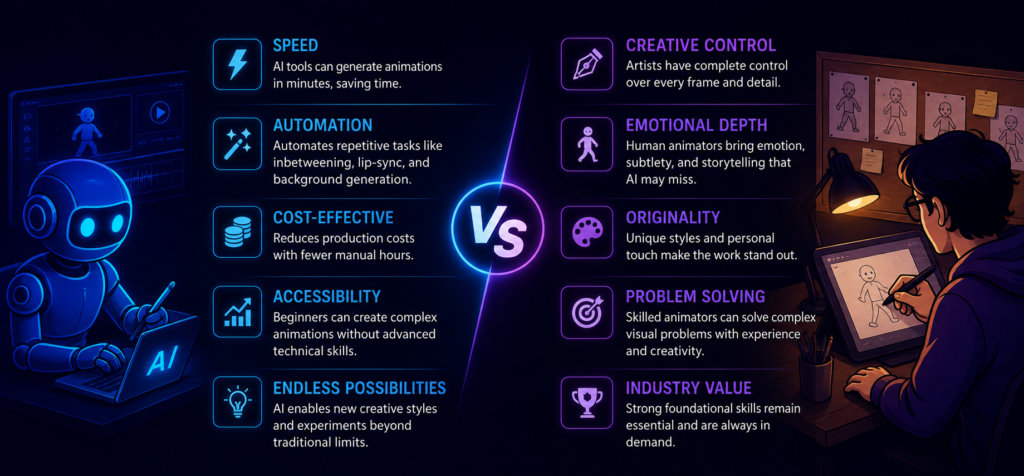
| Task | Handled Well by AI Tools Today | Still Requires Human Animator Skill |
| Rough in-betweening | Yes, as a first draft | Refining spacing and arcs |
| Rotoscoping/masking | Yes, largely automated | Fine edge cleanup on complex motion |
| Mocap data cleanup | Yes, faster smoothing | Adding performance nuance |
| Lip-sync first pass | Yes, audio-driven | Exaggeration, personality, emotion |
| Character rigging | Partial (auto-rigging tools) | Custom rigs for stylized characters |
| Storyboarding & story beats | No, weak at narrative logic | Full creative control |
| Final compositing & polish | No, inconsistent output | Full manual control |
| Client revisions & direction | No | Full human judgment |
Common Mistakes Beginners Make With AI in Animation
Students who are new to animation, especially those exploring an animation course after 12th, often fall into a few predictable traps once they discover AI tools:
- Skipping fundamentals: Jumping straight to AI-assisted workflows without learning timing, spacing, squash and stretch, and anticipation. This shows up immediately in a portfolio as technically fast but visually stiff work.
- Treating AI output as final: Submitting raw AI-generated in-betweens or lip-sync without manual polish, which studios can spot instantly.
- Over-relying on one tool: Learning a single AI plugin instead of understanding the software ecosystem — Maya, Blender, Toon Boom, After Effects — that most Kolkata and India-based studios actually use.
- Ignoring traditional drawing skills: Especially in 2D and character animation, where a strong grasp of anatomy and gesture drawing still separates good animators from average ones, regardless of software.
Why Formal Animation Training Matters More, Not Less
Here is the part that often gets missed in “AI will replace animators” articles: as AI absorbs the repetitive, low-skill tasks, the value of animators who understand storytelling, timing, and direction actually goes up, not down. Studios do not need more people who can push a button. They need people who can direct the output of AI-assisted tools toward something that feels intentional and emotionally convincing.
This is exactly why a structured animation training institute matters more in 2026 than it did a decade ago. Self-teaching from scattered YouTube tutorials might get you familiar with software buttons, but it rarely builds the disciplined understanding of animation principles, industry pipeline knowledge, and portfolio-building strategy that a classroom, mentorship, and structured curriculum provide. A good animation diploma course in Kolkata should be teaching both — the timeless fundamentals and the current AI-assisted tools that professionals are actually using on the job.
What a Modern Animation Course Should Teach You
If you are comparing animation colleges in Kolkata or animation training institutes anywhere in India, here is a practical checklist of what a genuinely future-ready curriculum should cover:
- Core animation principles — timing, spacing, weight, squash and stretch, anticipation, and follow-through, taught through hands-on practice, not just theory.
- Industry-standard software — Adobe After Effects, Adobe Animate, Autodesk Maya, Toon Boom Harmony, and Blender, since these remain the backbone of most studio pipelines.
- 2D and 3D animation workflows — so you understand both hand-drawn and CG pipelines, since many studios use hybrid workflows.
- AI-assisted tools as a supplement — understanding tools for rotoscoping, mocap cleanup, and rendering acceleration so you graduate familiar with current studio practices.
- Storyboarding and pre-production skills — because concept and story remain fully human-driven and are the hardest thing for AI to replicate.
- Portfolio and showreel development — the single most important asset when applying for internships or jobs in animation and VFX studios.
- Live projects and industry exposure — working on briefs similar to real client work, ideally with mentorship from working professionals.
Expert tip: When evaluating any animation course, ask directly whether the syllabus has been updated in the last 12–18 months to reflect current software and AI-assisted workflows. Animation software and tools change fast, and an outdated syllabus is one of the most common — and least visible — problems with older training institutes.
Animation Course After 12th: Is It the Right Path?
For students finishing Class 12, animation is one of the more practical creative careers to pursue directly, without necessarily needing a traditional degree first. Unlike many creative fields, animation and VFX hiring in India is skills-and-portfolio driven — studios generally care more about what you can demonstrate in a showreel than which university name is on your certificate.
That said, an animation course after 12th works best when it is structured, not casual. A diploma-style program that runs for 12 to 24 months, with dedicated software training, live projects, and portfolio mentorship, tends to produce far more job-ready graduates than a loose collection of online tutorials. Students coming from a Science, Commerce, or Arts background in Class 12 can all pursue animation successfully — the field does not require a specific stream, though a habit of sketching or basic design interest is a genuine advantage.
Animation Training Course Fees: What Affects the Cost
Animation training course fees in India vary widely, generally influenced by a few clear factors:
- Course duration — a 3-month certificate program will cost less than a full diploma spanning 12–24 months.
- Specialization depth — programs covering both 2D and 3D animation, VFX, and compositing typically cost more than a single-skill course.
- Software licensing and lab access — institutes providing hands-on access to industry-standard software (Maya, Toon Boom, Adobe Creative Cloud) factor this into fees.
- Placement and mentorship support — programs with dedicated placement assistance, live client projects, and industry mentorship generally sit at a higher fee bracket than purely instructional courses.
Rather than comparing fees in isolation, it is worth comparing fee-to-outcome value: how much hands-on software time you get, whether you build a real portfolio, and whether the institute has documented placement support. The cheapest course is rarely the best value if it leaves you without a strong showreel or software fluency at the end.
Why Choose Moople Institute in Kolkata
Moople Institute is an animation training institute in Kolkata built specifically for students who want a career-focused path into animation, VFX, graphic design, and web design — not just a casual introduction to software. The animation diploma course at Moople is structured around the same principle covered throughout this article: strong fundamentals first, industry-standard software fluency second, and current AI-assisted workflow awareness layered on top, so graduates are prepared for how studios actually work in 2026, not how they worked a decade ago.
For students in Kolkata weighing multiple animation colleges, a few things are worth confirming directly with any institute you shortlist: how recently the curriculum was updated, how much hands-on lab and software time is included, whether live or client-style projects are part of the course, and what placement or portfolio support is offered after completion. Moople Institute is happy to walk prospective students through exactly this before enrollment, so you know precisely what you are investing in.
FAQs
Is AI going to replace animators?
No. AI tools are automating repetitive, technical tasks like in-betweening, rotoscoping, and mocap cleanup, but they cannot replace human judgment in storytelling, timing, and performance. Studios continue to hire trained animators to direct and refine AI-assisted output.
Do I need to learn AI tools to become an animator?
It helps, but it is not a substitute for core animation skills. Employers still expect strong fundamentals and software fluency; AI tool familiarity is an added advantage, not a replacement skill.
What is the best animation course after 12th in Kolkata?
Look for a diploma-style program covering 2D and 3D animation, industry-standard software (Maya, Toon Boom, Adobe tools), live projects, and portfolio support. Moople Institute in Kolkata offers a structured animation diploma course built around these criteria.
How long does an animation diploma course usually take?
Most animation diploma courses in India run between 12 and 24 months, depending on how many specializations (2D, 3D, VFX, compositing) are covered.
What software do animation training institutes typically teach?
Common software includes Adobe After Effects, Adobe Animate, Autodesk Maya, Toon Boom Harmony, and Blender, alongside AI-assisted plugins for rotoscoping, cleanup, and rendering.
Are animation training course fees worth it compared to free tutorials?
Structured courses offer software access, mentorship, live projects, and portfolio guidance that free tutorials generally cannot replicate consistently. For most beginners, this significantly shortens the time it takes to become job-ready.
Conclusion
AI is genuinely useful for animators — it removes hours of repetitive work from in-betweening, rotoscoping, and mocap cleanup, letting artists spend more time on the creative decisions that actually define good animation. But it has not changed what makes someone hireable in this industry: strong fundamentals, software fluency, and a portfolio that shows real storytelling ability. If anything, AI has raised the bar, because studios now expect animators who can direct and refine AI-assisted output with a trained eye.
If you are exploring an animation course in Kolkata, look for a program that treats AI as one tool among many, not a shortcut around learning the craft properly.
Ready to build a career in animation with training that reflects how studios actually work today? Explore the animation diploma course at Moople Institute in Kolkata — with hands-on software training, live projects, and portfolio mentorship designed to get you job-ready. Visit moople institutte to check course details, fees, and upcoming batch dates, or book a free counselling session with our team.
Visit Us Today :

Farhat Jabeen is passionate about documenting the student enrollment journey in the fields of technology, design, and digital media. Through her writing, she shares practical guidance, industry insights, and real-world learning experiences that help aspiring students confidently navigate their path toward creative and technology-driven careers. Her goal is to empower learners with the knowledge they need to choose the right educational journey.