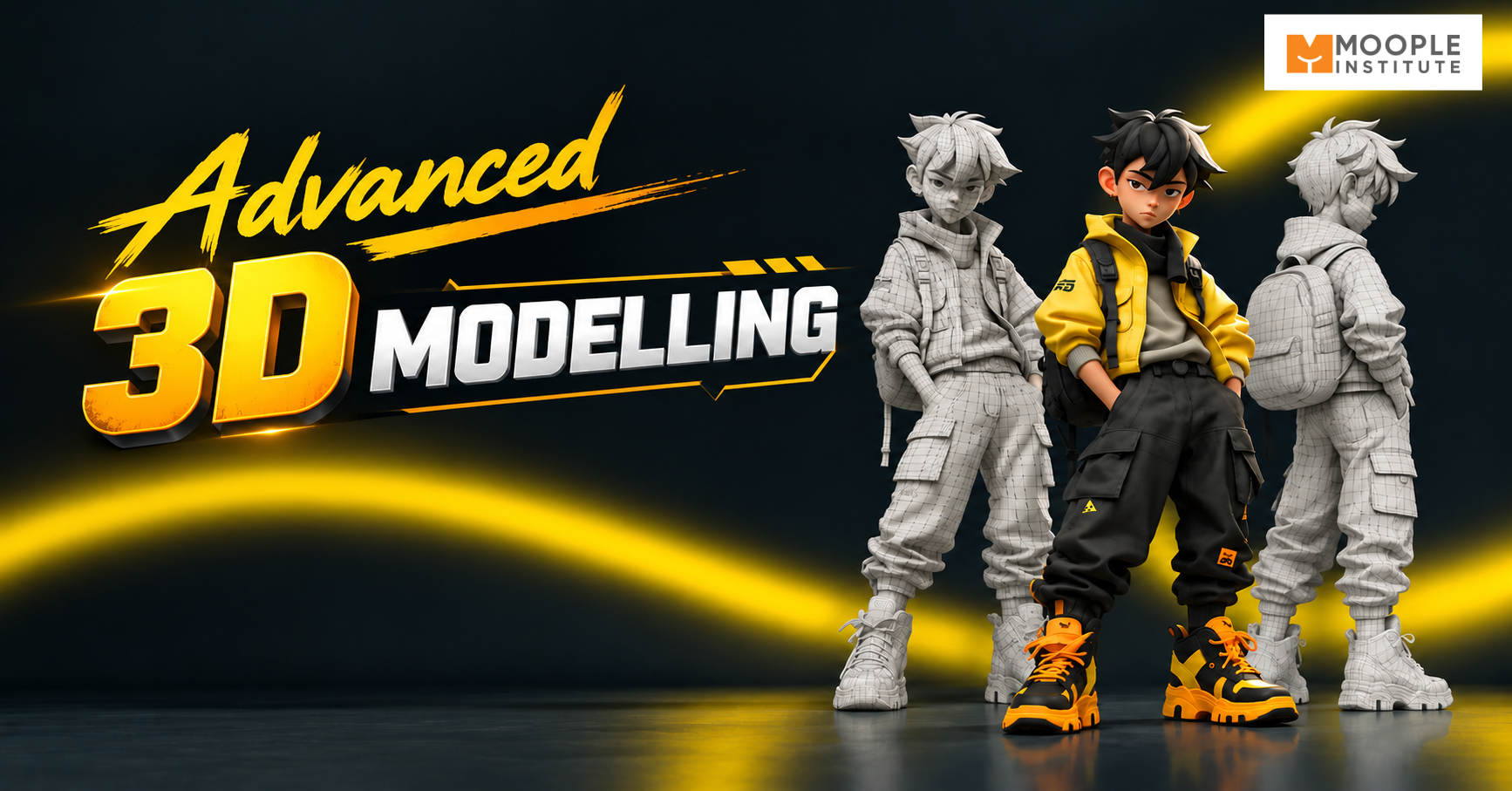
If you have ever paused a movie to stare at a dragon’s scales or a spaceship’s hull, you have already appreciated the work of a 3D modeller. Advanced 3D Modelling is the skill that turns a flat sketch or a director’s idea into a fully three-dimensional asset that can be lit, animated, and rendered for film, television, and games. It sits at the very foundation of the visual effects (VFX) pipeline, and it is one of the few technical art skills where beginners can go from “hobbyist” to “hireable” within a focused training period.
This guide breaks down what advanced 3D modelling actually involves, why studios treat it as a career-defining skill, what an advanced 3D modelling course should teach you, and how to judge whether a 3D modelling course in Kolkata is worth your time and money. We will also cover common student mistakes, the tools professionals actually use in 2026, and realistic career paths—the details most blog posts on this topic skip.
Table of Contents
What Is Advanced 3D Modelling?
Advanced 3D Modelling is the process of building detailed, production-ready three-dimensional assets — characters, creatures, vehicles, props, and environments — using techniques like hard-surface modelling, digital sculpting, retopology, and UV mapping, so the asset is ready for texturing, rigging, and rendering in a professional VFX or animation pipeline.
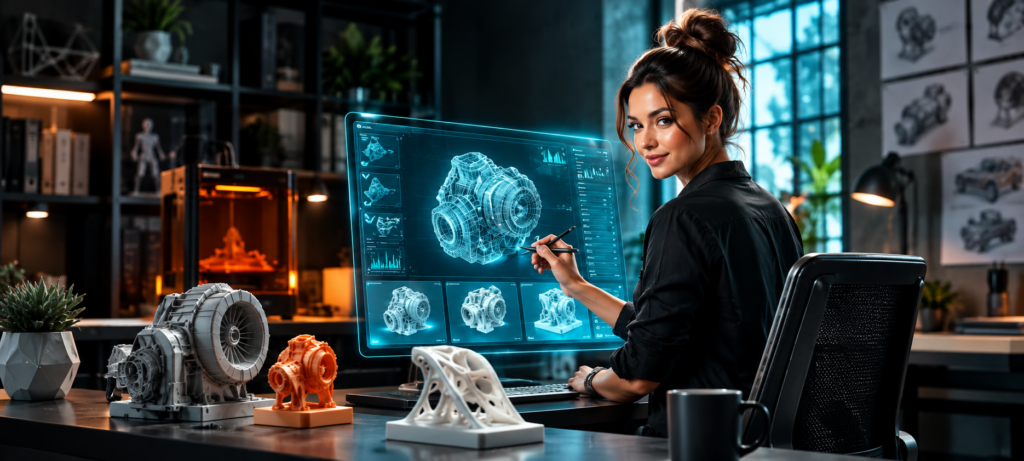
Unlike basic modelling, which focuses on simple shapes and forms, the advanced stage is about precision: clean topology that deforms correctly when animated, surface detail that holds up in close-up shots, and models optimised enough to render without crashing a studio’s render farm.
Where 3D Modelling Sits in the VFX Pipeline
Most people assume VFX is mainly about explosions and compositing. In reality, almost every VFX shot begins with a model. A typical pipeline looks like this:
Concept art → 3D modelling → UV unwrapping → texturing → rigging → animation → lighting → rendering → compositing.
If the model is weak, every stage after it inherits that weakness. A poorly built character mesh will pinch and stretch during animation no matter how skilled the animator is. That’s why studios treat modellers as specialists, not generalists doing “one small part” of the job.
Why Advanced 3D Modelling Matters in VFX
The Industry Is Growing Faster Than the Talent Pool
India’s animation, VFX, and post-production sector is not a niche market anymore. According to the <cite index=”5-1″>FICCI-EY 2026 report, the animation, VFX, and post-production segment is expected to grow at 10 percent annually, rising from Rs 105 billion in 2025 to Rs 138 billion by 2028</cite>. Growth like this is only possible with a steady supply of trained modellers, riggers, and texture artists — roles that Indian studios currently struggle to fill with job-ready candidates.
The same report notes a shift in how studios are spending their budgets: <cite index=”5-1″>tentpole films now allocate 25 to 30 percent of their budgets to VFX and post-enhancement, while mid-budget films have increased VFX usage to 10 to 15 percent of their budgets</cite>. That broader base of demand means opportunities are no longer limited to a handful of big-budget blockbusters — mid-budget films, OTT series, ad films, and even short-form content now need modelling talent regularly.
Separately, earlier CII-GT industry estimates projected that <cite index=”2-1″>India’s AVGC-XR sector — Animation, VFX, Gaming, Comics, and Extended Reality — would create over 160,000 new jobs annually, with roughly 2 million new jobs anticipated by 2030</cite>. Whatever the exact figure turns out to be, the direction is consistent across every report: more studios, more content, more open roles for people who can actually build clean, animation-ready 3D assets.
Global Studios Are Hiring in India
India isn’t just producing content for itself. Indian VFX studios routinely work on Hollywood and international streaming projects, which means the skill bar is set globally, not locally. Studios like Prime Focus, DNEG India, and Red Chillies VFX contribute shots to major international releases, and their hiring pipelines look for candidates who can model to the same standard expected in Los Angeles or London. This is precisely why “advanced” matters in advanced 3D modelling — basic competency is not enough to compete for these seats.
Expert Tip
If you’re serious about a VFX career, don’t just learn to make things look good in a portfolio render. Learn to make topology that survives rigging and animation. Recruiters at studios almost always check wireframes before they check the shaded render.
Core Skills Taught in an Advanced 3D Modelling Course
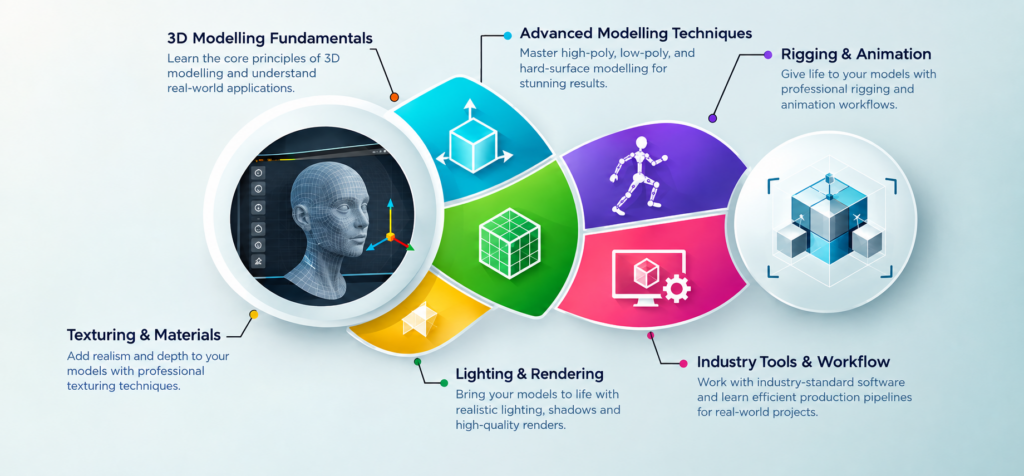
A genuinely useful advanced 3D modelling course covers far more than “how to use software.” Here is what should actually be on the syllabus.
Hard-Surface Modelling
This covers vehicles, weapons, machinery, sci-fi props, and architectural elements — anything with sharp edges, mechanical parts, or engineered surfaces. Students learn edge control, bevels, and Boolean workflows to keep surfaces clean under studio lighting.
Organic and Character Modelling
This is sculpting-based work: human anatomy, creatures, and stylised characters. It relies heavily on an understanding of form, proportion, and musculature, since even a slightly wrong silhouette can make a character look “off” to an audience without them knowing why.
Retopology and UV Mapping
A sculpted high-resolution model isn’t animation-ready. Retopology rebuilds the mesh with clean, efficient geometry (edge loops around joints, mouths, and eyes), and UV mapping unwraps that geometry so textures apply correctly. This is the single most overlooked skill among self-taught artists, and it’s often the deciding factor in whether a portfolio piece looks like hobby work or professional work.
Texturing Fundamentals for Modellers
While texturing is its own specialism, modellers need working knowledge of PBR (Physically Based Rendering) texture sets — base colour, roughness, normal, and displacement maps — because how a model is built directly affects how well it can be textured later.
Industry-Standard Software
| Software | Primary Use | Learning Curve |
| Autodesk Maya | Hard-surface & animation-ready modelling | Moderate |
| ZBrush | Digital sculpting, organic detail | Moderate–High |
| Blender | General-purpose modelling, texturing, rendering | Moderate |
| Substance 3D Painter | Texturing & material creation | Moderate |
| Marvelous Designer | Cloth & garment simulation | Moderate |
A well-structured advanced 3D modelling course doesn’t just teach buttons — it teaches why a professional workflow moves between these tools in a specific order, and how that order affects deadlines on a real production.
Advanced 3D Modelling vs. Basic 3D Modelling
Students often ask what actually separates “basic” from “advanced” modelling. Here’s a direct comparison.
| Aspect | Basic 3D Modelling | Advanced 3D Modelling |
| Topology | Functional, not animation-ready | Clean edge loops, deformation-ready |
| Detail level | Low to medium poly, simple shapes | Great detail with optimised poly count |
| Software depth | Single tool, surface-level use | Multi-tool pipeline (Maya + ZBrush + Substance) |
| UV & Texturing readiness | Often skipped or messy | Proper UV layout, PBR-ready |
| Portfolio value | Suitable for personal projects | Suitable for studio hiring pipelines |
| Typical use case | Learning, prototyping, hobby projects | Film, VFX, game production assets |
Definition (featured snippet format): Basic 3D modelling focuses on creating simple, functional shapes, while advanced 3D modelling produces detailed, animation-ready, production-quality assets built with clean topology, optimised geometry, and industry-standard texturing workflows suitable for VFX and film pipelines.
Career Paths After an Advanced 3D Modelling Course
A common misconception is that 3D modelling leads to only one job title. In practice, it opens several related career tracks:
- 3D Generalist — handles modelling, texturing, lighting, and basic animation for smaller studios or freelance projects.
- Character Modeller — specialises in organic sculpting for films, games, or streaming content.
- Hard-Surface Modeller — focuses on vehicles, props, weapons, and mechanical assets.
- Environment Artist — builds sets, terrains, and architectural spaces for films and games.
- Texturing & Look-Development Artist — a natural next step once modelling fundamentals are strong.
- VFX Asset Pipeline Lead — a senior role overseeing modelling standards across a production, usually reached after 4–6 years of experience.
Freelancing is also realistic once a strong portfolio exists — many Indian modellers work remotely with international studios and game developers on a project basis, which is one reason this skill appeals to students who want location flexibility after graduation.
Explore More Blog: 3D Modeling Classes for Animation, Gaming and VFX
How Studios Actually Use 3D Models
A practical example makes this concrete. Say a production needs a “damaged spaceship interior” for a sci-fi film. The modelling artist doesn’t just build a nice-looking hallway. They must:
- Match the concept art’s proportions exactly, since camera blocking depends on it.
- Keep the polygon count light enough for the lighting team to test multiple setups quickly.
- Build modular pieces (wall segments, pipes, panels) so the environment team can reuse assets across multiple shots without remodelling from scratch.
This is the kind of practical, production-thinking that separates a student who has “finished a tutorial” from one who is ready for a studio floor — and it’s exactly what a strong advanced 3D modelling course should simulate through real briefs, not just isolated exercises.
How to Choose the Right 3D Modelling Course in Kolkata
If you’re comparing options for a 3D modelling course in Kolkata, don’t just look at the fee structure. Ask these questions before enrolling:
- Does the curriculum include retopology and UV mapping, or does it stop at sculpting?
- Are mentors currently working professionals, or only full-time trainers with no recent studio experience?
- Does the course include a portfolio-building phase with feedback, not just assignment submissions?
- Is there placement support, and can the institute show recent placement outcomes?
- Does the syllabus cover the software combination studios actually use (Maya, ZBrush, Substance), rather than just one tool?
Many students choose a course based only on software list length rather than depth of teaching. Learning five tools shallowly is far less valuable to a recruiter than mastering two or three tools deeply enough to build a portfolio-ready asset from scratch.
Common Mistakes Students Make
Even motivated students repeat the same errors when learning 3D modelling:
- Skipping topology fundamentals because sculpting feels more “fun” than clean-up work — this shows up immediately when a model is rigged and breaks during animation.
- Overdetailing too early, adding fine sculpted detail before the base proportions and silhouette are correct.
- Ignoring reference material, relying on memory instead of studying real anatomy, mechanics, or architecture.
- Building a portfolio of only finished renders, with no wireframe or turnaround shots — recruiters specifically want to see the underlying mesh.
- Learning tools in isolation instead of practising the full modelling-to-texturing pipeline, which is how real studio work actually happens.
Expert Tips to Learn Advanced 3D Modelling Faster
- Study real-world references (anatomy books, engineering photos) before you open the software — modelling is observation first, technique second.
- Recreate one professional-quality asset per month rather than ten unfinished ones; depth beats volume in a portfolio.
- Get topology critiqued by someone with studio experience early — bad habits are much harder to unlearn after six months than after six weeks.
- Learn keyboard shortcuts and hotkeys deliberately; professional modellers work at a speed that’s simply impossible with mouse-only workflows.
- Treat every project brief like a client brief — with a deadline, a spec sheet, and a review round — because that’s exactly how studio work operates.
Why Learn Advanced 3D Modelling at Moople Institute
Moople Institute, based in Kolkata, trains students aged 18–25 in animation, graphic design, web design, and VFX with a strong hands-on focus. Our Advanced 3D Modelling course is structured around the actual VFX pipeline — not isolated software tutorials — so students leave with a portfolio built the way studios expect to see one: clean topology, proper UVs, and production-style briefs, not just pretty renders.
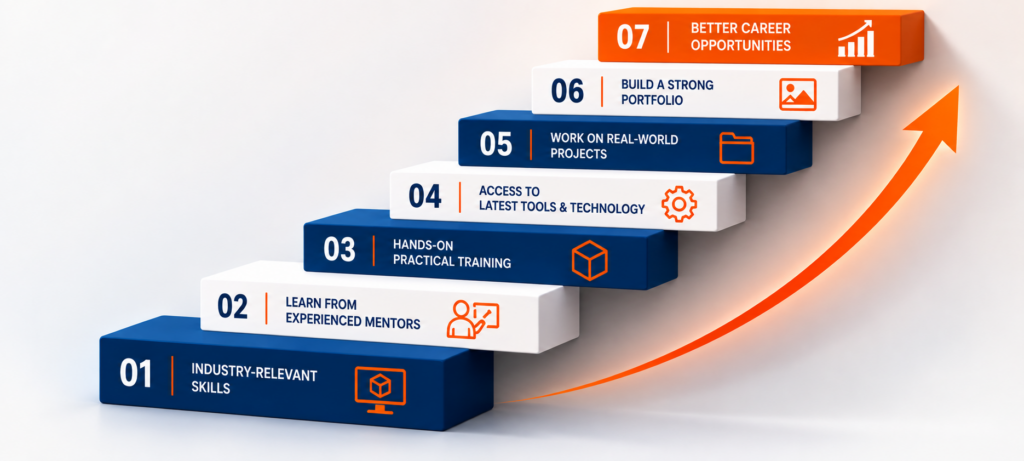
Training happens under mentors with real industry exposure, in small batches that allow individual feedback on wireframes and topology — the details generic online courses tend to skip entirely. For students specifically searching for a 3D modelling course in Kolkata, this local, in-person mentorship is often the difference between a portfolio that gets shortlisted and one that gets scrolled past.
FAQs
Q1. What is the difference between 3D modelling and advanced 3D modelling?
Basic 3D modelling covers simple shapes and forms for learning purposes, while advanced 3D modelling focuses on production-ready assets with clean, animation-safe topology, detailed sculpting, and proper UV and texturing preparation used in real film and VFX pipelines.
Q2. Do I need a design background to join an advanced 3D modelling course?
No. Most students start with no formal design background. What matters more is willingness to practise consistently, since modelling is a skill built through repetition and feedback rather than raw natural talent.
Q3. How long does it take to become job-ready in 3D modelling?
Most focused students reach a job-ready portfolio level in 6 to 12 months of consistent, structured training, though timelines vary based on prior software exposure and how much time is dedicated to practice outside class.
Q4. Which software should I learn first for 3D modelling?
Most training paths start with either Maya or Blender for foundational modelling, then move into ZBrush for organic sculpting and Substance 3D Painter for texturing, since this mirrors the typical studio pipeline.
Q5. Is there demand for 3D modellers in Kolkata specifically, or only in Mumbai and Hyderabad?
While Mumbai and Hyderabad host larger studio hubs, remote and freelance work has opened opportunities for Kolkata-based artists to work with studios anywhere in India or internationally, provided their portfolio meets industry standards.
Q6. Can 3D modelling lead to a career outside VFX and film?
Yes. The same advanced modelling skills apply to game development, product visualisation, architectural visualisation, medical animation, and advertising — industries where <cite index=”1-1″>3D animation and modelling demand is rising across medical, gaming, entertainment, and research sectors
Conclusion
Advanced 3D modelling isn’t just a technical skill you tick off a syllabus — it’s the foundation that every character, creature, prop, and environment in a VFX shot is built on. Studios don’t just want people who know software; they want artists who understand form, structure, and production-ready workflows well enough to hand off clean assets under deadline pressure. That combination — creative eye plus technical discipline — is exactly what a well-structured advanced 3D modelling course should build in you.
With India’s animation and VFX sector continuing to expand and international studios increasingly hiring Indian talent, the opportunity is real. What matters now is choosing training that treats modelling as a production skill, not just a software tutorial.
Ready to turn your interest in 3D art into a real VFX career? Explore the Advanced 3D Modelling course at Moople Institute, Kolkata, and book a free portfolio consultation with our mentors to see exactly where you stand and what to learn next.

Farhat Jabeen is passionate about documenting the student enrollment journey in the fields of technology, design, and digital media. Through her writing, she shares practical guidance, industry insights, and real-world learning experiences that help aspiring students confidently navigate their path toward creative and technology-driven careers. Her goal is to empower learners with the knowledge they need to choose the right educational journey.