A rotoscope artist can spend days tracing one actor frame by frame so a compositor can drop them into a new background. Machine-learning tools now produce a usable first matte in minutes. The artist still has to fix what the software gets wrong, and that is the real story of AI in visual effects: less manual grind, more judgment.
If you’re 18–30 and weighing a Diploma in VFX with AI, the short answer is this: it’s a VFX course that teaches the classic compositing pipeline and layers AI-assisted workflows on top. Below, we cover what is changing in studios, what the curriculum covers at Moople Institute in Kolkata, and how to judge any course before you pay.
What Is a Diploma in VFX with AI?
It is a job-oriented programme that trains you in core VFX craft (rotoscopy, paint, compositing, motion graphics) while introducing AI-assisted tools that speed up repetitive work. At Moople, the programme appears on the website as Visual Effects & AI. The course page lists an 18-month duration and Class 10 pass as the eligibility. Confirm current details with your nearest branch, since schedules and eligibility can change.
How AI Is Changing VFX
AI is not replacing the VFX pipeline. It is compressing the slowest parts of it.
| Task | Traditional approach | With AI assistance |
| Rotoscopy | Tracing shapes frame by frame | ML-assisted mattes (such as After Effects’ Roto Brush or trainable nodes in Nuke), refined by the artist |
| Cleanup and paint | Clone-stamping wires, rigs and logos by hand | Content-aware tools fill gaps fast; the artist checks grain and continuity |
| Look development | Hunting for references, hand sketches | Quick AI-generated mood boards before real work starts |
| Denoise and upscale | Slow, manual passes | AI-based tools handle much of the work faster |
Entry-level tasks like roto and cleanup are exactly where AI helps most, so juniors are expected to deliver faster and catch errors sooner. In practice, fundamentals matter more now, not less. An AI matte can flicker around hair, lose motion-blurred edges and misread transparent objects. You can only fix that if you understand edges, colour and motion.
What You Learn: Module by Module
Moople’s published curriculum breaks into five modules.
| Module | Focus | Software |
| 1 | Fundamentals of composition | Photoshop, After Effects |
| 2 | Rotoscoping and stereoscopy | Silhouette FX, Mocha, Nuke |
| 3 | Paint and prep | Photoshop, Silhouette FX, Mocha, Nuke |
| 4 | Live action and CG compositing | After Effects, Nuke |
| 5 | Motion graphics | After Effects, Premiere Pro |
The institute describes the curriculum as AI-integrated, but the course page does not name specific AI tools. Ask your branch counsellor which AI workflows are covered in which module, and request to see sample student work.
Why compositing sits at the centre
Nuke’s node-based approach is a staple of professional compositing, and the largest module is devoted to live-action and CG compositing. That weighting makes sense: compositing is where roto, paint, CG and AI-generated elements finally meet, and where a shot is judged.
What to Check in Any VFX Course
Use this list when you visit a branch, whichever institute you are comparing:
- Shot-based assignments, not only software tutorials
- Node-based compositing taught properly, on real footage
- A straight answer on which AI tools are covered, and where
- A showreel review before the course ends
- A workstation you can use for practice outside class hours
Career Paths After a VFX Course
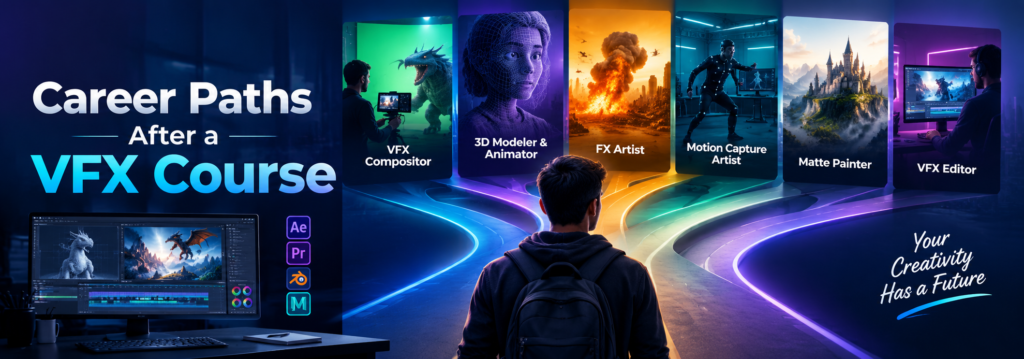
Moople’s course page lists roles such as VFX artist, compositor, rotoscope artist, matchmove artist and matte painter in film and television, plus game VFX and advertising and motion graphics work. It also lists placement guidance as part of the programme. Ask how that works in practice, including portfolio reviews and interview support, rather than assuming a job is guaranteed.
One practical tip: build a 60–90 second showreel of four or five shots with before-and-after breakdowns. Studios hiring juniors want to see what you actually did on a shot, and a breakdown shows exactly that.
Diploma or BSc in VFX?
The diploma is the faster, skills-first route. Moople’s BSc in VFX Film Making is a four-year degree, listed under MAKAUT, and suits Class 12 students who want a university credential alongside their training. If your goal is to start working on shots sooner, the diploma fits. If a degree matters to you or your family, compare both before deciding. If you also like editing and titles, the motion graphics and video editing course is a related option.
VFX Course in Kolkata: Choosing a Branch
Moople lists branches at Chowringhee, Sealdah, Jodhpur Park, New Alipore, Baguiati, Barasat, Sonarpur, Serampore, Chandannagar and Berhampore, so a VFX course in Kolkata is within reach whether you travel from the north, south or Hooghly side. Visit before you decide. See the workstations, ask to sit in on a compositing class, and check batch timings against your college schedule.
FAQs
1. Will AI replace VFX artists?
Not outright, but it is changing the work. Repetitive tasks get faster, and artists who can direct, correct and composite AI output become more useful to a studio.
2. Who can join the Diploma in VFX with AI?
Moople’s course page lists Class 10 pass as the eligibility. Graduates and working professionals can also enquire through the branch contact form.
3. Do I need drawing or coding skills?
The course page does not list either as a requirement. A sharp eye for detail and patience with frame-by-frame work help more.
4. How long does the course take?
The course page lists an 18-month duration. Ask your branch how batches are scheduled.
5. Which software will I learn?
The listed software is Photoshop, After Effects, Premiere Pro, Silhouette FX, Mocha and Nuke.
6. How do I know if the course suits me?
Visit a branch, ask for a demo or a walkthrough of the VFX course, look at student shots, and ask which AI workflows are taught.
Conclusion
AI is changing how VFX shots get made, but not who is accountable for the final frame. A Diploma in VFX with AI works best when it pairs tool fluency with strong compositing fundamentals, which is what Moople’s module structure points to. If you are in Kolkata and want to explore it, book a free counselling session at your nearest branch, ask for a walkthrough of the VFX course, and bring your questions about AI tools.

Farhat Jabeen is passionate about documenting the student enrollment journey in the fields of technology, design, and digital media. Through her writing, she shares practical guidance, industry insights, and real-world learning experiences that help aspiring students confidently navigate their path toward creative and technology-driven careers. Her goal is to empower learners with the knowledge they need to choose the right educational journey.