Students searching for game design courses want to understand what game designers actually do, what skills they need, what tools they use, and whether learning game design can help them build a career in the gaming industry.
If you enjoy games and often wonder why a particular level feels challenging, why a character behaves a certain way, or how rewards keep players engaged, you are already thinking like a game designer.
A game designer is responsible for shaping the experience of playing a game. Their work involves developing gameplay ideas, designing rules and challenges, planning levels, balancing difficulty, and working with artists, programmers, writers, and sound professionals to turn an idea into a playable experience.
For students considering game design courses, understanding this role is important because game design is much more than simply playing games or creating attractive characters.
What Does a Game Designer Actually Do?
A game designer turns a game concept into a structured player experience.
Depending on the project and their role, a designer may work on:
- Game concepts and gameplay mechanics
- Rules and objectives
- Character abilities and interactions
- Level and environment design
- Missions, quests, and challenges
- Player progression and rewards
- Difficulty and game balance
- User experience and player flow
- Game documentation
- Testing and improving gameplay
For example, imagine an adventure game where the player has to cross a dangerous forest. A game designer may decide what obstacles appear, when enemies are introduced, what abilities the player has, how difficult the section should be, and what reward the player receives after completing it.
The visual appearance of the forest may primarily be handled by an environment artist, while programmers implement the systems. The designer helps determine how those elements function together as part of the gameplay.
Game Designer vs Game Developer: What’s the Difference?
These roles often overlap, particularly in smaller studios, but their primary responsibilities can differ.
| Game Designer | Game Developer |
| Designs gameplay mechanics | Builds game systems and functionality |
| Plans rules and player interactions | Writes and implements code |
| Designs levels and challenges | Integrates gameplay features |
| Creates gameplay documentation | Tests and fixes technical issues |
| Focuses heavily on player experience | Focuses heavily on technical implementation |
A game designer does not necessarily need to be an expert programmer. However, understanding basic programming concepts can make communication with developers easier.
That is one reason a structured game design class can be useful: students can learn how creative ideas connect with the technical side of game production.
What Skills Does a Game Designer Need?
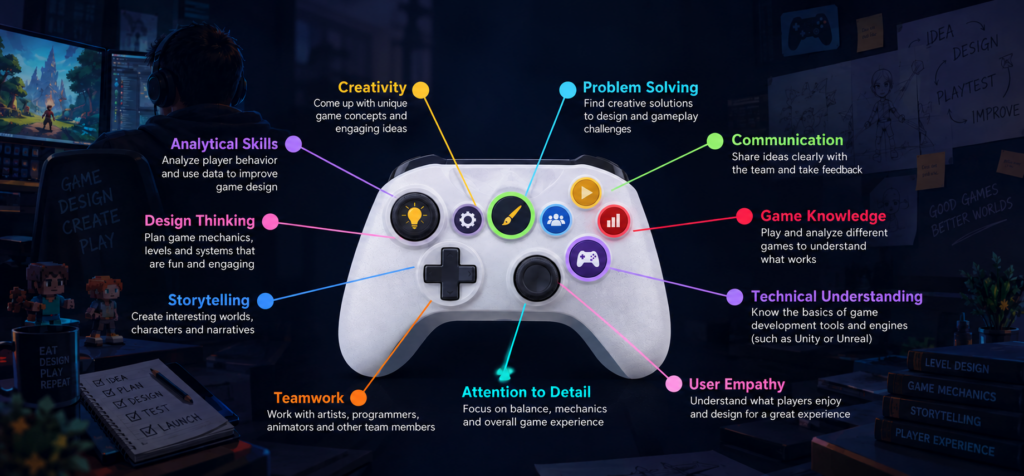
Game design combines creativity with problem-solving. Strong designers need to think about both what they want players to experience and how that experience can actually be created.
Important skills include:
1. Creative Thinking
Designers generate concepts for gameplay, characters, challenges, worlds, and player interactions. Creativity helps, but the ability to turn creative ideas into workable systems is equally important.
2. Problem-Solving
If players find a level too easy, too frustrating, or confusing, the designer needs to identify why and propose changes.
3. Understanding Game Mechanics
Mechanics are the rules and systems that define what players can do. Movement, combat, inventory, puzzles, crafting, scoring, and progression can all involve game mechanics.
4. Level Design
Level designers plan spaces and encounters to create a particular gameplay experience. They consider pacing, difficulty, exploration, rewards, and player direction.
5. Communication
Game development is collaborative. Designers regularly communicate with programmers, artists, animators, writers, producers, and testers.
6. Testing and Iteration
The first version of a game mechanic is rarely perfect. Designers playtest, collect observations, identify problems, make changes, and test again.
What Tools Do Game Designers Use?
The tools vary depending on the studio and project. Students exploring game design courses may encounter game engines and development tools such as Unity or Unreal Engine, along with software used for documentation, planning, prototyping, and visual development.
The important thing is not simply knowing the names of software packages. A good designer should understand why and when a particular tool is useful.
For example, a prototype can help answer questions such as:
- Is the mechanic actually fun?
- Is the objective clear?
- Is the difficulty appropriate?
- Does the player understand what to do?
- Does the level flow naturally?
What Happens During a Game Design Project?
A typical workflow can look something like this:
Idea → Game concept → Gameplay mechanics → Prototype → Playtesting → Refinement → Production → Testing
Suppose a student designs a simple platform game. Instead of immediately creating dozens of levels, they might first build one small playable section.
After testing it, they could discover that the jump feels too slow or that players cannot understand where they should go. The designer then adjusts the mechanic or level and tests it again.
This prototype-test-improve cycle is an essential part of professional game development.
Can You Learn Game Design Without Being a Gamer or Programmer?
You do not need to be a professional gamer or an advanced programmer to begin learning game design.
However, being curious about games helps. You should be willing to analyse games rather than simply play them.
Ask questions such as:
- Why does this level introduce this mechanic here?
- Why does the game reward the player at this point?
- What makes this boss difficult?
- How does the game teach a new ability?
- Why does one level feel more enjoyable than another?
Basic technical knowledge is also valuable, particularly if you want to work closely with developers.
What Should You Look for in Game Design Courses?
Students comparing game design courses should look beyond the course title. A useful learning program should provide opportunities to understand both theory and practical production.
Consider whether the program includes:
- Game mechanics and gameplay design
- Level design
- Game development workflows
- Prototyping
- Game engines or relevant development tools
- Playtesting and iteration
- Project-based learning
- Portfolio development
- Guidance from experienced instructors
For students in Kolkata, practical exposure can be particularly valuable because a portfolio gives you something concrete to discuss when applying for internships, entry-level roles, or further opportunities.
Frequently Asked Questions
1. What is the main role of a game designer?
A game designer plans and develops the gameplay experience, including mechanics, rules, challenges, levels, progression, and player interactions.
2. Is game design the same as game development?
No. Game design focuses primarily on gameplay and player experience, while game development can include programming and technical implementation. In smaller teams, one person may handle responsibilities from both areas.
3. Do game designers need to know coding?
Not every game designer needs advanced coding skills, but understanding programming concepts and game-engine workflows can be highly useful.
4. What can I learn in a game design class?
Depending on the program, a game design class may cover gameplay mechanics, level design, prototyping, game engines, development workflows, testing, and project creation.
5. Are game design courses suitable for beginners?
Many introductory programs are designed to help students build foundational knowledge before moving into more advanced concepts. Check the individual course structure and entry requirements before enrolling.
6. Can game design be a career?
Game design can lead to roles related to gameplay design, level design, systems design, and other areas of interactive entertainment. Career paths depend on skills, portfolio quality, experience, and the requirements of individual employers.
7. What is more important: creativity or technical knowledge?
Both matter. Creativity helps generate interesting experiences, while technical understanding helps designers create ideas that can realistically be implemented and communicated to a development team.
Build Your Game Design Skills with Moople Institute
Game design is not simply about having an idea for a game. It is about understanding how players interact with that idea and continually improving the experience through design, testing, and iteration.
If you want to explore game development and build practical skills, you can learn more about the game development course at Moople Institute.
Conclusion
A game designer sits at the intersection of creativity, gameplay, technology, and player psychology. From developing mechanics and designing levels to testing prototypes and refining difficulty, the role involves solving problems throughout the game-development process.
For students aged 18–30 who are interested in interactive entertainment, learning through practical game design courses can provide a structured way to understand this process and begin developing relevant skills and projects.
Hi! I’m Doraemon — a fun-loving robotic cat from the future who loves writing blogs, sharing stories, and exploring interesting ideas. When I’m not helping Nobita, I’m busy turning everyday topics into fun and easy-to-read articles. 🐱✨