

If you’ve been searching for the best Cyber Security college in Kolkata, you’ve probably noticed that most websites either oversell themselves or drown you in jargon without answering your actual questions — what will I study, how much does it cost, and will I actually get a job afterward? This guide is written to fix that. We’ll walk you through what a BSc in Cyber Security really involves, how to judge a good Cyber Security Institute, what the course costs, and how Moople Institute in Kolkata approaches this training differently from a typical classroom-only program.
By the end, you’ll know exactly what to check before enrolling anywhere — not just with us
Why Cyber Security Is One of the Fastest-Growing Careers in India
Every business, from a small Kolkata retailer with an online store to a national bank, now runs on digital systems, and every one of those systems is a target. India’s cyber security workforce gap runs into hundreds of thousands of unfilled roles, and the pattern is the same across most developing digital economies: demand for trained professionals is growing faster than colleges can produce them.
This gap is exactly why a Cyber Security course has become one of the more practical choices for students finishing Class 12, especially students who enjoy problem-solving, logical thinking, and working with computers rather than memorising theory. Unlike some IT careers that are being reshaped by automation, cyber security roles depend on human judgement — someone has to decide whether a system alert is a real threat or a false alarm, and that decision-making skill is hard to automate away.
What Is a BSc in Cyber Security?
A BSc in Cyber Security is an undergraduate degree, typically three to four years long, that trains students to protect computer systems, networks, and data from unauthorised access, theft, and damage. The course blends core computer science fundamentals programming, networking, and operating systems with specialised security subjects like ethical hacking, digital forensics, and cryptography.

It’s different from a general Computer Science degree in one key way: everything you learn is filtered through the lens of “how could this be attacked, and how do I defend it?” That framing changes how you approach even basic topics like databases or web development.
Cyber Security Course After 12th: Eligibility and Subjects
Most students researching a cyber security course after 12th want a straight answer on two things: am I eligible, and what will I actually study in year one. Here’s the honest breakdown.
Eligibility Criteria
You generally need to have completed Class 12 with Physics, Chemistry, and Mathematics (PCM) or Physics, Chemistry, and Computer Science (PCMC) from a recognised board, with a minimum aggregate that most institutes set between 45% and 50%. Some institutes, including Moople, also accept students from a Commerce background with Mathematics, since foundational logic and problem-solving skills matter more in the first year than your exact stream.
Subjects Covered in the First Year
The opening year usually covers programming fundamentals (commonly Python or C), an introduction to networking, mathematics for computing, and the basics of operating systems. This isn’t security-specific, yet it’s the groundwork every security specialist needs before they can meaningfully understand how an attack actually works.
Expert tip: If your school didn’t offer computer science, don’t worry. A strong first-year curriculum is designed to bring everyone to the same baseline. What matters more than prior coding experience is your comfort with logical, step-by-step thinking.
How to Choose the Best Cyber Security College in Kolkata
Before we talk about Moople’s program specifically, it’s worth knowing what actually separates a genuinely good Cyber Security college in Kolkata from one that just has a good marketing website. Here’s what to check:
- Lab access, not just lectures: security is a hands-on discipline; a college without a dedicated lab for penetration testing and network simulation is teaching theory only.
- Industry-current tools — ask specifically whether the syllabus includes tools like Wireshark, Metasploit, Burp Suite, or SIEM platforms, not just textbook diagrams.
- Faculty with real-world exposure — trainers who have worked on actual security audits or incident response bring context no textbook can.
- Certification alignment — check if the coursework maps to recognised certifications like CompTIA Security+ or CEH, which employers actually look for.
- Placement transparency — a college that shares real placement data (not vague claims) is confident in its outcomes.
This is the checklist we’d suggest using for any institute you’re evaluating, including ours.
Moople Institute’s BSc in Cyber Security Program
Moople Institute has spent years training students in Kolkata across animation, design, and digital media, and we built our BSc in Cyber Security program on the same principle that shaped those courses: skills should be tested against real tools and real scenarios, not just exam papers.
Curriculum Highlights
Our curriculum is structured around four pillars — network security, ethical hacking, digital forensics, and cloud security — with each semester adding a layer of complexity on top of the previous one. Students don’t just learn what a firewall does; they configure one, then try to bypass it in a controlled lab environment, then document the process the way a professional security report would require.
Hands-On Labs and Industry Tools
Every practical module runs on a dedicated security lab set up with virtual machines, so students can safely simulate attacks and defences without any risk to live systems. [Insert specific lab infrastructure details, e.g., number of workstations, specific software licences used]
Faculty and Mentors
Our faculty combines academic instructors with [insert number] industry mentors who bring direct experience from IT security roles, so classroom discussions are grounded in what companies are actually dealing with right now — not five-year-old case studies.
Placement and Career Support
Moople runs dedicated placement preparation, including mock technical interviews, resume reviews specific to security roles, and connections with hiring partners across Kolkata’s growing IT sector. [Insert actual placement percentage or number of hiring partners once verified]
Real example: A recent batch project had students identify and patch vulnerabilities in a deliberately “broken” test web application — the same style of exercise used in entry-level penetration testing interviews, so students walk into placement season having already done the kind of task they’ll be evaluated on.
Syllabus Overview: What You’ll Actually Study
| Year | Core Focus | Key Subjects |
| Year 1 | Foundations | Programming, Networking Basics, Mathematics for Computing, Operating Systems |
| Year 2 | Core Security | Network Security, Cryptography, Ethical Hacking Fundamentals, Database Security |
| Year 3 | Applied Security | Digital Forensics, Cloud Security, Malware Analysis, Security Auditing |
| Year 4 (if applicable) | Specialisation | Capstone Project, Industry Internship, Advanced Penetration Testing |
This structure mirrors how most recognised Cyber Security Institute programs across India sequence their learning, moving from fundamentals to applied, project-based work — which is exactly how the skill is used on the job.
Fees, Duration, and Eligibility at a Glance
| Detail | Information |
| Course Duration | [Insert exact duration, e.g., 3 years] |
| Eligibility | Class 12 (PCM/PCMC preferred, other streams considered) |
| Total Fees | [Insert actual fee structure] |
| Mode | Full-time, on-campus with lab access |
| Certification Support | Aligned with industry certifications |
Common mistake to avoid: Comparing colleges only on fee amount. A cheaper course with no lab access or an outdated syllabus often costs more in the long run, because you’ll need to pay separately for certifications and practical training elsewhere before you’re job-ready.
Career Opportunities After a Cyber Security Course
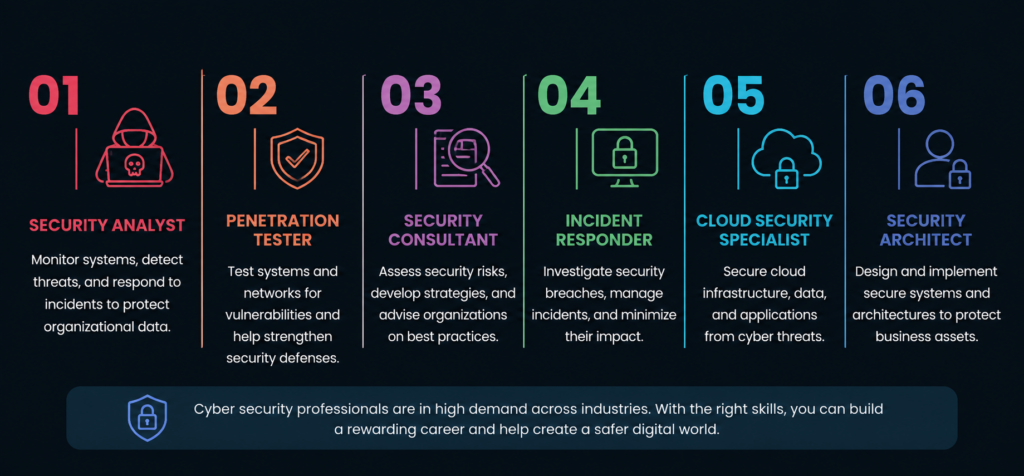
Graduates of a BSc in Cyber Security typically move into one of these entry-level roles:
- Security Analyst — monitors systems for threats and responds to incidents.
- Penetration Tester — legally attempts to break into systems to find weaknesses before attackers do.
- Network Security Engineer — designs and maintains secure network infrastructure.
- Digital Forensics Investigator — recovers and analyses data after a security breach.
- SOC (Security Operations Centre) Associate — works within a team monitoring live threats around the clock.
Salaries for entry-level roles vary widely by company size and city, so treat any specific number you see online with caution — it’s more useful to compare growth trajectory (security roles tend to see steady salary growth with certifications and experience) than a single starting figure.
Explore More: Top Career Opportunities After Completing a Master’s in Cyber Security
Cyber Security Institute vs. General B.Tech College
A question we get often: should you pick a dedicated Cyber Security Institute or a general engineering college with a security specialisation? Here’s how they typically compare.
| Factor | Dedicated Cyber Security Institute | General B.Tech College |
| Curriculum Focus | 100% security-specific from year one | Broad CS curriculum, security often an elective |
| Lab Time | Usually higher, security-specific tools | Shared general computer labs |
| Industry Mentorship | Often includes practising security professionals | Varies widely by college |
| Flexibility | Narrower focus, deeper specialisation | Broader base, useful if unsure of specialisation |
| Best For | Students certain about a security career | Students wanting to keep options open |
Neither option is “better” universally — it depends on how confident you already are that security is the specific path you want.
Common Mistakes Students Make While Choosing a College
The most frequent mistake is enrolling based on a college’s ranking claims alone, without verifying lab facilities or talking to current students. A close second is ignoring the difference between a security-focused BSc and a general Computer Science degree that simply mentions “cyber security” as one unit among many — these produce very different skill levels by graduation. Finally, many students underestimate how much of this field is self-driven; a good college gives you structure and mentorship, but consistent personal practice — trying tools, following security news, joining Capture The Flag (CTF) challenges — is what actually separates strong candidates at placement time.
Expert Tips to Build a Real Cyber Security Career
Start following real vulnerability disclosures and security advisories while you’re still studying — sites like CVE databases or vendor security bulletins show you what attackers are actually exploiting right now, which textbooks can’t keep up with. Practice on legal, purpose-built platforms designed for ethical hacking practice rather than testing skills on live systems you don’t own, which is both illegal and unnecessary given how many safe practice environments exist today. And build a small portfolio — even documenting a few practice lab exercises on a personal blog or GitHub shows recruiters you engage with the field beyond assignments.
Frequently Asked Questions
Is a BSc in Cyber Security a good career choice in India?
Yes. India’s digital economy is expanding quickly, and organisations across banking, IT services, healthcare, and government need trained security professionals, which keeps demand for this specialisation strong.
Can I do a Cyber Security course after 12th with a Commerce background?
Some institutes, including Moople, do accept Commerce students with Mathematics, since foundational logic matters more than your exact stream in the first year. It’s best to confirm specific eligibility with the admissions office.
What is the difference between Cyber Security and Ethical Hacking courses?
Cyber Security is the broader discipline covering defence, policy, and infrastructure protection, while Ethical Hacking is one specialised skill within it, focused on finding vulnerabilities through simulated attacks.
Do I need to know coding before joining a Cyber Security course?
No prior coding experience is required. Programming fundamentals are taught from the first semester, so students without a computer science background can catch up during year one.
How is Moople Institute different from other colleges offering this course?
Moople combines dedicated lab-based practical training with industry-aligned tools and mentorship, so students graduate having already practiced the kind of tasks used in real security interviews, not just exam-based theory.
What certifications should I aim for alongside a BSc in Cyber Security?
CompTIA Security+, Certified Ethical Hacker (CEH), and CompTIA Network+ are commonly recognised entry points that complement a degree well.
Conclusion and Next Steps
Choosing the best Cyber Security college in Kolkata isn’t about picking whichever name shows up first in search results; it’s about checking lab access, faculty experience, syllabus depth, and real placement transparency, the same checklist we’ve walked through above. A well-structured BSc in Cyber Security gives you both the theoretical grounding and hands-on practice employers are actively looking for, especially as India’s security workforce gap continues to widen.
If you’re finishing Class 12 and considering a Cyber Security course, Moople Institute’s program is built specifically around practical, lab-based learning in Kolkata. Reach out to our admissions team to see the current syllabus, lab facilities, and fee structure in detail, and to speak directly with current faculty about what a typical week in the program looks like.

Farhat Jabeen is passionate about documenting the student enrollment journey in the fields of technology, design, and digital media. Through her writing, she shares practical guidance, industry insights, and real-world learning experiences that help aspiring students confidently navigate their path toward creative and technology-driven careers. Her goal is to empower learners with the knowledge they need to choose the right educational journey.