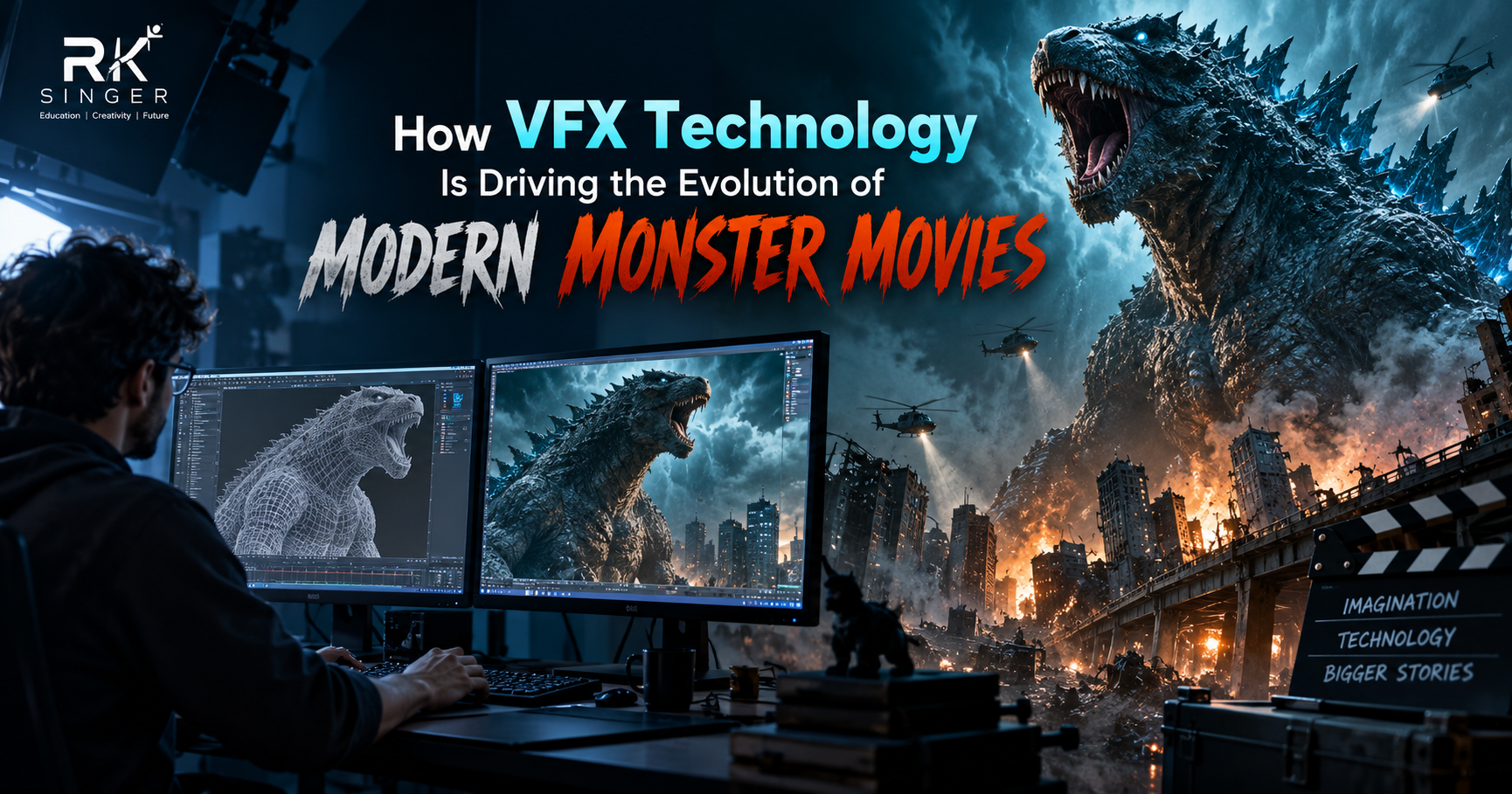
Monster movies have always held a special place in cinema. From the stop-motion terror of King Kong in 1933 to the towering, breathing creatures of today’s blockbusters, the genre has continuously pushed filmmakers to invent new ways of bringing the impossible to life. What has changed most dramatically over the decades isn’t the appetite audiences have for giant creatures and grotesque beings — it’s the technology used to create them. Visual effects (VFX) have transformed monster movies from stiff, rubber-suited spectacles into hyper-realistic, emotionally resonant experiences that blur the line between fantasy and reality.
In this blog, we’ll explore how VFX technology has evolved, the tools and techniques driving today’s monster movie magic, and why this is one of the most exciting times to build a career in visual effects.
The Early Days: Practical Effects and Stop-Motion Magic
Before computers entered the picture, monster movies relied entirely on practical effects. Filmmakers used miniatures, matte paintings, animatronics, and stop-motion animation to create creatures frame by frame. Ray Harryhausen, one of the pioneers of this era, spent countless hours manipulating small models to create the illusion of movement in classics like “Jason and the Argonauts” and “Clash of the Titans.”
While groundbreaking for their time, these techniques had obvious limitations. Movements were often jerky, creature designs were constrained by what could physically be built, and scenes involving large-scale destruction were difficult to pull off convincingly. Despite these constraints, the craftsmanship of this era laid the creative foundation that modern VFX artists still draw inspiration from today.
The CGI Revolution
The 1990s marked a turning point. With films like “Jurassic Park” (1993), computer-generated imagery (CGI) proved it could create creatures that felt alive — with texture, weight, and believable motion. Steven Spielberg’s dinosaurs weren’t just visually impressive; they moved with a sense of mass and intention that practical effects alone struggled to achieve.
This shift opened the floodgates. Studios began investing heavily in digital effects, and monster movies started to look less like men in suits and more like living, breathing creatures inhabiting a real world. CGI allowed filmmakers to imagine monsters of any size, shape, or texture, unrestricted by the physical limitations of puppetry or costume work.
Motion Capture: Giving Monsters a Soul
One of the most significant advancements in modern monster VFX has been motion capture (mocap) technology. Instead of animating a creature from scratch, VFX artists can now record the movements and facial expressions of a live actor and translate them onto a digital character.
This technique has been used to remarkable effect in films like “King Kong” (2005) and “Godzilla” franchises, where the physicality of a performer adds subtle nuances — a weight shift, a flicker of emotion in the eyes — that pure animation often misses. Performance capture doesn’t just make monsters look real; it makes them feel real, giving audiences a creature they can emotionally connect with, even fear or sympathize with.
Photorealistic Texturing and Simulation
Today’s VFX pipelines go far beyond simple modeling and animation. Artists use advanced simulation software to recreate the physics of skin, muscle, fur, water, fire, and destruction with astonishing accuracy. When a kaiju stomps through a city in a film like “Godzilla vs. Kong” or “Pacific Rim,” every collapsing building, dust cloud, and rippling puddle is calculated using physics-based simulation engines.
Texturing has also advanced dramatically. Modern monsters are built with multiple detailed layers — subsurface scattering to simulate how light passes through skin, dynamic wetness and grime effects, and procedurally generated scales or fur that react naturally to movement and lighting. This level of detail is what allows a creature to hold up even in extreme close-up shots.
Real-Time Rendering and Virtual Production
One of the biggest recent shifts in the VFX industry is the move toward real-time rendering, powered by game engines like Unreal Engine. Traditionally, rendering a single VFX-heavy frame could take hours. With real-time engines, directors and VFX supervisors can now see near-final quality visuals instantly on set, allowing for better creative decisions during filming rather than guessing how a scene will look after months of post-production.
This has given rise to virtual production techniques, such as LED volume stages, where digital environments are displayed behind actors in real time. For monster movies, this means creature interactions, lighting, and environmental effects can be previewed and adjusted live, creating a more collaborative and efficient filmmaking process.
AI and Machine Learning in Creature Design
Artificial intelligence is beginning to play a growing role in VFX pipelines. Machine learning tools now assist with tasks like rotoscoping, motion tracking, de-aging, and even generating realistic muscle and skin deformation automatically. This doesn’t replace the artist — but it does speed up repetitive technical work, freeing VFX teams to focus more on creative storytelling and refining a monster’s unique personality and menace.
AI-assisted tools are also helping smaller studios and independent filmmakers achieve effects that were once only possible with massive Hollywood budgets, democratizing high-quality monster design across the industry.
Sound Design and VFX: A Combined Sensory Experience
While VFX handles the visual side, it’s worth noting how tightly it now integrates with sound design to create fully immersive monster experiences. The thunderous roar of a kaiju, synced precisely with its jaw movement and the shockwave rippling through its environment, is often designed collaboratively between VFX and sound teams. This synergy is part of why modern monster movies feel so visceral compared to their predecessors.
Why This Matters for Aspiring VFX Artists
The evolution of monster movie VFX isn’t just a technical story — it’s an opportunity. The entertainment industry is hungry for skilled VFX professionals who understand simulation, texturing, compositing, motion capture cleanup, and creature animation. Studios across the world, including major visual effects houses in India, are actively hiring artists trained in these specialized skills.
If you’re passionate about bringing fantastical creatures to life, now is one of the best times to build a career in this field. Enrolling in a structured VFX course can help you learn industry-standard software, workflows, and creative techniques used by professionals working on real monster movie productions. A good course doesn’t just teach software — it teaches you how to think like a VFX artist, solving creative and technical problems the way studios do.
For students based in eastern India, a VFX course in Kolkata offers the advantage of quality training without needing to relocate to major metro hubs. Kolkata has steadily grown as a hub for creative education, and local institutes now offer industry-relevant curricula covering compositing, 3D modeling, simulation, and animation — all essential skills for anyone hoping to work on monster or creature-based VFX projects.
For those looking for a more comprehensive, degree-level path, pursuing a BSc in VFX and filmmaking can be an excellent choice. This kind of program combines the technical depth of visual effects training with a broader understanding of filmmaking — cinematography, storytelling, editing, and production design — giving graduates a well-rounded skill set that’s highly valued by studios working on large-scale, effects-driven films.
The Future of Monster Movie VFX
Looking ahead, the line between practical and digital effects will likely continue to blur further. Hybrid approaches — combining animatronics with digital enhancement, real-time rendering with traditional compositing — are becoming the industry standard because they offer the best of both worlds: the tactile realism of practical effects and the limitless creative freedom of CGI.
As virtual production, AI-assisted tools, and increasingly powerful rendering engines mature, we can expect monster movies to become even more immersive, with creatures that react dynamically to their environments and audiences in ways we haven’t yet imagined.
Conclusion
From stop-motion puppets to photorealistic, motion-captured giants, VFX technology has completely reshaped how monster movies are made and experienced. Every leap in visual effects — CGI, mocap, simulation, real-time rendering, and AI — has pushed creature design closer to believability, making monsters feel less like special effects and more like characters with presence and personality.
For anyone inspired by this evolution, the path into the industry has never been more accessible. Whether through a focused VFX course, a locally available VFX course in Kolkata, or a broader academic route like a BSc in VFX and filmmaking, aspiring artists today have more resources than ever to turn their passion for monsters, magic, and movie-making into a real career.
FAQs
1. How has VFX technology changed monster movies over the years?
VFX has evolved from practical effects like stop-motion and animatronics to advanced CGI, motion capture, and real-time rendering, allowing for far more realistic and emotionally expressive creatures.
2. What software do VFX artists use to create movie monsters?
Common tools include Autodesk Maya, ZBrush, Houdini for simulations, Nuke for compositing, and increasingly, real-time engines like Unreal Engine for previsualization and virtual production.
3. Do I need a technical or artistic background to start a career in VFX?
Both help, but neither is mandatory to begin. Many successful VFX artists start with a strong interest in art or storytelling and develop technical skills through structured training and practice.
4. Is a VFX course enough to get a job in the film industry?
A well-structured VFX course covering compositing, modeling, animation, and simulation can provide the foundational skills studios look for, especially when paired with a strong personal portfolio.
5. What is the advantage of pursuing a BSc in VFX and filmmaking over a short-term course?
A BSc program offers a broader, more in-depth education covering both technical VFX skills and filmmaking fundamentals like cinematography and storytelling, which can be valuable for long-term career growth in the industry.

Pooja Sharma is a creative education content writer who creates engaging articles on career guidance, skill development, and learning opportunities to help students make informed decisions.