If you’re a student in Kolkata trying to break into the creative industry, you’ve probably typed “graphic design course vs multimedia course” into Google more than once, only to end up more confused than before. That confusion is normal. Both fields overlap on the surface — both involve visuals, both need software skills, and both promise a creative career. But the day-to-day work, the tools, and the job roles are quite different.
At Moople Institute, we’ve counselled hundreds of students across Kolkata who faced this exact dilemma before enrolling. This article breaks down the real difference between a graphic design course and a multimedia course, so you can choose the right graphic & multimedia design course in Kolkata based on your interests, budget, and career goals — not guesswork.
Table of Contents
What Is Graphic Design?
Graphic design is the craft of communicating ideas through static visual content — logos, posters, packaging, brochures, social media creatives, and brand identities. A graphic designer works mainly with layout, typography, colour theory, and composition to make a message clear and visually appealing.
Think of every brand logo you recognise instantly — a graphic designer built that. The work is largely two-dimensional and print- or screen-based, and it forms the visual backbone of almost every business, from a local bakery in Gariahat to a national FMCG brand.
A typical graphic design course trains students on tools like Adobe Photoshop, Illustrator, InDesign, and CorelDRAW, along with the underlying design principles — grid systems, colour psychology, and typography hierarchy — that separate a professional designer from someone who just “knows software.”
What Is Multimedia Design?
Multimedia design is broader and more technical. It combines graphics, animation, audio, video, and sometimes interactivity into a single output. A multimedia designer might work on a motion graphics ad one week and a 3D product animation the next.
Where graphic design stays largely static, multimedia design moves — literally. It includes 2D and 3D animation, video editing, motion graphics, basic VFX, sound design, and sometimes web or app interface animation. A multimedia course usually covers software such as Adobe After Effects, Premiere Pro, Autodesk Maya or 3ds Max, and sometimes basic web animation tools.
If graphic design is about designing a single frame, multimedia design is about designing what happens between the frames.
Graphic Design vs Multimedia Design: Key Differences
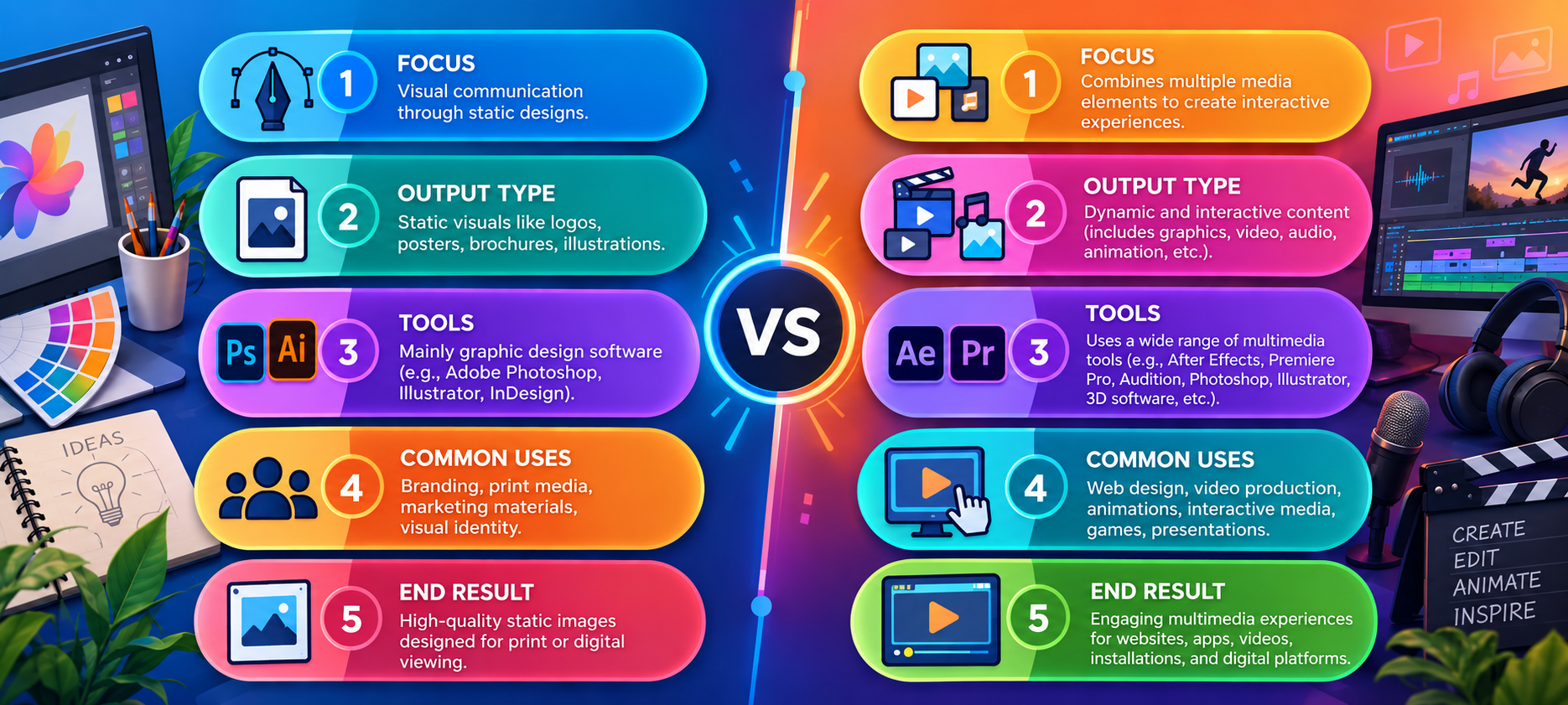
Here’s a side-by-side comparison to make the distinction concrete before you decide on a course.
| Factor | Graphic Design | Multimedia Design |
| Core output | Static visuals (logos, posters, layouts) | Moving visuals (animation, video, motion graphics) |
| Primary tools | Photoshop, Illustrator, InDesign, CorelDRAW | After Effects, Premiere Pro, Maya, 3ds Max |
| Skill focus | Typography, layout, branding, colour theory | Animation principles, timing, storytelling, sound sync |
| Typical course duration | 3–12 months (varies by depth) | 6–18 months (more technical depth needed) |
| Common job roles | Graphic Designer, Brand Designer, UI Visual Designer | Motion Graphic Artist, Video Editor, 2D/3D Animator |
| Industries hiring | Advertising, marketing, publishing, e-commerce | Film, gaming, ad films, OTT, VFX studios |
| Entry difficulty | Easier to start, faster to build a portfolio | Steeper learning curve, longer skill-building phase |
| Freelance scope | High — logos, branding, social media kits | High — but needs stronger technical showreel |
Notice that neither field is objectively “better.” They serve different creative instincts. If you enjoy composing a single striking image, graphic design will feel natural. If you enjoy telling a story frame by frame, multimedia design will pull you in.
Skills You Need for Each Field
Skills for Graphic Design
A strong graphic designer needs a sharp eye for composition, an understanding of colour psychology, and command over typography — knowing which font pairs work for a luxury brand versus a street-food stall, for instance. Beyond software, employers look for consistency: can you keep a brand’s visual identity uniform across ten different formats?
Skills for Multimedia Design
Multimedia design demands everything graphic design does, plus a sense of timing and movement. You need to understand animation principles like easing and anticipation, basic storytelling structure, and how visuals sync with sound. It’s a more layered skill set, which is also why multimedia professionals often command slightly higher project rates once they’re experienced.
Expert tip: Even if you plan to specialise in multimedia design, spend your first few months mastering graphic design fundamentals. Nearly every animation project starts with a static storyboard or key visual — weak fundamentals here show up in your final animated output too.
Career Opportunities and Salary Expectations in Kolkata
Kolkata’s creative job market has grown steadily with the rise of advertising agencies, e-commerce brands, and regional OTT and gaming studios setting up smaller production units in the city. Here’s a realistic look at where each path can take you.
Graphic design career paths: Graphic Designer, Junior Art Director, Brand Identity Designer, Packaging Designer, Social Media Creative Designer, and Freelance Designer. Entry-level graphic designers in Kolkata typically start in a modest but stable salary bracket, with earnings rising noticeably once a designer builds a strong portfolio and gains 2–3 years of agency experience.
Multimedia design career paths: Motion Graphics Artist, Video Editor, 2D Animator, 3D Modeler, VFX Compositor, and Multimedia Content Creator. These roles often pay a bit higher at the mid-level stage because fewer trained professionals can confidently handle animation and video pipelines compared to the larger pool of graphic designers.
Freelancing is strong in both fields. Many Moople alumni take on independent branding projects for local businesses while also working full-time, since graphic and multimedia skills are in constant demand from small and medium enterprises that can’t afford a full in-house creative team.
Graphic Design Course Duration and Curriculum
One of the most common questions students ask is about graphic design course duration, since it directly affects planning around college, part-time work, or job readiness timelines.
A short-term graphic design course usually runs for 3 to 6 months and covers software basics along with fundamental design theory. This suits students who want quick, job-ready skills for entry-level roles or freelance work. A more advanced graphic design course in Kolkata, spanning 9 to 12 months, goes deeper into brand identity systems, packaging design, print production, and portfolio-building — better suited for students aiming at agency jobs or a long-term design career.
Multimedia courses, on the other hand, generally run longer — 6 to 18 months — because animation and video work require more hands-on practice hours to build muscle memory in tools like After Effects or Maya. A rushed multimedia course often produces students who know the software menus but can’t animate convincingly, which is a real gap employers notice during portfolio reviews.
Curriculum should typically include:
- Design fundamentals: colour theory, typography, composition
- Software training: industry-standard tools relevant to the specialisation
- Live projects: real client-style briefs, not just tutorials
- Portfolio development: a structured showreel or portfolio website
- Industry exposure: internships, guest sessions, or studio visits
Which Course Should You Choose?
Choosing between the two doesn’t need to be complicated. Ask yourself three questions:
- Do you enjoy stillness or movement? If you get more excited designing a single striking poster than animating a short clip, lean toward graphic design.
- How much time can you commit? Multimedia design generally needs more months of consistent practice before you’re job-ready compared to graphic design.
- What kind of work environment appeals to you? Advertising agencies and branding studios hire more graphic designers; production houses, gaming studios, and VFX companies hire more multimedia professionals.
There’s also a practical middle path many students overlook: starting with a graphic and multimedia design course that covers both disciplines in a structured way, then specialising later once you discover which work excites you more during live projects. This is exactly why combined programs exist — they let you test both waters before committing to one lane.
Common Mistakes Students Make While Choosing
Many students pick a course based on which one “sounds cooler” rather than which matches their actual working style, and this mismatch often surfaces only after a few months, once the novelty fades. Another frequent mistake is judging a course purely by its duration or price without checking whether it includes live client-style projects — software tutorials alone rarely prepare you for real briefs, tight deadlines, or client feedback loops. Some students also skip checking placement support and industry tie-ups, assuming skills alone are enough to get hired, when in reality a strong portfolio combined with real industry connections matters just as much in Kolkata’s competitive creative job market.
Expert tip: Before enrolling, ask to see actual student portfolios from the last batch, not just marketing samples. A course’s real quality shows in what its recent graduates can produce, not in its brochure.
Why Study a Graphic & Multimedia Design Course in Kolkata
Kolkata has quietly become a growing hub for creative education, with advertising agencies, e-commerce brands, and regional production houses all needing local design and multimedia talent. Studying locally means lower living costs compared to Delhi or Mumbai, access to a growing internship network within the city, and the ability to build client relationships with local businesses while still studying — something Moople actively encourages through live project assignments.

At Moople Institute, our graphic & multimedia design course in Kolkata is structured around this exact regional advantage: students work on real local business briefs, get mentored by working industry professionals, and leave with a portfolio built on actual client feedback rather than only classroom exercises.
Expert Tips From Moople Institute
Build your portfolio from day one, not after the course ends — every project, even practice work, is a potential portfolio piece if done well. Learn one core tool deeply before jumping to the next; shallow knowledge of five software tools is far less valuable to employers than mastery of two. Finally, follow working professionals and studios on platforms like Behance and Instagram to understand current industry trends, since design trends shift faster than most course syllabi can update.
FAQs
Q1. Which is better, graphic design or multimedia design?
Neither is universally “better” — it depends on your interest. Graphic design suits students who enjoy static visual communication like branding and layouts, while multimedia design suits those drawn to animation, video, and motion-based storytelling.
Q2. What is the graphic design course duration in Kolkata?
Most graphic design courses in Kolkata range from 3 to 12 months, depending on depth. Short-term courses (3–6 months) cover software basics, while advanced graphic design courses (9–12 months) include branding, print production, and portfolio building.
Q3. Can I learn both graphic design and multimedia design together?
Yes. Many institutes, including Moople, offer a combined graphic & multimedia design course that covers both disciplines, letting students explore each before specialising based on their strengths and interests.
Q4. Is a multimedia course harder than a graphic design course?
Multimedia design generally has a steeper learning curve because it involves animation timing, motion principles, and often 3D software, which takes longer to master compared to static design fundamentals.
Q5. What jobs can I get after a multimedia course in Kolkata?
Common roles include Motion Graphics Artist, 2D/3D Animator, Video Editor, and VFX Compositor, with opportunities in advertising agencies, production houses, and growing regional gaming or OTT studios.
Conclusion
Choosing between a graphic design course and a multimedia course isn’t about picking the “trendier” option — it’s about matching the course to how you naturally think and create. If you love composing strong, static visuals that communicate instantly, graphic design is your path. If you’re drawn to movement, storytelling, and bringing static ideas to life, multimedia design will keep you far more engaged over the long run. And if you’re genuinely unsure, a combined graphic & multimedia design course gives you the room to explore both before you specialise.
Still not sure which path fits you best? Talk to Moople Institute‘s career counsellors for a free one-on-one session, explore our graphic & multimedia design course curriculum, and see real portfolios from our Kolkata-based alumni before you enrol. Visit moople. in or book a free counselling call today to start building a career you’ll actually enjoy.
Why Study a Graphic & Multimedia Design Course in Kolkata

Farhat Jabeen is passionate about documenting the student enrollment journey in the fields of technology, design, and digital media. Through her writing, she shares practical guidance, industry insights, and real-world learning experiences that help aspiring students confidently navigate their path toward creative and technology-driven careers. Her goal is to empower learners with the knowledge they need to choose the right educational journey.