
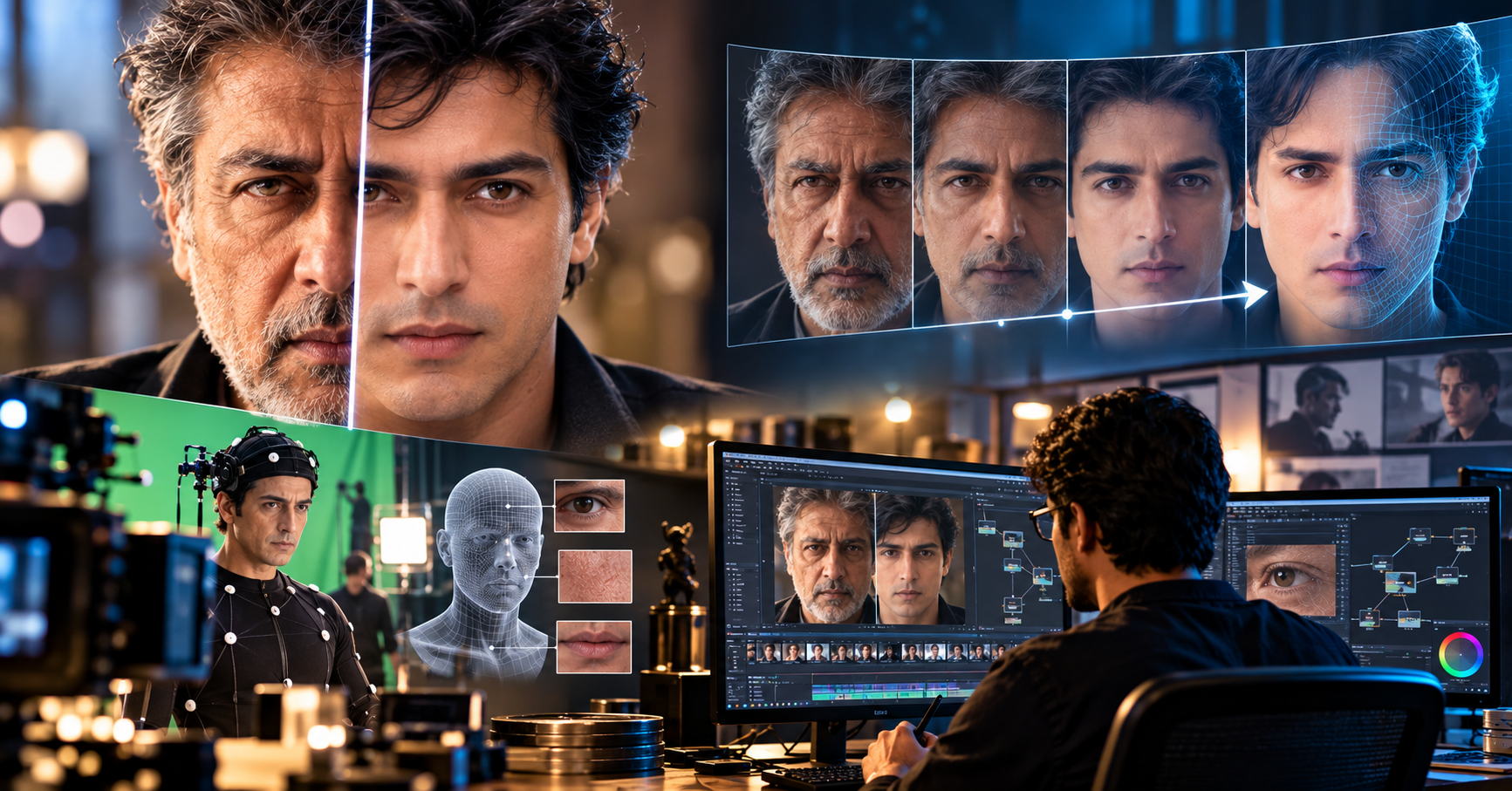
When Harrison Ford appears as a young man in the opening sequence of Indiana Jones and the Dial of Destiny, you are watching hundreds of hours of digital artistry, not just make-up. This is de-ageing, one of the most demanding skills in visual effects. If you are considering a BSc in VFX filmmaking, it is also a good example of the craft you could be doing professionally.
What Is De-Ageing in VFX?
De-ageing is the process of digitally making an actor look younger than they are. Artists smooth skin, restore the structure of the face and sometimes rebuild it entirely, all while keeping the actor’s real performance intact.
Martin Scorsese’s The Irishman is the best-known example. Robert De Niro, Al Pacino and Joe Pesci played characters across several decades without a change of actor. The same technique appears in superhero films, biopics and flashback-heavy dramas, and increasingly in series and ads.
How De-Ageing Actually Works
There is no single button. Studios choose a method based on the shot, the budget and how much the face moves.
| Approach | What it involves | Best for |
|---|---|---|
| 2D retouching | Frame-by-frame paint and compositing to soften wrinkles and fix skin tone | Subtle changes, short shots |
| 3D face replacement | A digital face model, tracked to the actor’s head and rendered with matching lighting | Big age jumps, moving close-ups |
| AI-assisted tools | Machine learning models trained on younger reference footage, refined by artists | Speeding up repetitive work |
Whatever the method, the pipeline follows roughly the same path:
- Reference gathering. Artists study old footage and photographs of the actor.
- Tracking. The head and facial movement are tracked so the effect stays locked in place.
- Modelling or retouching. Artists rebuild or clean up the face.
- Lighting and rendering. The result must match the shot’s lighting.
- Compositing. Everything is blended with the live footage until you cannot see the join.
Compositing is where most shots succeed or fail. A technically perfect face still looks fake if its grain, colour and edges do not match the plate.
Skills Behind a De-Ageing Shot
Nobody learns de-ageing in isolation. It sits on top of fundamentals that every VFX artist needs:
- Rotoscoping and paint, to isolate the face and remove skin imperfections cleanly
- Tracking, so effects do not slide off the face
- Compositing, using node-based tools such as Nuke or After Effects
- 3D modelling and lighting, for shots that need a rebuilt face
- Facial anatomy, to understand why a 30-year-old’s cheeks move differently from a 70-year-old’s
- Colour sense, because skin is the hardest thing to get right on screen
Moople’s certificate programme, Visual Effects & AI, covers roto, paint, compositing and special effects, which are the foundations listed above.
Careers Where De-Ageing Skills Matter
Few people are hired only as “de-ageing artists”, but the skills open doors to roles you will see on studio credit rolls:
- Roto and paint artist, usually the first role for freshers
- Tracking or matchmove artist
- Compositor
- Beauty and cosmetic retouch artist
- Facial or character look-development artist, after more 3D experience
Beauty work and clean-up are needed in nearly every production, from films and web series to commercials and music videos. That is why learning the fundamentals through a de-ageing lens is useful even if you never touch a Hollywood-scale project.
Why a BSc in VFX Filmmaking Is Worth Considering
A shorter course can teach you tools. A degree gives you time to build judgement, which is what separates a technician from a filmmaker.
According to Moople’s website, its BSc in VFX Filmmaking is a four-year degree awarded by MAKAUT. The institute also lists an in-house production studio, a curriculum developed with that studio and an AI-integrated framework. It is also an NFDC-affiliated training partner.
Here is how the two paths compare:
| Certificate course | BSc in VFX filmmaking | |
|---|---|---|
| Focus | Specific tools and techniques | Full filmmaking and VFX pipeline |
| Format | Shorter, skills-first | Four-year degree |
| Good fit | Quick entry, upskilling | Building a long-term film career |
Confirm eligibility, fees, syllabus details and scholarship options directly with the admissions team, since these can change each year.
Learning VFX in Kolkata
You do not have to leave the city to learn this. Moople lists branches across Kolkata and nearby areas, including Chowringhee, Jodhpur Park, New Alipore, Sealdah, Baguiati, Sonarpur, Barasat, Serampore, Chandannagar and Berhampore. A branch near your home makes it easier to practise every day, which matters more than any single lesson.
Practical Tips for Beginners
- Watch VFX breakdowns. Studios publish them for major films, and they show exactly what was done to a shot.
- Start with a single face. Take a short clip of a friend and try removing blemishes and softening lines, then compare it with the original.
- Study real faces. Notice how skin texture, eye area and jawline change with age.
- Build a small reel early. Three or four clean, well-explained shots beat twenty weak ones.
- Do not skip basics. Strong roto and compositing make every advanced skill easier.
Frequently Asked Questions
1. Is de-ageing the same as make-up?
No. Make-up changes the actor’s appearance on set, while de-ageing happens in post-production and can go much further.
2. Do I need to know drawing to learn VFX?
Drawing helps, but it is not mandatory. A good eye for light, colour and detail matters more.
3. Is de-ageing done entirely by AI?
No. AI tools can speed up parts of the work, but artists still review, correct and composite every shot.
4. What is the difference between a VFX course and a BSc in VFX filmmaking?
A VFX course usually focuses on specific tools and techniques over a shorter period. A degree is longer and covers filmmaking more broadly. Moople offers both.
5. Can I get a VFX job straight after learning compositing?
Many beginners start in roto, paint or junior compositing roles. A strong showreel counts for a lot.
6. Can I study VFX in Kolkata without moving elsewhere?
Yes. Several Kolkata branches, including Chowringhee, Jodhpur Park and Sealdah, are listed on Moople’s site.
Conclusion
De-ageing looks like magic, but it is built from skills you can learn: tracking, paint, compositing, lighting and a trained eye. A BSc in VFX filmmaking gives you the time and studio exposure to turn those skills into a career, and Kolkata now has options close to home.
If you are curious, visit the Moople Institute or book a free counselling session to see the VFX labs and ask about the programme.
Pooja Sharma is a creative education content writer who creates engaging articles on career guidance, skill development, and learning opportunities to help students make informed decisions.