
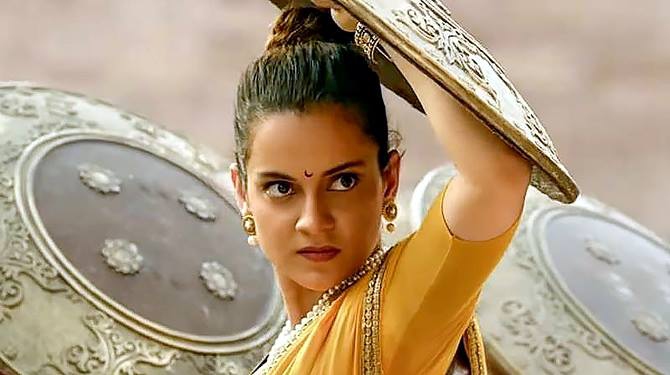
Kangana Ranaut’s upcoming film Manikarnika: The Queen of Jhansi is the new popular meme among fans. They absolutely love it and can’t get enough of it. This period drama is an epic story of Rani Lakshmi Bai, who was the queen of Jhansi. History recalls her as the first warrior queen in India. Her saga of bravery had us recite poems in school textbooks. Directed by National Award-winning director Radha Krishna Jagarlamudi, written by K.V Vijayendra Prasad, from the Writers of Bahubali and Bhaag Milkha Bhaag. This film is on its way to creating a legacy of its own. Over the past few years, Bollywood has seen a string of period drama films. But mark my words; this one will blow your mind. The film is based on the life of Rani Lakshmi Bai of Jhansi and her war against the British East India Company during the Indian Rebellion of 1857.
What do we know so far?
Since the release of its trailer, all we know is that the visual effects quality reflected in Manikarnika will be a topic of discussion after the release. We will dive into the technical elements spotted in the trailer later. But before we go there, let us discuss the awesome picture correction. Some people also call it the colour correction. Colour correction is the technique that enables us to distinguish all the prominent colours on the screen with brilliance. This leaves no room for any kind of mistake.
Another amazing feature is the proper depiction of the time period. That itself tells us about the huge contribution of VFX in post-production.
Post-production and visual effects of MANIKARNIKA
It is no easy task to bring the 1800s to 2018. Creating two centuries-back settings and atmosphere took a lot of toll on the visual effects artists. The visual effects training was thoroughly guided by giving a brief sketch of what the scenario was like two centuries back.
Another technique used in the film is crowd multiplication. This technique has shown its importance in a lot of war and crowd sequences. Remember the army of the dead in Game of Thrones or the army of Dothraki? They were all shot with crowd multiplication. In such cases, a set of the crowd is taken and then duplicated to put in several chunks, which make up a greater army. This is a visual effects technique which makes the scenes easier to shoot.
Extra efforts in the Visual effects department
A lot of people do not know this, but when scenes of period drama films get created, a lot of the VFX elements have to be drawn by hand. You cannot simply put them into the scene using visual effects. VFX artists have to draw them first and then proceed with the insertion. Realism is a very big factor when a project is as big as Rani Lakshmi Bai. Creating a saga like this takes a large amount of planning.
The palaces, backdrops, war fields, animals, crowd generation, etc get done with the help of extremely skilled VFX artists.
In addition to that, no compromise could ever be made when it came to narrating the story of glorious Manikarnika. In the trailer itself, Amitabh Bachchan is voicing the background. With Kangana Ranaut’s mind-boggling acting, the VFX had to be up to the standard. The makers made sure that no department was even remotely left vacant in terms of post-production.
While editing, thousands of frames that were initially edited separately were then brought forward for review. Only the ones that the director approved got selected in the end.
What should you be looking forward to?
Well, one thing is for sure. You will surely be looking for VFX courses in the dying thirst to learn the craft. Other than that, look out for marvellous post-production work done by the VFX artists. Keep an eye on the second trailer, and let’s see what more we can find there.
A VFX course helps you develop both creative and technical skills to create stunning visual effects for films, advertisements, games, and digital media. You can look forward to learning 3D modelling, animation, compositing, motion graphics, CGI, video editing, and industry-standard VFX software. Practical projects, expert guidance, and studio exposure can also help you build a strong portfolio and prepare for exciting career opportunities in the growing VFX industry.
Frequently Asked Questions
1. What is the story of Manikarnika: The Queen of Jhansi?
Manikarnika: The Queen of Jhansi tells the inspiring story of Rani Lakshmi Bai, her journey from Manikarnika to becoming the courageous Queen of Jhansi, and her role in the Indian Rebellion of 1857.
2. How was the movie Manikarnika made?
The making of Manikarnika involved extensive production design, period costumes, action choreography, cinematography, visual effects, and detailed set construction to recreate the historical world of 19th-century India.
3. What role did editing play in Manikarnika?
Editing played an important role in shaping the film’s storytelling and action sequences. Carefully arranged cuts, transitions, pacing, and sound helped create dramatic intensity and maintain audience engagement.
4. How were the action scenes in Manikarnika created?
The film’s action scenes combined stunt choreography, horse riding, sword fighting, cinematography, visual effects, and post-production editing to present Rani Lakshmi Bai’s bravery in a cinematic way.
5. What can students learn from the making and editing of Manikarnika?
Students interested in animation, filmmaking, VFX, and video editing can learn how storytelling, cinematography, visual effects, sound design, and editing work together to create a large-scale historical film.
Conclusion
Manikarnika: The Queen of Jhansi is more than a historical drama—it is an example of how powerful storytelling can be enhanced through filmmaking, cinematography, action design, visual effects, sound, and professional editing. The film’s depiction of Rani Lakshmi Bai’s courage demonstrates the importance of combining creative vision with technical filmmaking skills. For aspiring filmmakers, animators, VFX artists, and editors, studying the making and editing of such films can provide valuable insight into how complex stories are transformed into engaging cinematic experiences.

Pooja Sharma is a creative education content writer who creates engaging articles on career guidance, skill development, and learning opportunities to help students make informed decisions.