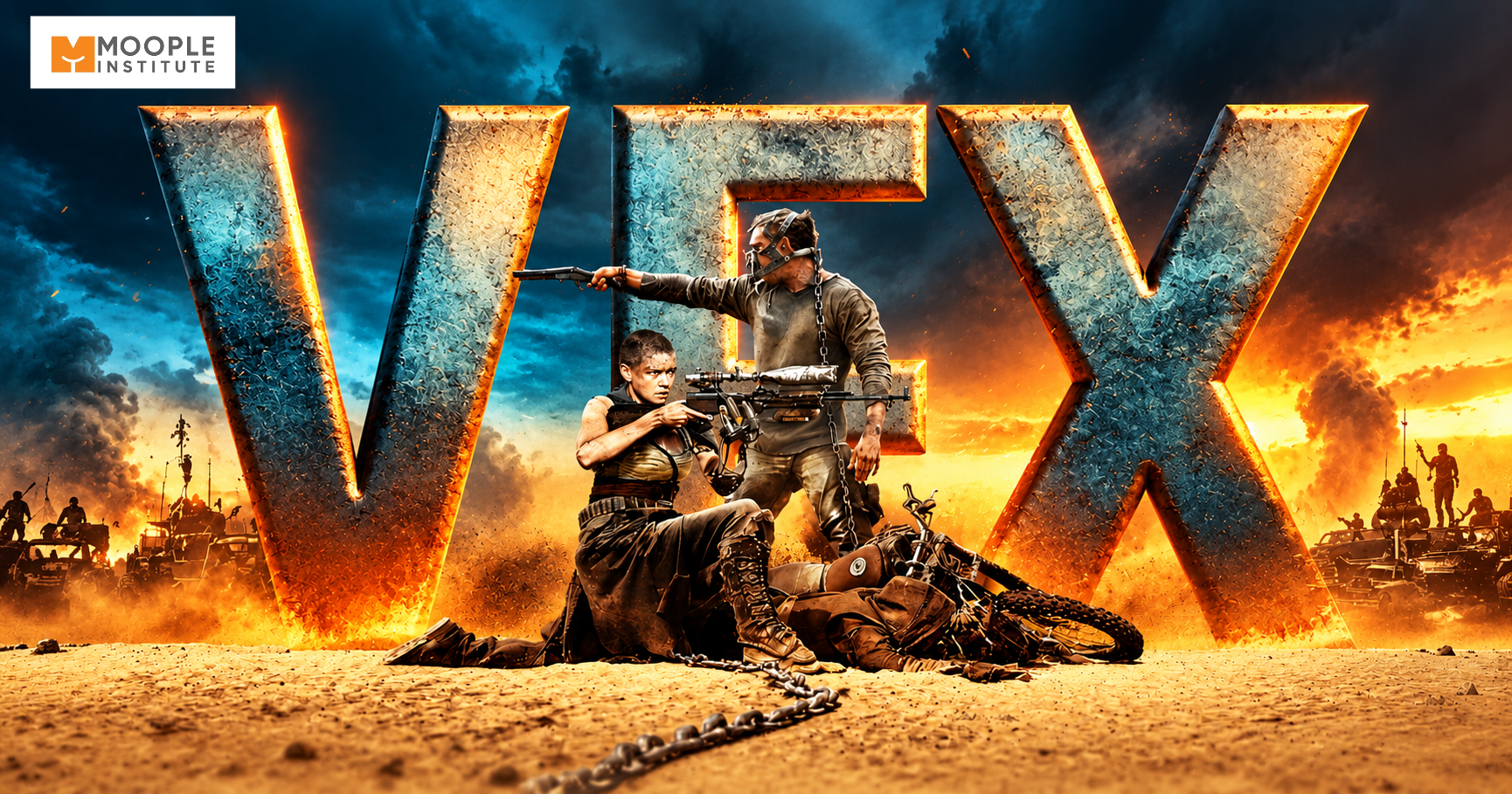
A lot of what looks real on screen was fixed after the camera stopped: wires erased, skies swapped, a handful of extras turned into a crowd. That clean-up and compositing work is exactly where a VFX course for beginners starts, and it is far more approachable than the explosions-and-dragons image suggests. This guide explains what a VFX course teaches, who can join, how long it takes, and where it can lead, using the programme details published by Moople Institute in Kolkata.
What a VFX course actually teaches
Visual effects means creating or altering footage after it is shot. In practice, beginners learn rotoscoping (cutting subjects out frame by frame), paint and prep (removing unwanted objects), tracking, compositing (layering everything into one believable shot) and motion graphics. You do not need to draw well. You do need patience, because a few seconds of footage can take hours of careful, repetitive work.
It suits school leavers, graduates and working editors or designers in the 18 to 30 range who want a technical creative career.
Is this a VFX course for beginners? Picking the right programme
Yes, and Moople’s three VFX-related options start from zero. They differ mainly in length and depth:
| Programme | Duration | Best for |
|---|---|---|
| Visual Effects & AI (certificate) | 18 months | Beginners who want focused compositing and roto skills |
| BSc in VFX Film Making | 4 years, 8 semesters (MAKAUT affiliated) | Students who want a degree plus drawing, film language and editing |
| Motion Graphics, Video Editing & AI | 6 months | Those who want a quick entry through editing before specialising |
If you are unsure, the certificate is the usual starting point. Whichever you pick, plan on practising on your own to build a portfolio.
VFX course syllabus: module by module
The certificate course is built around compositing, with each module adding a layer of skill:
| Module | Topics | Software |
|---|---|---|
| 1 | Fundamentals of composition | Photoshop, After Effects |
| 2 | Rotoscoping, stereoscopy | Silhouette FX, Mocha, Nuke |
| 3 | Paint, prep | Photoshop, Silhouette FX, Mocha, Nuke |
| 4 | Live action, CG compositing | After Effects, Nuke |
| 5 | Motion graphics | After Effects, Premiere Pro |
Notice that module 4, covering live action and CG compositing, is the heart of the course. Compositing is the skill studios hire for, and Nuke’s node-based workflow is worth taking seriously early. The BSc spreads similar ground across eight semesters: drawing, visual design and film language first, then motion graphics, rotoscoping, tracking and paint, followed by matte painting, camera tracking and match moving (using SynthEyes and 3D Equalizer). The final years cover CG integration, portfolio making, documentary and advertisement projects and a dissertation.
VFX course eligibility
Moople’s VFX Course page states that Class 10 completion is enough for the certificate. The BSc page mentions Class 10 with 50% in its FAQ, while enquiry forms list Class 10, Class 12, graduates and working professionals, so confirm the exact degree criteria with a counsellor before you apply. No portfolio or prior software knowledge is mentioned as a requirement.
Fees and payment options
The BSc fee range is listed as ₹4,60,000 to ₹5,80,000, varying by location and timing, with scholarships for eligible students and the West Bengal Student Credit Card Scheme for state residents. The certificate fee is not published, so ask your centre for the current figure. The listed plans are:
- Full upfront payment: 10% discount
- First three months in instalments: 5% discount
- Pay as you learn: no discount
- Financing through Neev and NuCash
VFX career scope
Moople’s course pages list film and television roles such as VFX artist, compositor, matte painter, rotoscope artist, matchmove artist and VFX supervisor. Gaming, advertising, architectural visualisation, music videos and AR/VR use the same skills. Most newcomers begin in roto or paint and move into compositing as their shots improve, so your showreel counts for more than the certificate itself. Ask about placement support and what recent students have actually produced.
Learning VFX in Kolkata and nearby
Moople teaches at Baguiati, Barasat, Berhampore, Chandannagar, Chowringhee, Jodhpur Park, New Alipore, Sealdah, Serampore and Sonarpur. Choose by commute, then visit your nearest centre to see the workstations. If you are comparing VFX training in Kolkata options, check that the software list matches the table above and ask to see student shot breakdowns.
FAQs
Can I learn VFX without drawing skills?
Yes. Rotoscoping and compositing reward accuracy and patience more than sketching. Drawing matters more in matte painting, which the BSc introduces gradually.
How long does a VFX course take?
The certificate runs 18 months, the BSc four years and the video editing programme six months.
What is the eligibility for a VFX course after 10th or 12th?
The certificate page lists Class 10. For the BSc, confirm with a counsellor, since the pages differ slightly.
Which software will I use? Photoshop, After Effects, Premiere Pro, Silhouette FX, Mocha, and Nuke are on the certificate; the BSc adds Illustrator, Audition, SynthEyes, and 3D Equalizer.
Is VFX the same as animation?
No. VFX blends effects into live-action footage, while animation builds characters and scenes from scratch. Moople runs separate animation courses.
Can I study while working or in college?
The BSc is offered full-time and on weekends. For the certificate, ask your centre about batch timings.
Your next step
A good VFX course for beginners should leave you with real shots in a portfolio, not only a certificate. Compare the programmes above, then book a free counselling session with Moople to confirm fees, eligibility, and batch dates at your nearest centre.
Pooja Sharma is a creative education content writer who creates engaging articles on career guidance, skill development, and learning opportunities to help students make informed decisions.